
Most teams asking what is AI publishing are already feeling the same pressure: the content calendar is heavier, distribution channels keep multiplying, and the team is expected to publish more without adding editors, researchers, producers, or operators.
The obvious answer is to generate more drafts. That is also where many teams get into trouble.
Teams think the problem is content creation. The real problem is publishing architecture: how ideas become approved assets, how quality is enforced, how humans stay in control, how content moves into blogs, newsletters, podcasts, and social channels, and how performance data changes the next batch.
That changes the conversation. AI publishing is not a button that writes posts. It is an operating model for turning research, prompts, editorial judgment, automation, and distribution into a repeatable system.
Table of contents
- What is AI publishing in practical terms
- Why AI publishing is a workflow problem
- The core AI publishing workflow
- Human in the loop versus fully automated AI publishing
- Quality gates that make AI publishing usable
- Distribution is where AI publishing becomes real
- Data model integrations and state management
- Metrics that matter in AI publishing
- Common failure modes and what breaks
- How to implement AI publishing without losing control
- Where bl0ggers.com fits
What is AI publishing in practical terms
The short operator definition
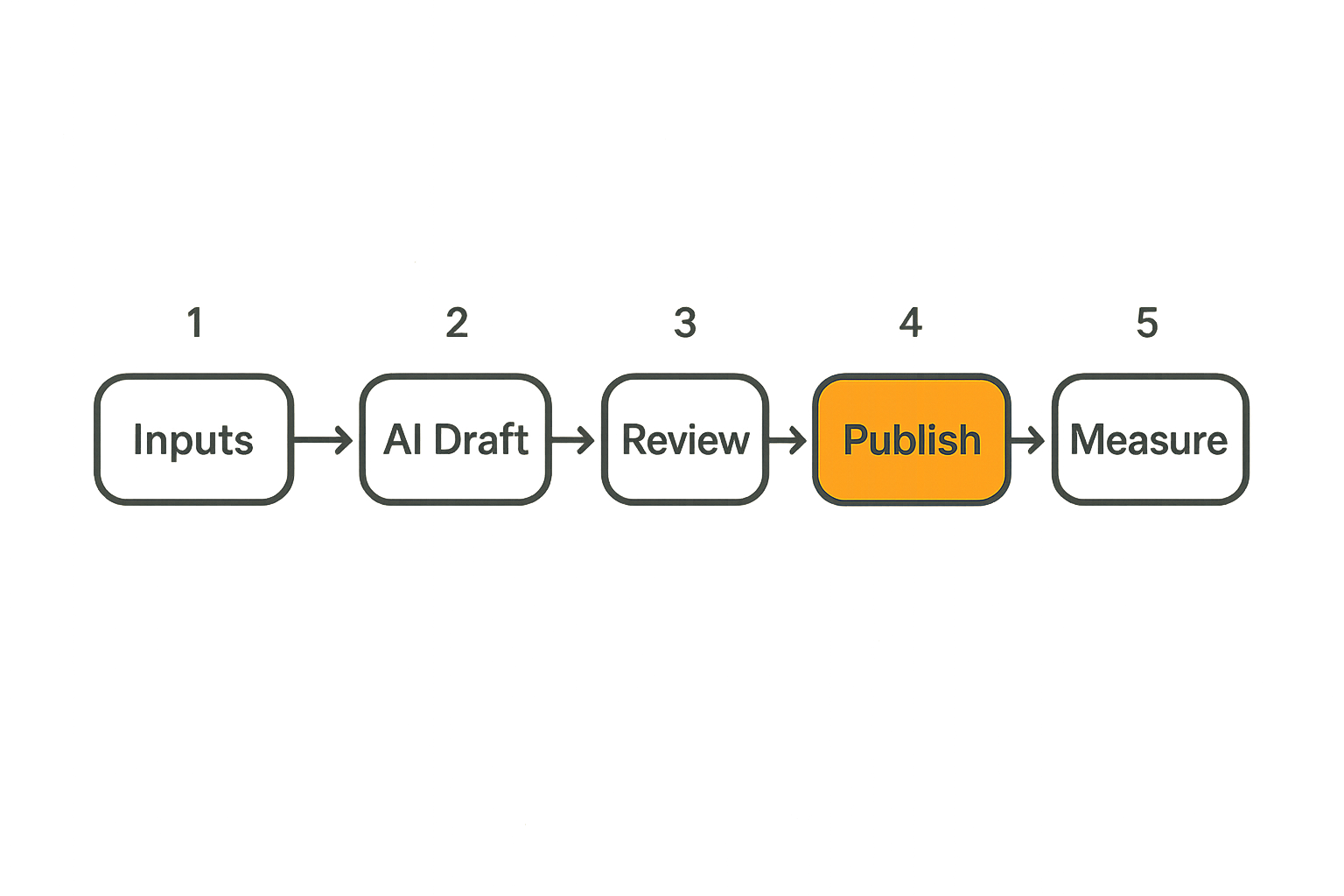
AI publishing is the use of AI systems to help research, generate, adapt, review, schedule, distribute, and measure content across publishing channels.
That sounds simple. In production, it is not.
A useful way to think about it is this: AI publishing is a content operations layer. It sits between ideas and live assets. It can produce blog drafts, newsletter versions, podcast scripts, social excerpts, summaries, metadata, and briefs. But the valuable part is not the text alone. The valuable part is the controlled path from idea to published work.
For a content marketer, that may mean turning a keyword cluster into five reviewed articles and three email sends. For a publisher, it may mean producing local or niche coverage with human approval. For a creator, it may mean converting a long video or podcast into a written post, newsletter, and short-form distribution queue.
Why the definition is not enough
Definitions hide the operational mess.
If AI produces a draft but nobody owns review, the system stalls. If it publishes automatically without brand checks, the system creates risk. If performance data never feeds back into planning, the team just creates more content without learning.
The practical question is not whether AI can write. It can. The practical question is whether your publishing process can absorb AI output without flooding editors, weakening trust, or creating a pile of half-finished assets.
Practical rule: AI publishing is only useful when it reduces operational friction, not when it simply increases draft volume.
The 2026 context
In 2026, AI publishing is moving from experiment to infrastructure. Teams are no longer asking whether models can summarize, outline, or draft. They are asking how to connect AI output to editorial standards, content management systems, newsletters, podcast workflows, and reporting.
This is why the topic matters now. The teams that win are not necessarily the ones with the most prompts. They are the ones with the clearest workflow: input quality, review lanes, quality gates, approvals, distribution triggers, and measurement loops.
Related reading from our network: teams making platform decisions face similar workflow tradeoffs in infrastructure, especially when AI workloads touch compute and automation, as covered in cloud computing services for decentralized compute builders.
Why AI publishing is a workflow problem
The mistake teams make is treating drafts as the product
The mistake teams make is assuming the draft is the bottleneck. Sometimes it is. More often, the bottleneck is everything around the draft.
Editors need context. Designers need assets. Newsletter operators need subject lines and segments. SEO leads need metadata and internal links. Legal or compliance teams may need review. Founders may need to approve point of view. Someone must schedule the post, publish it, verify the page, and track performance.
If AI only creates a document in a shared folder, you have not built AI publishing. You have built a draft generator.
Where human judgment actually belongs
Human review should not be random. It should be designed.
Editors should spend time on positioning, accuracy, examples, narrative, claims, tone, and risk. They should not spend time copying text between tools, renaming files, pasting metadata, or asking who has approval.
A human-in-the-loop system works best when AI handles repeatable structure and humans handle judgment. If you want a deeper architecture breakdown, the prior guide to human-in-the-loop AI publishing workflow architecture maps review routing, gates, and team ownership in more detail.
The publishing system view
Once you view AI publishing as a system, the components become clearer:
- Inputs: topics, keywords, audience profiles, transcripts, briefs, product notes, research, source URLs.
- Generation: outlines, drafts, summaries, variants, titles, snippets, metadata.
- Review: factual checks, editorial edits, brand voice, compliance, approvals.
- Distribution: CMS, newsletter tool, podcast feed, social scheduler, subdomain, webhook.
- Measurement: traffic, engagement, conversions, retention, update needs.
What breaks in practice is usually the handoff between these components. A strong workflow reduces handoff ambiguity.
The core AI publishing workflow
Step 1 capture demand and intent
AI publishing starts before generation. The first step is deciding what should exist.
Bad input creates bad output at scale. A vague prompt like write a blog post about email marketing creates generic content. A useful content request includes audience, intent, channel, angle, constraints, examples, internal context, and desired action.
A practical intake object might include:
topic: ai newsletter workflow
audience: solo creator with paid newsletter
intent: explain how to turn podcast notes into email issues
asset_type: blog_post
review_required: editor
channels:
  - blog
  - newsletter
  - social_excerpt
risk_level: medium
owner: content_lead
This is not bureaucracy. It is how you prevent AI from guessing the assignment.
Step 2 generate structured assets
The next step is generation, but not as one giant blob of text.
A stronger system generates structured assets:
- Research notes and source summary.
- Search or audience intent brief.
- Outline with section logic.
- Draft with claims and examples.
- Metadata, excerpt, tags, and suggested internal links.
- Newsletter adaptation.
- Social or short-form snippets.
This structure makes review easier. An editor can reject an outline before a full draft exists. A newsletter operator can approve a subject line separately. A publisher can route a high-risk topic to a senior reviewer.
Step 3 review approve distribute and learn
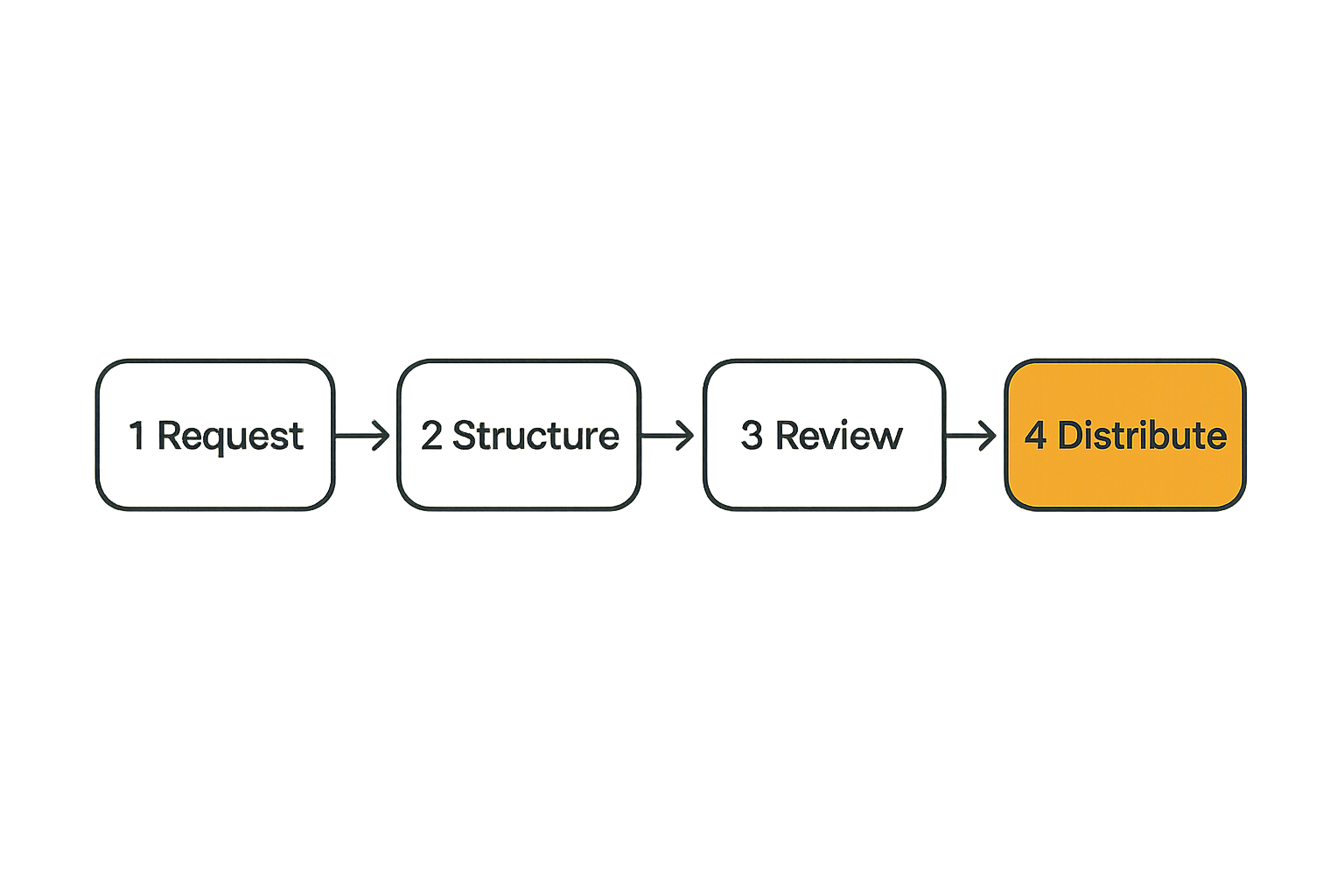
AI publishing should have an explicit workflow sequence:
- Capture topic request and owner.
- Enrich with audience, intent, and source material.
- Generate outline and asset plan.
- Review outline for angle and fit.
- Generate draft and channel variants.
- Run quality gates for accuracy, brand, SEO, and risk.
- Approve, schedule, and publish.
- Measure results and feed learning into the next cycle.
Practical rule: Do not automate publication until you have automated status, ownership, and review visibility.
This is where teams often mature from prompt experiments into actual publishing operations.
Human in the loop versus fully automated AI publishing
What works
Human-in-the-loop AI publishing works when the process is clear. AI handles speed and structure. Humans handle accountability.
This is especially useful for:
- Expert-led blogs where opinion and accuracy matter.
- Newsletters with a distinct voice.
- B2B content where claims affect buyer trust.
- Creator businesses where audience relationship is the asset.
- Publishers running multiple niche properties.
The point is not to slow the system down. The point is to place review where it prevents expensive mistakes.
What fails
Fully automated AI publishing fails when teams use it to avoid editorial responsibility.
It can produce repetitive articles, weak claims, duplicate angles, mismatched tone, and content nobody on the team would proudly send to a customer. It can also create operational cleanup: editors rewriting everything, support teams answering confused readers, and SEO teams pruning low-value pages later.
There are cases where automation makes sense: low-risk summaries, internal digests, structured updates, product changelog drafts, metadata generation, and controlled template-based content. But for public-facing editorial work, full automation needs tight constraints.
A comparison for operators
| Approach | Best for | Main risk | Control level | Operator advice |
|---|---|---|---|---|
| Draft-only AI | Fast ideation and first drafts | Creates document clutter | Low | Use only as a starting point |
| Human-in-the-loop AI publishing | Blogs, newsletters, expert content | Review queue design | High | Best default for most teams |
| Fully automated publishing | Low-risk structured updates | Brand and accuracy drift | Medium to low | Use with strict templates |
| AI-assisted repurposing | Podcasts, webinars, creator content | Losing original voice | Medium | Keep source context attached |
Related reading from our network: the same operator discipline shows up in product teams, where prioritization and feedback loops matter more than raw output; see product management for founders.
Quality gates that make AI publishing usable
Editorial gates
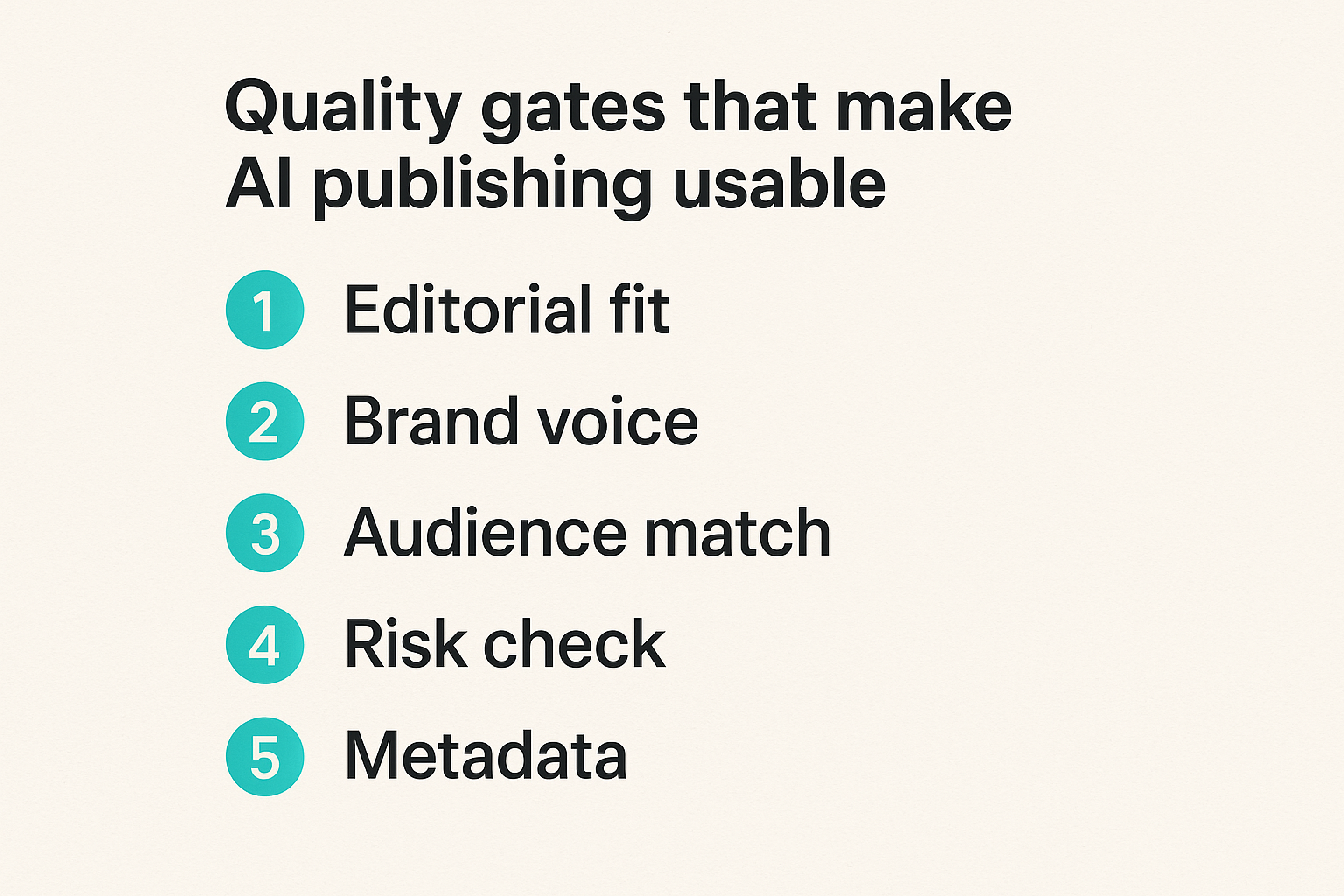
Editorial gates answer a simple question: should this be published by us?
They check whether the piece has a real angle, useful examples, accurate terminology, and a clear reader outcome. They also catch empty intros, repetitive phrasing, unsupported claims, and sections that sound plausible but add no value.
Common editorial gates include:
- Does the article answer a specific reader problem?
- Is the point of view clear enough to be memorable?
- Are examples concrete rather than generic?
- Are claims hedged when sources are not available?
- Does the piece avoid filler and obvious advice?
Brand and audience gates
Brand gates make sure the content sounds like it belongs to the publisher.
For creators, this often means preserving voice. For B2B teams, it means matching positioning and terminology. For newsletters, it means respecting the reader relationship and not suddenly sounding like a generic software manual.
Audience gates are just as important. A beginner explainer, an expert operator guide, and an investor memo should not use the same structure or vocabulary.
Practical rule: Brand voice is not a prompt line. It is a review standard backed by examples, constraints, and rejection criteria.
Compliance and risk gates
Some content carries risk. Medical, financial, legal, cybersecurity, public policy, and regulated industry content need stricter review. Even outside regulated markets, teams should watch for claims about competitors, pricing, guarantees, performance, or customer outcomes.
A simple risk model helps:
- Low risk: summaries, internal notes, metadata, evergreen how-to content.
- Medium risk: product comparisons, tactical advice, industry analysis.
- High risk: legal, financial, medical, security, or claims-heavy content.
High-risk does not mean impossible. It means the review lane must match the risk.
Distribution is where AI publishing becomes real
Blogs and search pages
A blog post is not finished when the draft is approved. It still needs a slug, title, meta description, excerpt, tags, internal links, images, schema decisions, CMS placement, and publication timing.
For AI publishing, the blog workflow should be explicit. Otherwise teams generate text faster than they can publish it.
If your team is building that layer, the prior article on automated blog posting platform architecture is useful because it treats automated posting as a stateful workflow rather than a CMS shortcut.
Newsletters and owned audiences
Newsletters are a different publishing surface. They are more intimate, more time-sensitive, and more dependent on trust.
AI can help create subject lines, summaries, segment-specific introductions, sponsor copy drafts, and issue outlines. But an email issue should still have a human owner. The inbox is unforgiving. If the tone is wrong or the recommendation is weak, readers feel it immediately.
The practical question is whether your AI publishing system can adapt the same source asset into a newsletter version without losing context.
Podcasts short-form and repurposing
Creators and publishers often have long-form source material: interviews, webinars, podcasts, livestreams, panels, and internal calls. AI publishing can convert these into multiple assets.
A single recording can become:
- A transcript summary.
- A blog article.
- A newsletter issue.
- A podcast description.
- Five short clips or quote cards.
- A topic backlog for future posts.
What fails is treating repurposing as mere summarization. The best repurposed assets are adapted for the channel, not copied from the source.
Related reading from our network: even consumer checkout workflows show how small operational steps create or destroy outcomes, as in this practical guide to Shutterfly promo codes in 2026.
Data model integrations and state management
The content object matters
AI publishing needs a content object, not just a text field.
At minimum, each asset should carry:
- Topic and working title.
- Audience and intent.
- Asset type and channel.
- Source material.
- Draft content.
- Review status.
- Assigned owner.
- Risk level.
- Publication target.
- Performance data.
This gives the team traceability. When someone asks why a piece exists, who approved it, or where it was published, the answer should not require searching five tools.
Review states prevent chaos
Review states are the difference between a pipeline and a pile.
A simple state model might look like this:
states:
  - idea
  - brief_ready
  - outline_review
  - draft_ready
  - editorial_review
  - approved
  - scheduled
  - published
  - needs_update
  - archived
Each state should have a clear owner and next action. If the state is editorial_review, the editor knows what to do. If it is scheduled, the publisher knows where it is going. If it is needs_update, the content lead knows the asset is live but stale.
Webhooks APIs and publishing triggers
Integrations make AI publishing operational. Webhooks and APIs can move approved assets into a CMS, notify reviewers, update a project board, trigger newsletter preparation, or send performance data back into the content system.
But integrations should follow approvals, not bypass them. A webhook that publishes every generated draft is dangerous. A webhook that publishes approved assets with the right metadata is useful.
The practical question is: what event should trigger the next step?
Examples:
- Outline approved triggers draft generation.
- Draft approved triggers CMS staging.
- CMS publish triggers newsletter adaptation.
- Performance threshold triggers refresh review.
Metrics that matter in AI publishing
Production metrics
Production metrics show whether the system is moving.
Track:
- Ideas submitted.
- Briefs completed.
- Drafts generated.
- Drafts approved.
- Revisions per asset.
- Time from idea to publish.
- Assets stuck in review.
These metrics expose bottlenecks. If drafts are generated quickly but approvals take three weeks, generation is not the constraint.
Quality metrics
Quality metrics show whether the output is worth publishing.
Track:
- Rejection rate by asset type.
- Common edit reasons.
- Accuracy issues caught.
- Brand voice issues caught.
- Reader complaints or unsubscribes.
- Update frequency after publication.
Do not hide these numbers. They are how the system improves.
Business metrics
Business metrics connect publishing to outcomes.
For content marketers, that may include qualified traffic, demo requests, assisted conversions, or pipeline influence. For publishers, it may include subscriptions, page depth, retention, ad yield, or paid membership conversion. For creators, it may include replies, clicks, paid upgrades, community participation, or product sales.
AI publishing should not be measured only by how much content it produces. That is the easiest metric and often the least useful.
Practical rule: If AI increases output but weakens trust, the system is underperforming no matter how many assets it ships.
Common failure modes and what breaks
Generic output at scale
The most common failure mode is generic output at scale.
The team starts with excitement. Draft volume increases. The calendar fills up. Then the content starts to blur together. Titles sound similar. Introductions repeat the same pattern. Examples are vague. The audience stops noticing.
This usually happens because the system lacks differentiated inputs: real customer questions, founder opinions, field notes, data, examples, interviews, or source material.
AI can synthesize and structure. It cannot replace the need for a real editorial angle.
Review bottlenecks
The second failure mode is review collapse.
AI creates more drafts than editors can reasonably process. The queue grows. Review quality drops. Editors become rewrite machines. Stakeholders lose confidence because everything is technically in progress but nothing is actually shipping.
The fix is not always more editors. Often the fix is better routing:
- Low-risk assets get lightweight review.
- Medium-risk assets get editorial review.
- High-risk assets get expert or legal review.
- Repetitive metadata gets automated checks.
- Weak briefs are rejected before drafting.
Distribution without ownership
The third failure mode is distribution drift.
A post is approved, but nobody owns publishing. A newsletter version exists, but nobody schedules it. Social snippets are generated, but nobody checks whether they match the campaign. A podcast summary is ready, but the episode page never gets updated.
What breaks in practice is not the model. It is ownership.
Every channel needs an owner, a status, and a definition of done.
How to implement AI publishing without losing control
Start with one lane
Do not start by automating every content type.
Pick one lane with enough volume to matter and low enough risk to learn safely. Good starting lanes include blog drafts from approved briefs, newsletter summaries from existing articles, podcast recap posts, internal research digests, or metadata generation for approved pages.
Define the lane tightly:
- Input format.
- Output format.
- Review owner.
- Approval criteria.
- Publishing destination.
- Measurement loop.
This makes the system testable.
Document your approval rules
Approval rules should be written down.
A useful approval checklist might include:
- The audience is specific.
- The article has a clear promise.
- The structure matches the intent.
- Claims are accurate or properly hedged.
- The examples are concrete.
- The tone fits the brand.
- The CTA is relevant.
- Metadata is complete.
- The distribution channel is selected.
Without written rules, review becomes personal preference. With written rules, the team can improve the system.
Automate the boring parts first
The safest automation targets are usually not the highest-glamour tasks.
Automate status changes, metadata creation, image placeholder requests, internal summaries, reviewer notifications, CMS staging, newsletter adaptation drafts, and performance snapshots before fully automating final publication.
This gives the team leverage without removing control.
A practical implementation sequence looks like this:
- Map the current publishing workflow.
- Identify repeated handoffs and manual copy-paste steps.
- Define content states and owners.
- Add AI generation to one controlled lane.
- Add quality gates and review checklists.
- Integrate approved assets with publishing tools.
- Measure cycle time, rejection rate, and performance.
- Expand only after the lane is stable.
Where bl0ggers.com fits
A practical fit for content teams
bl0ggers.com is built around the idea that AI publishing should increase output without removing editorial control.
That means the useful layer is not just generation. It is turning AI-generated research into publishable blogs, podcasts, newsletters, persona-led content journeys, review queues, subdomain publishing, and webhook-based automation. If you want the broader platform context, bl0ggers.com explains how the system is positioned for human-in-the-loop publishing teams.
The fit is strongest when a team already knows it needs more consistent publishing, but does not want a black-box machine posting unreviewed content under the brand.
When it is not the right fit
It is not the right fit if you want to avoid editorial ownership entirely.
AI publishing still needs strategy, judgment, review standards, and distribution decisions. A platform can reduce the operational drag, but it should not decide your point of view for you. If nobody owns the audience, the calendar, or the approval rules, automation will only expose that faster.
The better starting point is honest: define the workflow first, then add automation where it improves throughput and consistency.
Try bl0ggers.com
bl0ggers.com is for content teams, creators, and publishers who want to use AI to increase output without giving up editorial control. Try bl0ggers.com and build AI publishing as a workflow, not a content gamble.