
Publishing automation software usually enters the conversation after a team has already created a mess.
The content calendar is full, the newsletter is late, the blog has three half-approved drafts, and someone has a folder of AI-generated articles nobody trusts enough to publish. The team does not need more raw text. It needs a system that turns ideas into reviewed, formatted, distributed, measurable assets without creating a second job for editors.
Teams think the problem is content production speed. The real problem is publishing control.
That changes the conversation. Publishing automation software is not a magic writer, a scheduler, or a CMS plugin. It is an operating layer for briefs, drafts, quality gates, approvals, distribution, updates, and performance feedback. The practical question is not “Can AI make more articles?” It is “Can we automate the repeatable parts while keeping humans in the decisions that matter?”
Table of contents
- Publishing automation software is a workflow layer, not a content button
- Map the publishing lifecycle before buying software
- Where automation belongs and where it does not
- The core architecture of a publishing automation stack
- How to choose publishing automation software without buying shelfware
- Implementation workflow for a controlled rollout
- Quality gates that keep AI publishing usable
- What breaks when publishing automation is implemented badly
- Measurement: know whether automation is helping
- Where bl0ggers.com fits in a controlled publishing system
- Closing: publishing automation software is an operating decision
Publishing automation software is a workflow layer, not a content button
Publishing teams rarely fail because they cannot create words. They fail because words do not move cleanly through the system. A topic gets approved but the angle changes. A draft is generated but nobody owns review. An editor leaves comments in a document while the social copy lives somewhere else. The CMS version differs from the newsletter version. Measurement never makes it back into planning.
The mistake teams make is treating publishing automation software like a faster keyboard. That is too narrow. The useful framing is closer to production operations: every asset has a state, every state has an owner, and every transition has rules.
The output is not the system
A blog post is an output. A newsletter issue is an output. A podcast summary, LinkedIn thread, landing page update, and syndicated excerpt are outputs.
The system is everything that makes those outputs safe to publish:
- source inputs and research notes
- brief generation and editorial direction
- persona, audience, and funnel mapping
- draft creation and revision
- fact, claim, and compliance review
- SEO and formatting checks
- approval routing
- CMS publishing and newsletter scheduling
- distribution packaging
- performance feedback
If your automation only handles drafting, the rest of the work still falls back to humans through Slack, spreadsheets, and memory. That is where scale breaks.
Practical rule: Do not evaluate publishing automation software by asking how fast it creates text. Evaluate it by asking how reliably it moves work from intake to approved publication.
Why 2026 teams need control planes
AI has made content volume cheap. It has not made editorial judgment cheap. In many teams, AI increases the number of drafts faster than it increases the number of publishable assets. That creates queue pressure.
A useful way to think about it is a control plane. The software should make it clear what is being created, why it exists, who reviews it, what standard it must pass, where it will be published, and what happens after it goes live.
That is especially important for content marketers, publishers, creators, and newsletter operators because they often operate across multiple formats. One research input may become a blog post, newsletter segment, podcast script, short-form post, and lead magnet. Without a workflow layer, every format becomes a new manual project.
Map the publishing lifecycle before buying software
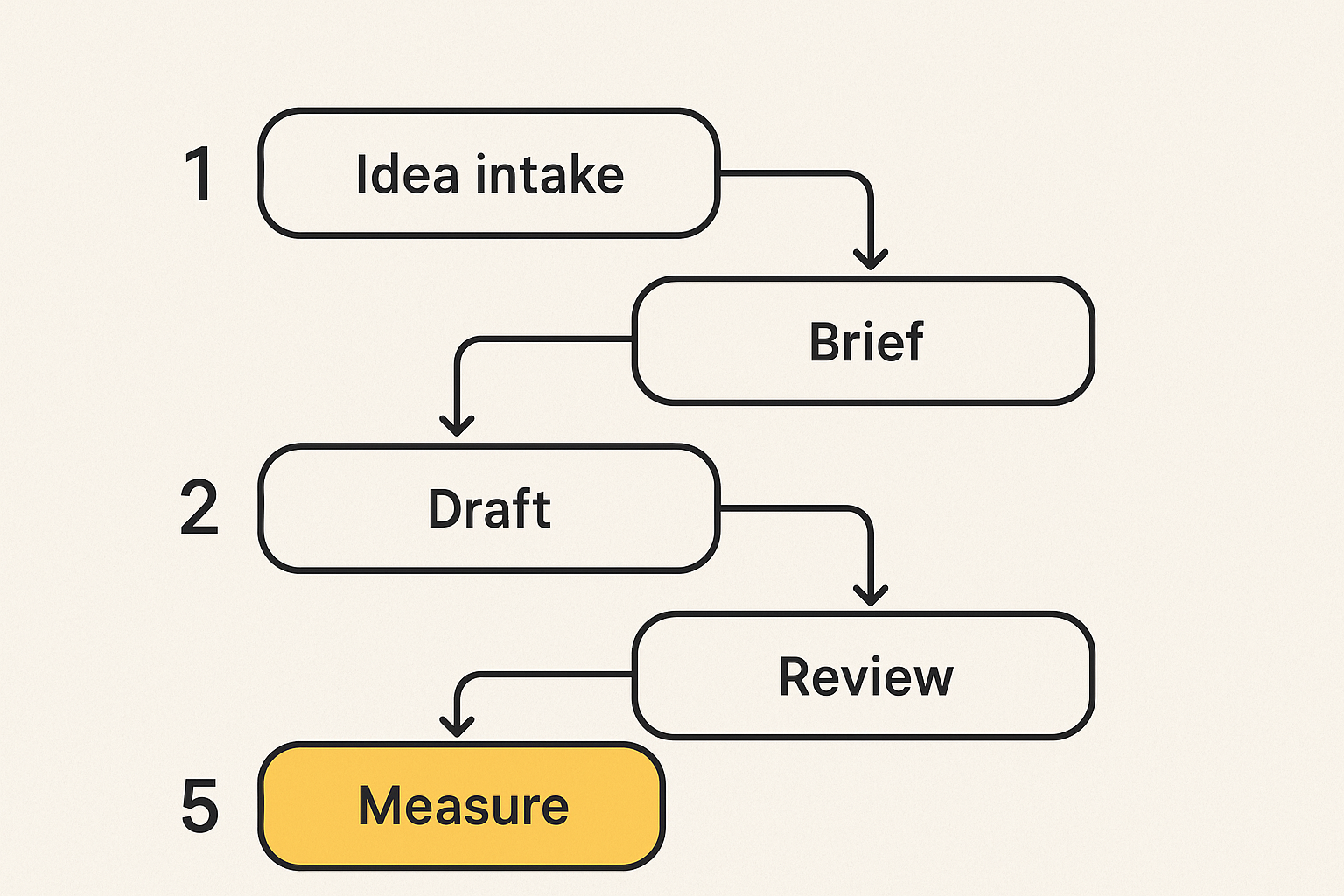
Before comparing platforms, map the lifecycle you already run. Most teams skip this step because it feels slower than testing tools. In practice, it prevents buying software that automates the wrong bottleneck.
The lifecycle does not need to be complicated. It needs to be explicit.
From idea intake to approved brief
Most publishing problems start upstream. Weak briefs create weak drafts, and automation amplifies that weakness.
A practical intake model should capture:
- target reader
- job-to-be-done or pain point
- search intent or audience intent
- angle and thesis
- product relevance
- required sources or internal knowledge
- forbidden claims
- format and distribution channel
- reviewer or approver
For example, “write about publishing automation software” is not a brief. A usable brief says: “Write for content operators evaluating AI-assisted publishing workflows in 2026. Reframe the topic around review lanes, approvals, quality gates, and distribution. Avoid claiming AI replaces editors.”
That difference matters. Automation can execute a strong brief. It cannot reliably infer your strategy from a vague topic.
From draft to publishable asset
The draft stage is where many teams confuse generation with completion. A generated draft still needs routing, editing, checks, packaging, and publishing.
A clean draft-to-publish flow usually looks like this:
- Draft generated from approved brief and source constraints.
- Automated checks run for structure, formatting, metadata, links, and missing sections.
- Human editor reviews angle, accuracy, tone, and usefulness.
- Specialist review happens only when required, such as legal, product, compliance, or subject matter expert review.
- Final asset is formatted for CMS, newsletter, and social distribution.
- Publication is scheduled or pushed through an integration.
- Performance data is attached back to the original content record.
The practical question is: which of these steps are currently visible, owned, and measurable? If the answer is “not many,” the problem is not only software. It is workflow design.
Related reading from our network: teams launching focused software products face similar sequencing problems in this practical launch system for specialty products, where validation and workflow discipline matter more than surface-level output.
Where automation belongs and where it does not
Publishing automation works best when it removes predictable handoffs. It works worst when teams use it to bypass judgment.
That distinction is not philosophical. It affects error rates, brand consistency, and trust inside the team.
Tasks that should be automated
Good candidates for automation are repetitive, rule-based, or transformation-heavy tasks:
- turning approved briefs into first drafts
- generating outlines from structured inputs
- creating metadata, excerpts, and social variants
- checking missing sections against a template
- formatting markdown or CMS fields
- preparing newsletter summaries
- assigning review lanes based on content type
- sending status notifications
- pushing approved content to a CMS or subdomain
- collecting published URLs and timestamps
- updating content inventory records
These are not low-value tasks because they are unimportant. They are low-judgment tasks because the rules can be expressed clearly.
Decisions that should stay human
Some decisions should remain human-controlled, even if AI assists the preparation:
- final thesis and positioning
- claims that affect trust or compliance
- examples involving customers or partners
- product comparisons
- controversial topics
- editorial voice decisions
- final approval to publish
The mistake teams make is removing humans from the highest-leverage points while keeping them stuck in formatting and copy-paste work. That is backwards.
Practical rule: Automate preparation, packaging, routing, and measurement before you automate editorial approval.
A simple boundary works well: automation can propose, assemble, check, and route. Humans approve, reject, reposition, or escalate.
The core architecture of a publishing automation stack
A publishing automation stack does not need to be enterprise-heavy. But it does need a few architectural primitives. Without them, the team ends up with a pile of tools instead of an operating system.
Think in terms of records, states, rules, and integrations.
Inputs, state, and routing
Every content asset should have a canonical record. That record may live in a dedicated platform, database, CMS, project management tool, or publishing system. The important point is that there is one place to answer: what is this, why are we making it, and where is it in the workflow?
A simple state model might look like this:
content_record:
  topic: publishing automation software
  format: blog_article
  audience: content_marketers
  status: editor_review
  owner: managing_editor
  review_lane: seo_editorial
  channels:
    - blog
    - newsletter
    - linkedin
  gates:
    brief_approved: true
    draft_generated: true
    editorial_review: pending
    cms_ready: false
    scheduled: false
This is boring on purpose. Boring state models prevent expensive confusion.
Routing rules then determine what happens next. A product-led article may require product marketing review. A regulated topic may require compliance review. A short creator newsletter may only need editor approval.
Quality gates and approval lanes
Quality gates are the difference between automation and content sprawl. They define what must be true before an asset moves forward.
Common gates include:
- brief approved
- source requirements satisfied
- outline accepted
- draft complete
- claims checked
- internal links placed
- metadata complete
- editor approved
- CMS preview reviewed
- publish scheduled
Approval lanes keep work from going to everyone. Not every article needs the CEO, product lead, SEO specialist, and legal reviewer. Good routing reduces review fatigue.
For more detail on review routing and quality gates, the prior guide on human-in-the-loop AI publishing workflow architecture goes deeper into how to keep humans involved without turning every asset into a committee project.
How to choose publishing automation software without buying shelfware
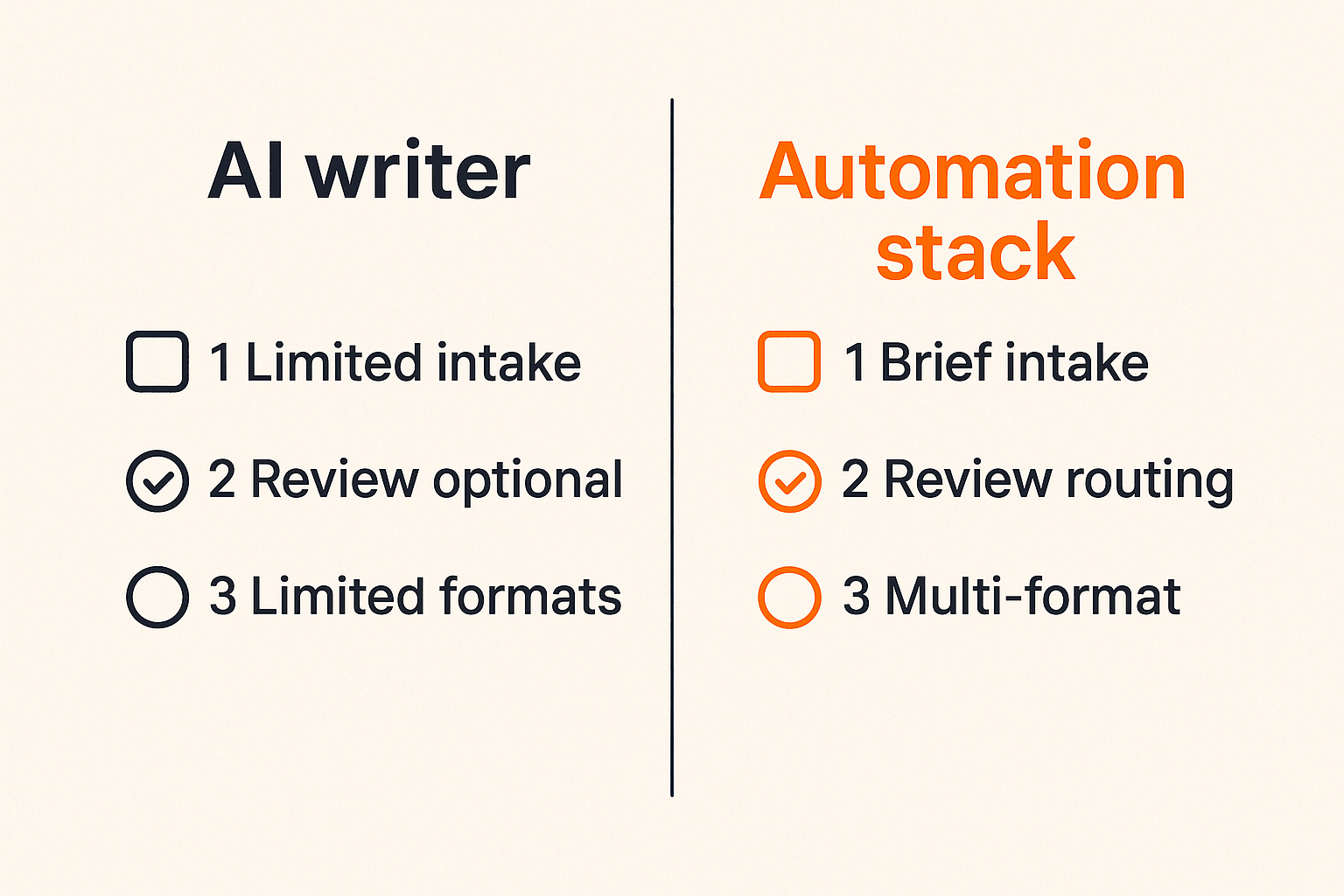
Most teams buy publishing tools around the most visible pain: “We need more articles,” “We need a scheduler,” or “We need AI drafts.” Then they discover the tool does not match the workflow.
The better approach is to compare software by operating fit.
Compare tools by workflow fit
Use a table like this before vendor demos:
| Capability | Basic AI writer | CMS scheduler | Publishing automation software |
|---|---|---|---|
| Brief intake | Limited | No | Yes |
| Draft generation | Yes | No | Yes |
| Review routing | Usually no | Limited | Yes |
| Quality gates | Limited | No | Yes |
| Multi-format packaging | Sometimes | Limited | Yes |
| Approval history | Limited | Sometimes | Yes |
| Webhooks or API automation | Sometimes | Sometimes | Important |
| Measurement feedback | Limited | Limited | Should support |
| Human-in-the-loop controls | Optional | Manual | Core requirement |
The exact labels do not matter. The point is to stop comparing tools only by generation quality. Generation quality matters, but it is not enough.
Questions to ask before a demo
Ask practical questions that reveal workflow depth:
- Can we define review lanes by content type, persona, or channel?
- Can editors approve, reject, or request revision before publishing?
- Can the system preserve source context and brief constraints?
- Can it generate multiple formats from one approved content record?
- Can it publish to our CMS, newsletter tool, or subdomain workflow?
- Can we stop automation at specific gates?
- Can we inspect why an asset was routed a certain way?
- Can we export or sync status data?
- Can non-technical editors operate it without waiting on engineering?
Practical rule: If a platform cannot represent your approval process, it will eventually route around your approval process.
This is where many “AI content platforms” fail in production. They are optimized for generation demos, not editorial operations.
Related reading from our network: remote teams see a similar pattern with meeting tools; the useful question is not whether the call works, but whether the collaboration workflow works, as outlined in this Zoom video chat workflow guide.
Implementation workflow for a controlled rollout
Do not roll out publishing automation software across every content type on day one. That is how teams generate noise, distrust, and cleanup work.
Start with one lane where the rules are clear and the upside is obvious.
Start with one repeatable content lane
Good first lanes include:
- SEO blog posts based on approved briefs
- newsletter issues with recurring sections
- podcast show notes and summaries
- product update posts
- partner announcement drafts
- weekly industry roundups
Avoid starting with high-risk thought leadership, controversial topics, or content requiring deep executive voice. Those lanes can come later after the workflow has earned trust.
A controlled rollout sequence:
- Choose one content lane with repeatable structure.
- Define the intake fields and brief format.
- Create a draft template and editorial checklist.
- Configure review routing and approval states.
- Generate a small batch of drafts.
- Review manually and record failure patterns.
- Adjust prompts, gates, and routing rules.
- Publish only assets that meet the standard.
- Measure cycle time, revision load, and content performance.
- Expand to another lane only after the first lane is stable.
This rollout is slower than a flashy demo. It is faster than cleaning up hundreds of mediocre drafts.
Define acceptance criteria before volume
Acceptance criteria should be written before the first automated draft is generated. Otherwise, teams argue about taste after the fact.
Example criteria for a blog article lane:
acceptance_criteria:
  thesis: clear in first 150 words
  audience: named and specific
  structure: matches approved outline
  claims: no unsupported statistics
  links: required internal links placed once
  metadata: title, slug, excerpt, tags complete
  voice: direct, practical, non-hype
  review: editor approval required
This gives editors leverage. Instead of saying “this feels off,” they can say “the thesis is unclear,” “the claim is unsupported,” or “the article missed the required operating examples.”
The earlier guide on AI writing software for marketing teams covers a similar point: the software is only useful when it fits the team’s planning, review, and measurement system.
Quality gates that keep AI publishing usable
Publishing automation without quality gates creates a volume problem. Publishing automation with quality gates creates throughput.
That is the difference operators care about.
Editorial checks that matter
Editorial review should focus on judgment, not formatting cleanup. A strong review checklist includes:
- Does the piece solve a real reader problem?
- Is the thesis specific enough?
- Does the article avoid generic claims?
- Are examples concrete and relevant?
- Are product mentions accurate and restrained?
- Are unsupported statistics removed or qualified?
- Is the tone consistent with the publication?
- Is there a clear next action for the reader?
The editor should not spend most of the review fixing headings, metadata, broken markdown, or missing excerpts. Those should be automated checks.
Operational checks that prevent rework
Operational gates prevent avoidable mistakes:
- duplicate slug detection
- missing meta description
- missing excerpt
- broken internal links
- unapproved external links
- empty image alt text
- incorrect category or tag
- CMS preview mismatch
- newsletter subject line missing
- scheduled date conflict
What breaks in practice is rarely one catastrophic error. It is dozens of small misses that make editors stop trusting the system.
Practical rule: A quality gate is only useful if it blocks the next step. A checklist nobody has to pass is documentation, not control.
For publishers working across blogs, newsletters, and media libraries, this principle is familiar. Related reading from our network: even home media stacks depend on state, automation, and reliability boundaries, as shown in this first tech architecture for streaming and home media.
What breaks when publishing automation is implemented badly
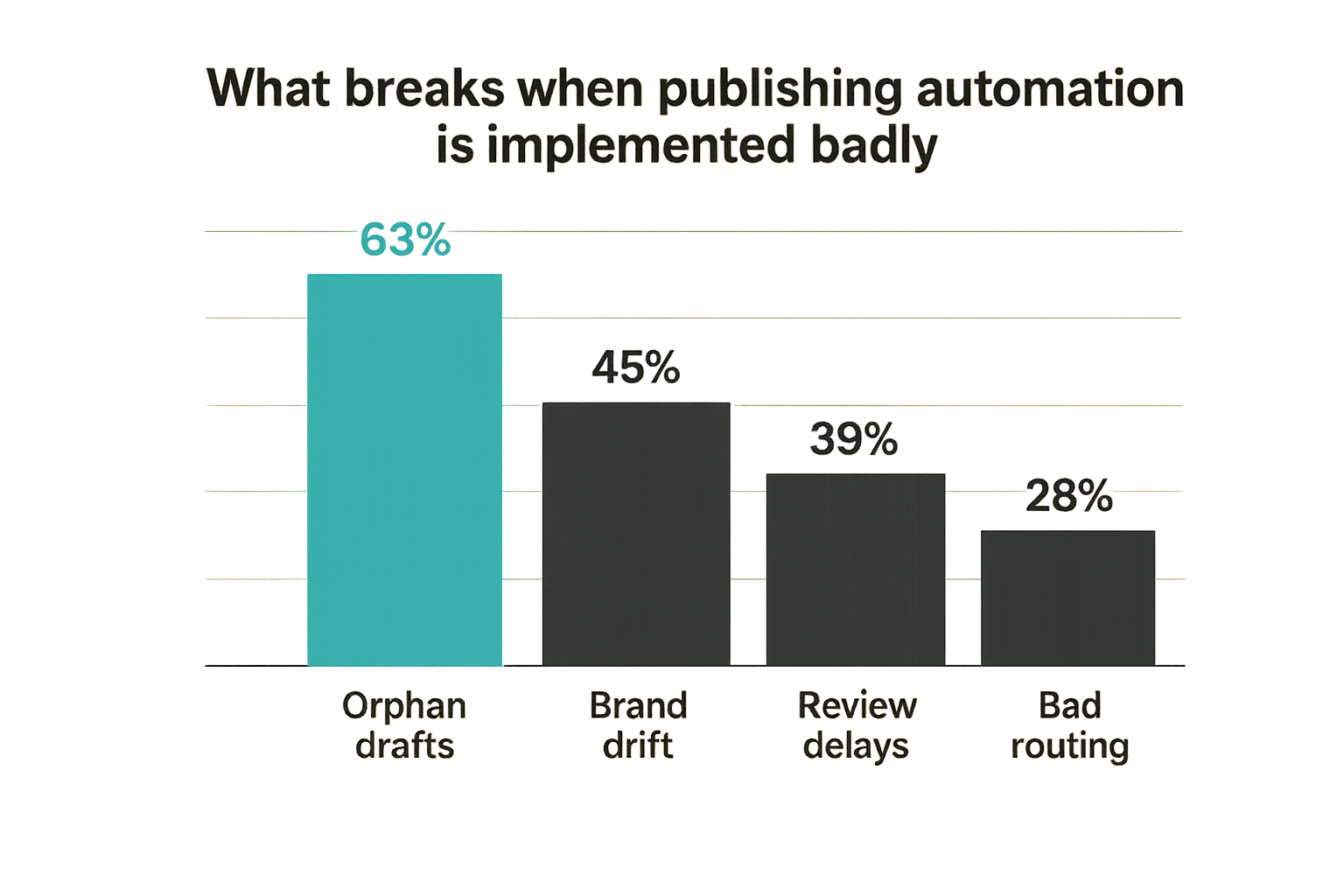
Bad automation does not always look bad at first. It often looks productive. The dashboard shows drafts generated, tasks completed, and publishing volume increasing.
Then the hidden costs appear.
Failure mode one: orphaned drafts
Orphaned drafts are generated assets with no clear owner, channel, or decision. They pile up in documents, CMS drafts, or project boards.
Common causes:
- topics created without approved briefs
- drafts generated faster than editors can review
- no reject/archive state
- no owner assigned after generation
- no content calendar capacity check
- no link between draft and distribution plan
The fix is not “generate fewer drafts” in isolation. The fix is to make draft generation conditional. If there is no approved brief, no owner, no review lane, and no publishing slot, the system should not create the asset.
Failure mode two: silent brand drift
Silent brand drift happens when automated content gradually becomes more generic, more exaggerated, or less aligned with the publication’s point of view.
It is dangerous because each individual piece may look acceptable. The damage appears across a body of work.
Warning signs include:
- repeated intros that sound the same
- broad claims without operational detail
- product mentions that feel bolted on
- overuse of trend language
- articles that rank topics but do not express a point of view
- newsletters that summarize but do not guide
The fix is to encode editorial direction into briefs, templates, and review criteria. Voice cannot live only in an old brand document. It has to show up in the workflow.
Measurement: know whether automation is helping
Publishing automation software should make the system easier to measure. If it only increases output, you cannot tell whether it improved operations or just increased activity.
Measure both the publishing workflow and the business result.
Operational metrics
Useful operational metrics include:
- brief approval time
- draft generation time
- first-pass acceptance rate
- average editor revision time
- number of review cycles
- time from brief approval to publish
- blocked assets by gate
- publish schedule adherence
- repurposed assets per source input
These metrics reveal bottlenecks. If draft generation takes minutes but editorial review takes two weeks, the next improvement is not a faster model. It is better briefs, routing, or acceptance criteria.
Editorial and business metrics
Output metrics alone are weak. Track quality and business signals:
- organic search impressions and clicks
- newsletter opens and clicks
- subscriber growth by content lane
- assisted conversions
- sales or support team usefulness
- content refresh candidates
- unsubscribe or complaint patterns
- editor confidence score
Some of these are quantitative. Some are operational judgment. Both matter.
A useful dashboard separates three layers:
| Layer | Question | Example metric |
|---|---|---|
| Production | Are we moving work faster? | Time from brief to publish |
| Quality | Are assets passing with less rework? | First-pass acceptance rate |
| Outcome | Is the content doing useful work? | Clicks, leads, replies, conversions |
That changes the conversation from “AI wrote 40 posts” to “the team shipped 12 approved assets, reduced review loops, and learned which lanes are worth expanding.”
Where bl0ggers.com fits in a controlled publishing system
Publishing teams that want AI output without editorial control should not pretend they want automation. They want bulk generation. That is a different operating model.
bl0ggers.com is built for the other case: teams, creators, and publishers that want AI-assisted publishing with review lanes, generated article workflows, podcast and newsletter formats, persona journeys, subdomain publishing, and webhook-based automation.
A fit for human-in-the-loop publishing
The strongest fit is a team that already knows it needs structure:
- content marketers building repeatable SEO and newsletter lanes
- publishers turning research into multiple content formats
- creators who want more output without losing voice
- newsletter operators who need recurring sections and approval control
- agencies or media operators managing multiple personas or properties
In that architecture, bl0ggers.com is not just a drafting surface. It is part of the publishing control layer: intake, generation, human review, distribution, and automation hooks.
The important point is ownership. Editors still decide what gets published. Automation handles the repeatable movement around that decision.
When not to use it
Do not use publishing automation software if you have not decided what good content means for your audience. It will not fix unclear positioning.
Do not use it to flood a market with undifferentiated posts. That may create activity, but it does not create trust.
Do not use it if nobody will own review. Human-in-the-loop workflows still require humans. The software can reduce the low-value work around review, but it cannot make editorial accountability disappear.
The best teams are honest about this. They use automation to make good workflows faster, not to hide weak workflows.
Closing: publishing automation software is an operating decision
Publishing automation software is not a shortcut around editorial work. It is a way to make editorial work more visible, repeatable, and scalable.
The teams that benefit are not the ones that generate the most drafts. They are the ones that define clear briefs, route reviews correctly, enforce quality gates, publish consistently, and feed performance data back into planning.
The operating model to keep
Keep the model simple:
- One content record per asset.
- One approved brief before generation.
- One clear owner at every state.
- One review lane based on risk and format.
- One set of gates before publication.
- One measurement loop after publication.
That is not glamorous. It is how publishing automation becomes useful instead of noisy.
The practical question for 2026 is not whether AI belongs in publishing. It already does. The practical question is whether your publishing automation software gives you enough control to use AI without lowering the standard.
Try bl0ggers.com
bl0ggers.com is for content teams, creators, and publishers who want to use AI to increase output without giving up editorial control. Try bl0ggers.com.