
AI writing software for marketing teams is no longer a side experiment run by one curious content manager. It is sitting inside editorial calendars, newsletter pipelines, agency retainers, creator operations, and publisher backlogs.
The pain is simple: output is easier to generate than it is to trust. Teams can produce ten drafts in an afternoon, but they still get stuck on briefs, fact checks, approvals, brand voice, distribution, and performance review.
Teams think the problem is finding a better AI writer. The real problem is building a publishing workflow where AI is useful without becoming an uncontrolled content factory.
That changes the conversation. The practical question is not which tool writes the best paragraph in a demo. The practical question is how your team moves from idea to published asset with enough speed, context, review, and accountability to keep quality intact.
Table of contents
- Why ai writing software for marketing teams is a workflow decision
- What marketing teams actually need from AI writing software
- Map the content workflow before selecting software
- Compare AI writing tools by operating capability
- Build a human in the loop publishing model
- Implementation workflow for content teams
- Governance and brand control for AI assisted content
- Integrations that matter for publishers and marketers
- Metrics that show whether AI writing is working
- Common failure modes when teams implement AI badly
- Make ai writing software for marketing teams operational
Why ai writing software for marketing teams is a workflow decision
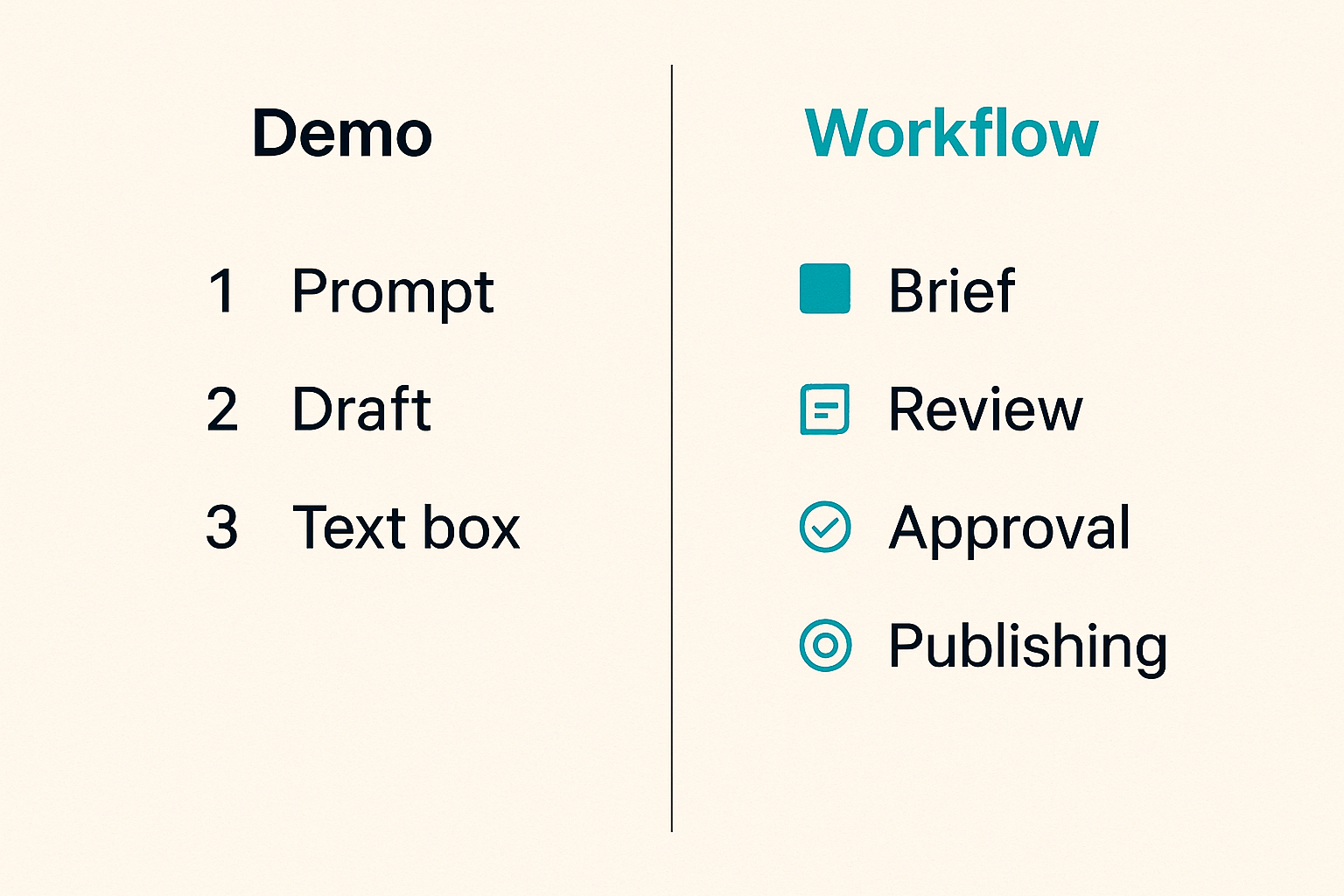
Most buying conversations start in the wrong place. Someone compares output samples, prompt templates, tone controls, or the quality of a landing page draft. Those things matter, but they are not where teams usually fail.
What breaks in practice is the work around the draft. Who approved the topic? Which audience is it for? What source material can the model use? Which claims need review? Where does the draft go next? Who owns the final decision to publish?
AI writing software for marketing teams should be evaluated like workflow infrastructure, not like a nicer text box.
The demo is not the operating model
In a demo, a tool turns a prompt into copy. In production, a team turns business context into a published asset.
Those are different jobs. A demo does not show whether the system supports editorial calendars, persona-specific content, review queues, role-based approval, version history, distribution, or performance feedback.
The mistake teams make is treating generated copy as the finished product. It is usually only one state in a longer production chain.
Practical rule: Do not buy AI writing software because it generates a good first draft. Buy it because it fits the way your team decides, reviews, publishes, and improves content.
The real unit of value is a publishable asset
A publishable asset has context, intent, structure, compliance with brand rules, distribution metadata, and a responsible owner. It can be shipped without someone asking where it came from or whether it is safe to use.
For a newsletter operator, that may mean a researched issue with subject lines, preview text, sponsor notes, and links. For a B2B content team, it may mean an SEO article with an outline, internal links, review notes, and CMS fields. For a creator, it may mean a blog post, a short-form script, and an email teaser from the same research base.
A useful way to think about it is this: AI should reduce the distance between an idea and a controlled publishing outcome. If it only creates more drafts, it may increase the workload.
What marketing teams actually need from AI writing software
Marketing teams do not need another place to paste prompts. They need a system that absorbs messy inputs, preserves editorial intent, and creates content that can move through a team.
The requirements are operational. They include briefs, audience definitions, source handling, approvals, publishing destinations, and measurement. If those pieces are missing, the tool becomes a toy that lives outside the real content process.
Inputs matter more than prompts
Better prompts help, but durable inputs matter more. A strong system should handle:
- Audience and persona definitions
- Product positioning and offer details
- Approved source material
- Brand voice rules
- SEO requirements and content briefs
- Editorial exclusions and claims to avoid
- Distribution channel requirements
If every user has to recreate that context manually, quality will vary by person and by day. The same tool will produce useful work for one editor and unusable work for another.
The practical question is whether the software can store and reuse the context that makes your content specific.
Outputs need ownership
Generated content should always have an owner. That owner may be a writer, editor, marketer, publisher, or creator. Without ownership, drafts pile up in shared folders and nobody knows whether they are approved, rejected, stale, or ready to schedule.
Ownership is not bureaucracy. It is how teams prevent unreviewed content from slipping into public channels.
Related reading from our network: teams choosing operational software in other categories face the same problem of confusing interface polish with workflow fit, which is why this guide to invoicing software workflow decisions is a useful adjacent comparison.
Map the content workflow before selecting software
Before you compare tools, map the workflow you actually need. This does not require a six-week consulting project. It requires naming the states a content asset moves through and deciding who can move it forward.
When this step is skipped, teams choose software based on the most impressive generation feature and then retrofit process later. That usually creates gaps.
Start with content states
Define the states that matter to your operation. A simple version might look like this:
- Idea captured
- Brief approved
- AI draft generated
- Editorial review
- Subject matter review
- Final approval
- Scheduled or published
- Performance reviewed
More complex teams may add legal review, sponsor approval, localization, repurposing, or channel-specific adaptation. The point is not to overcomplicate the process. The point is to make content state visible.
If a draft is simply sitting in a document, it is not obvious whether the next step is editing, approval, rewriting, or publication.
Define the review lanes
Not every asset needs the same review. A low-risk social post and a high-intent product comparison article should not go through identical gates.
A practical review lane model might include:
- Fast lane: low-risk, low-claim, editor approval only
- Standard lane: normal blog or newsletter content with editorial review
- Expert lane: technical, legal, medical, financial, or product claim review
- Executive lane: strategic messaging, launches, announcements, sensitive positioning
This is where human-in-the-loop matters. If you want the deeper architecture, the prior guide on human in the loop AI publishing workflow breaks down review routing, quality gates, and ownership in more detail.
Practical rule: Use AI to accelerate movement between states. Do not use AI to erase the states that protect quality.
Compare AI writing tools by operating capability
Most comparison pages rank tools by feature lists. That is useful for procurement, but it is incomplete for operators. Your real comparison should ask what the software does when several people are producing, reviewing, approving, and publishing content at once.
AI writing software for marketing teams should reduce coordination cost. If it produces more coordination work, the apparent productivity gain disappears.
The useful comparison table
| Capability | Generic AI writer | Workflow-oriented AI publishing system | Why it matters |
|---|---|---|---|
| Prompting | User writes prompts manually | Briefs, personas, templates, and reusable instructions | Reduces inconsistent output |
| Review | Copy is exported to docs | Drafts move through assigned review lanes | Keeps approval visible |
| Brand control | Tone settings and examples | Rules, exclusions, source policies, and editorial gates | Prevents off-brand publishing |
| Publishing | Manual copy and paste | CMS, newsletter, or webhook handoff | Reduces production friction |
| Measurement | Usually separate | Links output to cycle time and performance | Shows whether workflow improved |
| Team visibility | Individual workspace | Shared queue and asset status | Prevents draft sprawl |
The table is not about labels. A lightweight tool can be enough for a solo creator. A larger publisher may need queues, approvals, and integrations. The right answer depends on operating complexity.
Where generic tools fail in production
Generic tools fail when the organization expects them to behave like a publishing system. The tool may generate copy well, but it does not know the difference between a rough draft, an approved asset, and a scheduled article.
Common production failures include:
- Writers creating duplicate drafts from similar prompts
- Editors reviewing content without knowing the intended audience
- Approved language being overwritten by new generations
- Claims appearing without source support
- Published content not being connected to the original brief
- Performance data never feeding back into the system
The mistake teams make is assuming the writing layer will solve the operating layer. It will not.
Build a human in the loop publishing model
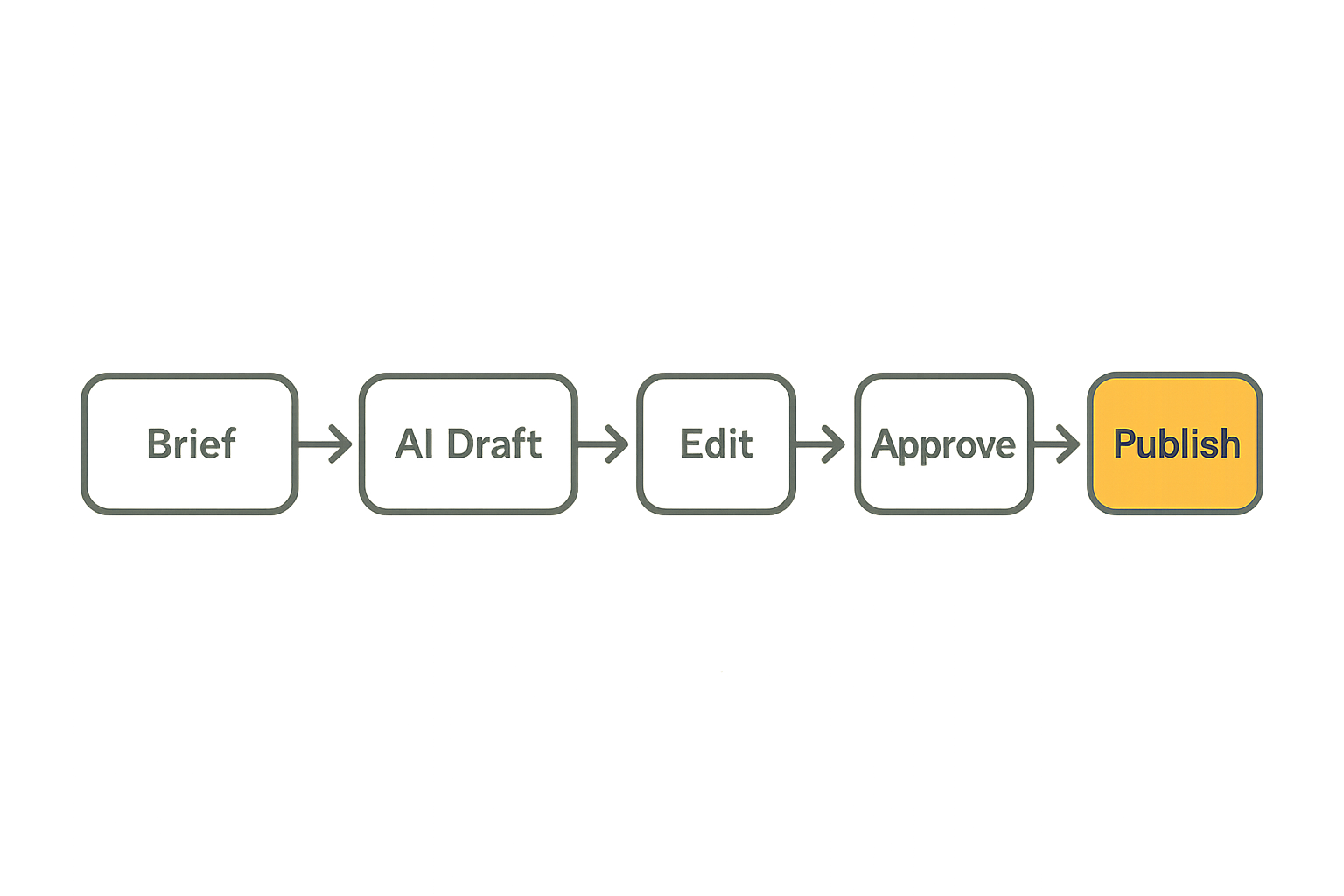
Human review should not be an afterthought bolted onto AI output. It should be part of the architecture. The goal is not to slow everything down. The goal is to apply human judgment where it actually matters.
That means separating routine generation from editorial decisions, claim validation, brand risk, and final publication authority.
Separate creation from approval
AI can create options. Humans should approve the final meaning.
This distinction matters because AI output can sound confident while still being misaligned, outdated, unsupported, or too generic. A workflow that treats generation as approval creates risk. A workflow that treats generation as input creates leverage.
A healthy model usually has these roles:
- Requester: defines the need and goal
- Generator: uses AI to create draft options or structured content
- Editor: improves clarity, accuracy, and voice
- Reviewer: checks subject matter, claims, or risk
- Publisher: schedules and ships the approved asset
One person may hold multiple roles in a small team. The roles still need to exist.
Use quality gates instead of vague review
Vague review produces vague feedback. Quality gates make review faster because people know what they are checking.
Useful gates include:
- Brief match: Does the content answer the assigned task?
- Audience fit: Is it written for the right reader?
- Source integrity: Are claims supported by approved material?
- Brand voice: Does it sound like the publisher?
- Differentiation: Does it add useful perspective, or is it generic?
- Publish readiness: Are metadata, links, formatting, and CTA complete?
For more practical standards around generated articles, the post on AI generated content best practices is a good companion to this workflow view.
Practical rule: Review should be a checklist with ownership, not a comment thread where every stakeholder reacts differently.
Implementation workflow for content teams
Implementation is where most teams either get value or create chaos. The safe path is to start with a bounded workflow, prove that it improves cycle time and quality, then expand.
Do not begin by giving everyone access and saying, use AI where helpful. That creates invisible variation. One person may use it for outlines, another for final copy, another for unsupported claims, and another not at all.
A practical rollout sequence
Use a staged rollout:
- Pick one content type, such as weekly blog posts or newsletter issues.
- Define the brief format and required inputs.
- Create approved prompt templates or generation recipes.
- Assign review lanes and approval owners.
- Generate a small batch of drafts.
- Review with quality gates, not general opinions.
- Publish only assets that pass the gate.
- Measure cycle time, revision depth, and content performance.
- Update templates and rules based on what broke.
- Expand to another content type only after the first lane is stable.
This sequence is slower than a chaotic launch, but faster than cleaning up a bad one.
What to automate first
Automation should target repetitive handoffs, not judgment. Good early automation candidates include:
- Brief intake forms
- Draft creation from approved templates
- Internal link suggestions
- Metadata generation
- Status changes in a queue
- Notifications to reviewers
- CMS draft creation
- Newsletter teaser generation
Do not automate final approval, high-risk claims, or sensitive positioning until your gates are mature.
Related reading from our network: remote teams face similar rollout issues when collaboration tools change how work moves between people, which makes this cloud based productivity and collaboration tools guide relevant for thinking about adoption.
Governance and brand control for AI assisted content
Governance sounds heavy until the first off-brand or unsupported article goes live. Then everyone wants controls retroactively.
The point is not to bury creators in rules. The point is to make the rules explicit enough that AI can help within boundaries and reviewers can make consistent decisions.
Create rules the system can enforce
Good governance rules are specific. Weak rules say, sound authoritative. Strong rules say, do not claim customer outcomes unless supported by approved case material.
Useful rule categories include:
- Claims allowed and claims prohibited
- Required disclaimers or caveats
- Competitor mention rules
- Source hierarchy and approved references
- Tone boundaries
- Persona-specific vocabulary
- CTA placement rules
- Editing standards for AI-generated language
These rules should live close to the workflow. If they sit in a brand PDF nobody opens, they will not shape production.
Keep sensitive claims out of autopilot
Some content should always require human review. Examples include legal interpretations, financial advice, health claims, security claims, product comparisons, customer promises, and anything involving regulated language.
AI can help draft these assets, but it should not be trusted as the approval authority. The reviewer must be responsible for the final claim.
A useful way to think about it is risk tiering. Low-risk content can move quickly. High-risk content gets more gates. The system should support both.
Integrations that matter for publishers and marketers
The UI is not the whole system. AI writing software becomes operational when it connects to the places where content is planned, reviewed, published, and measured.
If the tool creates great drafts but forces manual copy and paste through every step, the team still carries production drag.
CMS newsletter and distribution systems
For publishers and creators, the destination matters. A blog post is not done until it has slug, metadata, categories, image notes, internal links, and a publishing state. A newsletter is not done until it has a subject line, preview text, segmentation, sponsor blocks, and scheduling details.
Look for integrations or handoff patterns that support:
- CMS draft creation
- Newsletter draft creation
- Asset metadata mapping
- UTM and campaign fields
- Image placeholders or creative requests
- Canonical URL handling
- Repurposing into social or email snippets
Manual handoff is acceptable at low volume. It becomes expensive when output scales.
Webhooks queues and handoffs
For more mature teams, webhooks and queues matter because they let AI publishing fit into existing operations. A webhook can notify a project system when a draft is ready. A queue can route technical content to an expert. A publishing event can trigger distribution tasks.
This is where AI writing software starts behaving like infrastructure rather than a writing assistant.
Related reading from our network: teams handling private collaboration have to design for trust boundaries and handoffs too, and this guide to end to end encryption messaging architecture is an adjacent example of why workflow design matters beyond the interface.
Metrics that show whether AI writing is working
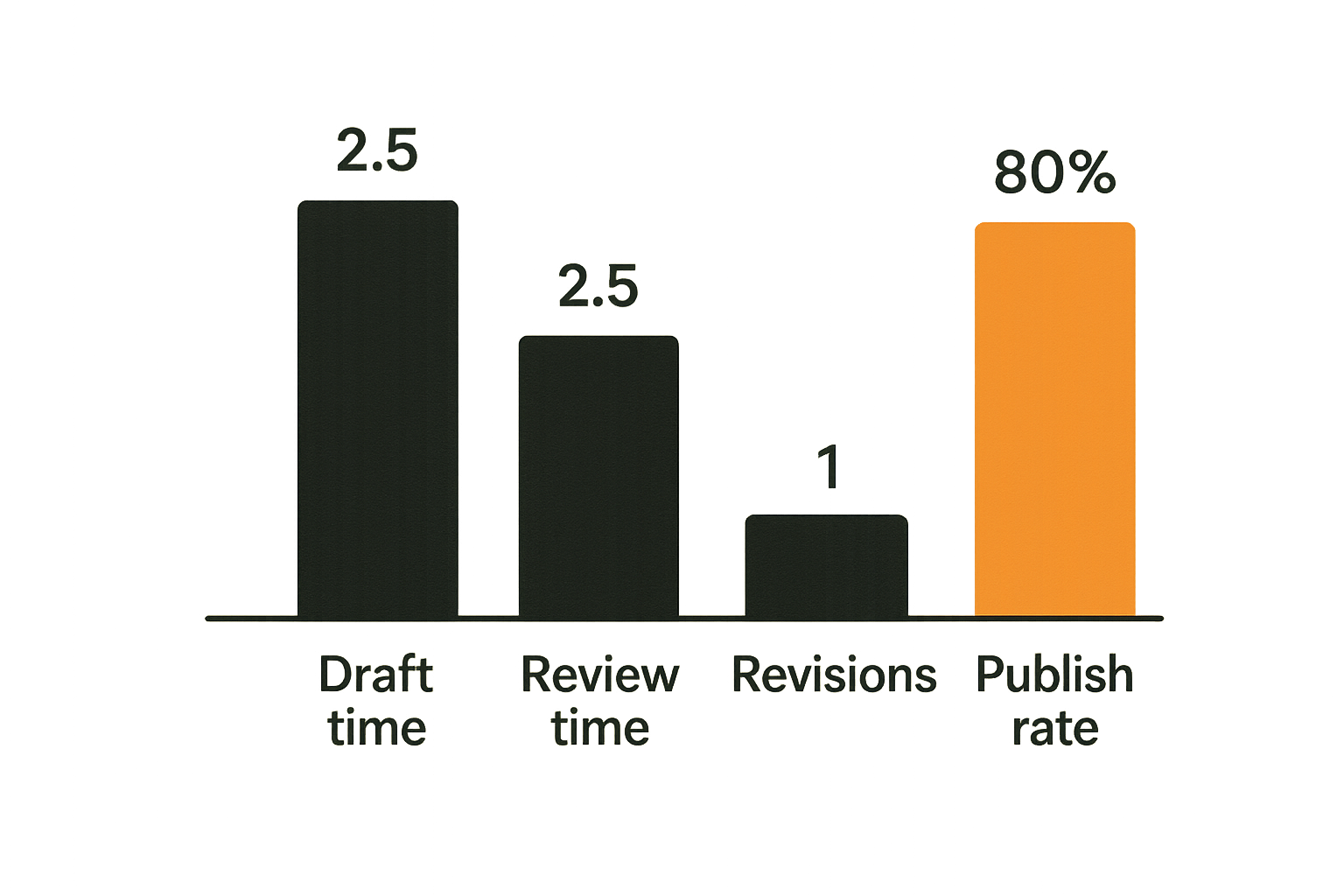
Volume is the easiest metric to inflate and the easiest metric to misread. Publishing more is not automatically better. Publishing more useful content with less delay and less rework is better.
The measurement model should show whether the system improves throughput without damaging trust.
Measure cycle time and revision cost
Start with operational metrics:
- Time from idea to approved brief
- Time from brief to first draft
- Time from draft to approval
- Number of revision rounds
- Percentage of drafts rejected
- Percentage of assets requiring expert review
- Time spent on formatting and CMS preparation
These numbers expose bottlenecks. If AI reduces drafting time but review time doubles, the workflow is not healthy. If the team publishes more but editors spend nights fixing generic copy, the cost moved rather than disappeared.
Track quality not just volume
Quality metrics vary by channel, but teams should watch signals such as:
- Organic clicks and qualified traffic
- Newsletter opens and click behavior
- Reader replies or unsubscribes
- Conversion assists
- Sales or support feedback
- Content decay and update frequency
- Editorial rejection reasons
The best metric set combines production health and audience response. If both improve, the system is working. If only output volume improves, be skeptical.
Common failure modes when teams implement AI badly
AI content programs usually fail in predictable ways. They do not fail because the model cannot write a paragraph. They fail because the team never designed the operating model around the paragraph.
What breaks in practice is visibility, accountability, and feedback.
The content flood problem
The content flood happens when a team generates more drafts than it can review, improve, publish, or measure. This feels productive for about two weeks. Then the backlog becomes noise.
Symptoms include:
- Dozens of unowned drafts
- Editors avoiding the queue
- Duplicate topics
- Thin articles competing with better assets
- No clear publish standard
- Performance review skipped because production never stops
What works is a pull system. Generate content when there is review capacity and a real publishing slot. Do not generate content just because the tool can.
The invisible approval problem
Invisible approval happens when people assume someone else checked the content. The writer assumes the editor reviewed claims. The editor assumes the product team approved positioning. The publisher assumes the draft is cleared because it is in the CMS.
This is how bad content ships.
Approval should be explicit. The system should show who approved what, when, and for which channel. If that sounds too formal, remember that the alternative is reconstructing decisions after a mistake.
Practical rule: If approval is not visible, it did not happen operationally.
Make ai writing software for marketing teams operational
The practical goal is not to replace the content team. It is to remove the low-value friction that keeps the team from publishing consistently.
AI writing software for marketing teams works when it supports the full system: briefs, generation, review, approval, publishing, distribution, and measurement. It fails when it only creates text and leaves the real workflow untouched.
Where bl0ggers.com fits
bl0ggers.com is built around the premise that AI publishing needs human control points. The useful layer is not only generation. It is turning AI-generated research and drafts into blogs, podcasts, newsletters, review queues, persona-led journeys, and publishing flows that teams can actually operate.
That matters for content teams, creators, newsletter operators, and publishers who want more output without giving up editorial judgment. The system should help the team move faster while preserving the right to inspect, edit, approve, and decide.
This is the difference between AI as a text generator and AI as part of a publishing workflow.
Rollout checklist
Before choosing or expanding AI writing software, check the basics:
- Do we know which content types AI will support first?
- Do we have standard briefs?
- Do we have reusable audience and persona context?
- Do we have review lanes for different risk levels?
- Do we know who approves publication?
- Can the system connect to CMS, newsletter, or distribution workflows?
- Are rejection reasons and revision patterns tracked?
- Do performance signals feed back into the workflow?
If the answer is no to most of these, the next step is not more prompting. The next step is content operations design.
AI writing software for marketing teams is valuable when it helps teams publish better work with less coordination drag. Treat it as workflow architecture, and the tool conversation becomes much clearer.
Try bl0ggers.com
bl0ggers.com is for content teams, creators, and publishers who want to use AI to increase output without giving up editorial control. Try bl0ggers.com