
AI generated content best practices get treated like a prompt problem. The team wants a better instruction, a better model, or a cleaner tone preset.
That is not where most AI publishing systems break.
Teams think the problem is generating decent drafts. The real problem is moving AI-assisted content through a controlled publishing workflow without losing accuracy, voice, ownership, approvals, distribution state, or feedback.
In 2026, the practical question is not whether AI can produce a blog post, newsletter, social thread, podcast outline, or landing page draft. It can. The question is whether your team can run that output through an operating model that protects trust while increasing throughput. That changes the conversation from AI writing to publishing architecture.
Table of contents
- AI generated content best practices are a workflow problem
- Define the publishing job before you generate
- Build an editorial control layer
- Set quality gates that models cannot skip
- Design prompts as reusable production inputs
- Human review should be routed by risk
- Distribution and repurposing need state management
- Measurement closes the loop
- Common failure modes in AI generated content best practices
- Where bl0ggers.com fits in the publishing stack
AI generated content best practices are a workflow problem
The output is not the asset
The mistake teams make is treating an AI draft as the finished unit of work. A draft is not the asset. The asset is a published, maintained, measurable piece of content that supports a real audience journey.
A useful way to think about it is this: generation is only one step in a longer chain. Before it, you have positioning, audience selection, intent, source material, and editorial rules. After it, you have review, fact checking, approvals, CMS formatting, distribution, search intent matching, repurposing, refreshes, and reporting.
If you only optimize the generation step, you create a faster way to produce unmanaged inventory. That inventory still has to be reviewed by humans, corrected, routed, approved, published, tracked, and sometimes taken down.
Practical rule: Do not measure AI content by drafts created. Measure it by approved, useful, published assets that remain accurate over time.
This is why AI generated content best practices are less about model worship and more about operational discipline. The teams that win are not the ones with the longest prompt. They are the teams that know where AI belongs, where humans must stay in control, and how work moves between both.
Why 2026 publishing teams need an operating model
The pressure on content teams is not slowing down. Search is fragmented. Newsletters are more competitive. Social posts have shorter shelf lives. Communities expect topical coverage faster. Founders and executives want more thought leadership, more product education, more comparison pages, more local pages, more partner content, and more repurposed formats.
AI helps with volume, but volume without an operating model becomes liability. Many teams discover this after the first content surge. They generate fifty articles, then realize nobody knows which are approved, which were edited, which need legal review, which reference stale product claims, and which were published to the wrong channel.
That changes the conversation. The question becomes: what workflow lets us increase output without giving up editorial control?
For teams building this foundation from scratch, the adjacent architecture discussion in Human in the Loop AI Publishing is useful because it frames review routing, automation, and approvals as infrastructure rather than taste.
Define the publishing job before you generate
Map content to a business motion
Before a model writes anything, the team needs to know what job the content is supposed to do. Not every asset has the same risk, owner, or success metric.
A product comparison page has a different job than a founder newsletter. A podcast summary has a different job than a compliance-sensitive help article. A local landing page has a different job than a trend commentary post.
Use a simple mapping table before generation:
| Content type | Primary job | Risk level | Human owner | Success signal |
|---|---|---|---|---|
| SEO article | Capture demand and educate | Medium | Editor | Qualified organic visits |
| Newsletter | Retain audience attention | Medium | Creator | Replies, clicks, unsubscribes |
| Product page | Convert existing demand | High | Marketing lead | Demo or signup intent |
| Support article | Reduce confusion | High | Product/support | Lower repeated tickets |
| Social repurpose | Distribute ideas | Low | Content operator | Engagement and saves |
This table does not need to be fancy. It needs to exist. Without it, AI content becomes an undifferentiated pile of drafts. With it, each asset has a purpose, risk profile, and review path.
Related reading from our network: teams making product decisions face a similar loop of signals, prioritization, release, and review in Product Iteration Best Practices.
Separate briefs from prompts
A brief is the editorial contract. A prompt is the machine instruction. Teams often blur the two and then wonder why every article feels inconsistent.
The brief should contain durable context:
- audience and reader maturity
- search or subscriber intent
- point of view
- required sources or internal notes
- claims to avoid
- examples to include
- product boundaries
- CTA path
- reviewer and approver
The prompt can translate that brief into model behavior. But if the brief is weak, the prompt becomes a pile of improvisation.
Practical rule: A prompt should execute a brief. It should not invent the strategy, audience, claims, or editorial policy.
A workable brief format looks like this:
content_job: educate mid-funnel buyers
audience: content marketers and newsletter operators
primary_question: how do we scale AI drafts safely
point_of_view: workflow beats prompt hacking
must_include:
  - review lanes
  - quality gates
  - approval states
avoid:
  - unsupported statistics
  - generic AI hype
human_owner: managing editor
risk_level: medium
This format keeps the team honest. It also gives AI systems structured input that can be reused, audited, and improved.
Build an editorial control layer
Use review lanes, not one giant queue
The practical question is not whether humans should review AI content. The practical question is which humans should review which content, at what depth, and at what point in the workflow.
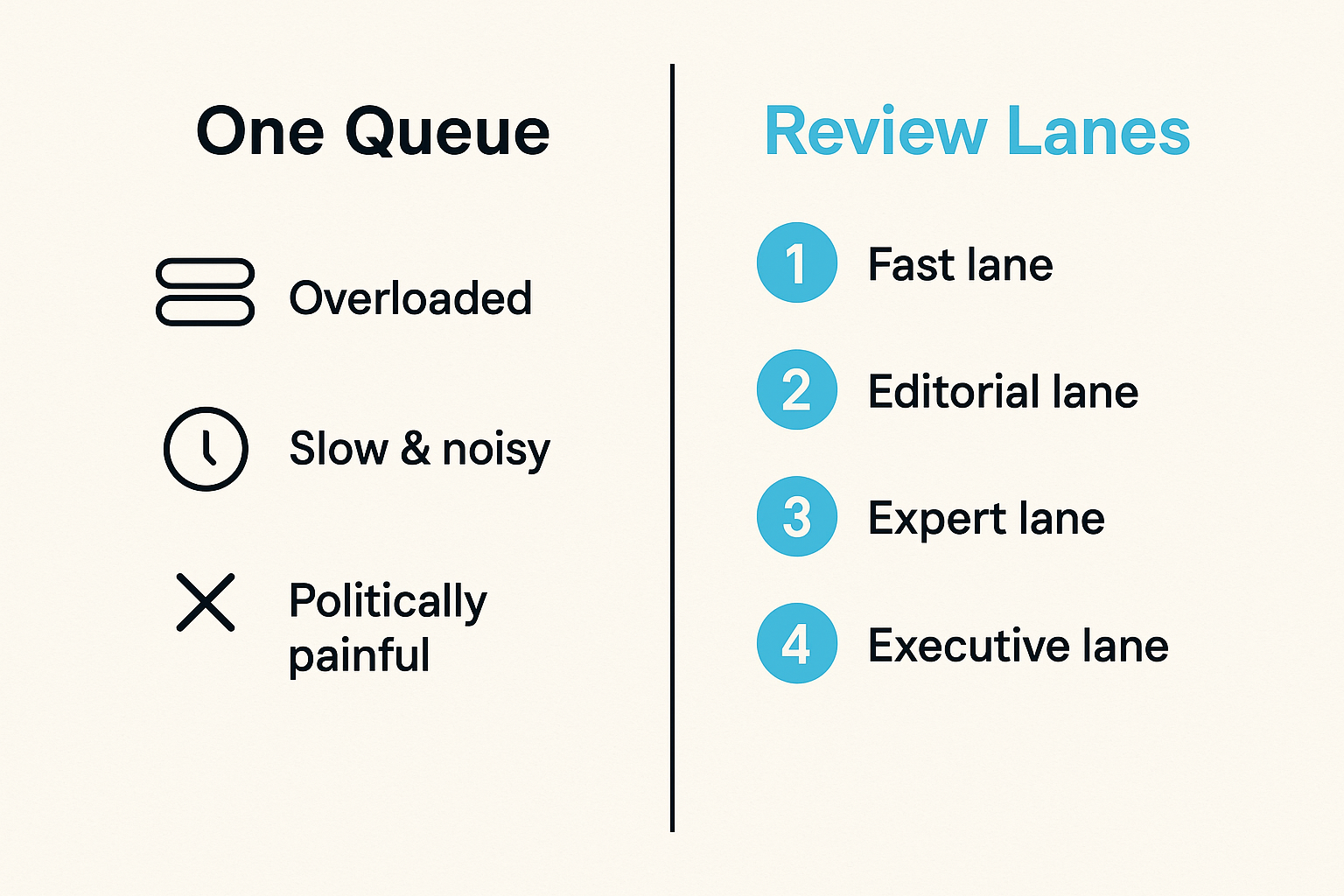
One giant review queue breaks quickly. Editors get flooded with low-risk rewrites while high-risk product claims sit beside social captions. The queue becomes slow, noisy, and politically painful.
A better pattern is review lanes:
| Lane | Content examples | Reviewer | Review depth |
|---|---|---|---|
| Fast lane | Social snippets, excerpt rewrites, internal summaries | Content operator | Format and tone |
| Editorial lane | Blog posts, newsletters, guides | Editor | Structure, usefulness, voice |
| Expert lane | Technical, medical, legal, financial, product claims | SME or accountable owner | Accuracy and risk |
| Executive lane | Founder POV, sensitive announcements | Executive or comms lead | Positioning and reputation |
What breaks in practice is ownership. If everyone is responsible, nobody is. Review lanes make ownership visible.
This is also where human-in-the-loop AI publishing becomes operational instead of theoretical. A human is not simply added at the end. Humans are routed based on risk, domain, and decision authority.
Make approval states explicit
AI publishing workflows need states. Without states, teams rely on Slack messages, spreadsheet colors, and memory. That works for ten assets. It fails at one hundred.
Use explicit states such as:
- idea captured
- brief approved
- draft generated
- editorial review
- SME review if required
- revision requested
- approved for publishing
- scheduled
- published
- monitored
- refresh required
- retired or redirected
A state is not bureaucracy. It is how the team knows what is allowed to happen next.
Practical rule: No AI-generated asset should move to publishing unless its required approval state is visible to the team.
You can manage this in a CMS, project tool, Airtable-style database, custom workflow, or publishing platform. The tool matters less than the state machine. The mistake teams make is having production volume without production state.
Set quality gates that models cannot skip
Accuracy checks
AI systems are useful, but they are not accountable. Your organization is. That means certain checks cannot be delegated entirely to the model.
Accuracy checks should cover:
- factual claims
- names, titles, dates, and product details
- pricing or packaging references
- regulatory or compliance language
- competitor comparisons
- customer examples
- quoted material
- internal policy claims
For many teams, the most dangerous errors are not dramatic hallucinations. They are small, plausible inaccuracies. A product feature described slightly wrong. A claim that used to be true but changed. A comparison that sounds fair but is outdated.
The workflow should force high-risk claims into a review lane. Do not ask the model to be the final judge of its own accuracy.
Voice, usefulness, and originality checks
Quality is not only factual correctness. Content can be accurate and still useless.
An editor should ask:
- Does this answer a real reader question?
- Does it say anything specific?
- Does it reflect our point of view?
- Does it include operational detail or only general advice?
- Does it sound like our brand or like a model average?
- Would a practitioner trust this after reading the first section?
AI-generated content often fails by being harmless. It says true things nobody needed. It repeats obvious definitions. It avoids tension. It over-explains simple ideas and under-explains implementation.
A useful quality gate should reject safe-but-empty content. If a piece does not change what the reader would do, it needs revision.
The earlier post on AI Generated Content Publishing goes deeper on how QA, governance, and publishing automation fit together after the draft exists.
Design prompts as reusable production inputs
Prompt modules beat magic prompts
There is nothing wrong with good prompts. The problem is expecting one giant prompt to carry the whole publishing operation.
A better approach is modular. Break instructions into components:
- audience module
- brand voice module
- structure module
- evidence rules
- risk rules
- formatting rules
- CTA rules
- repurposing rules
Then compose them based on the content job. A newsletter does not need the same structure module as an SEO guide. A technical tutorial needs different evidence rules than a community update.
This also makes prompts easier to debug. If every article has weak introductions, inspect the structure module. If every article overclaims, inspect the evidence rules. If every output sounds generic, inspect the voice examples.
The mistake teams make is editing prompts like personal notes. Production prompts should be treated more like templates, configurations, or policy files.
Keep examples close to the workflow
Models respond well to examples, but examples go stale. A brand voice sample from two years ago may no longer represent the company. A top-performing SEO article may rank for reasons unrelated to quality. A founder essay may be too personal for a product tutorial.
Keep example libraries small, current, and labeled by use case.
For example:
example_set:
  seo_operator_guides:
    use_for: practical long-form search content
    avoid_for: executive announcements
  newsletter_opinion:
    use_for: subscriber-facing commentary
    avoid_for: support documentation
  product_explainers:
    use_for: feature education
    avoid_for: industry trend posts
This prevents the model from mixing styles that should stay separate.
Practical rule: Prompt examples should be versioned, reviewed, and assigned to content types. Otherwise they become hidden editorial drift.
Related reading from our network: publishers using AI for local or community content face the same trust problem at the audience level, which is covered in AI Publishing Community Building.
Human review should be routed by risk
Low-risk content can move faster
Not every AI-assisted asset needs the same review depth. If your team treats every social caption like a legal memo, the workflow will stall. If your team treats every product claim like a caption, trust will suffer.
Low-risk work can usually move through lightweight review:
- headline variants
- meta descriptions
- excerpt rewrites
- social post drafts from an approved article
- internal summaries
- newsletter subject line options
- formatting cleanup
These assets still need standards, but they do not always need a senior editor. The goal is not to slow everything down. The goal is to apply human attention where it matters.
A useful rule is to ask what happens if the content is wrong. If the cost is minor embarrassment or a quick edit, use a fast lane. If the cost is customer confusion, legal exposure, reputational damage, or broken product expectations, route it to a stronger lane.
High-risk content needs named owners
High-risk AI content must have a named accountable owner. Not a channel. Not a team. A person or role with authority.
High-risk categories include:
- medical, legal, financial, or security advice
- product pricing and packaging
- integration instructions
- customer case studies
- public claims about competitors
- regulatory or compliance statements
- executive bylines
The owner does not need to write every word. But they need to approve the claims that matter.
This is where many teams quietly fail. They say content was reviewed, but nobody can say by whom, against what standard, or what changed. In production, that is not review. That is hope with a timestamp.
Distribution and repurposing need state management
One source, many outputs
AI makes repurposing cheap. That is useful, but it can create a state problem.
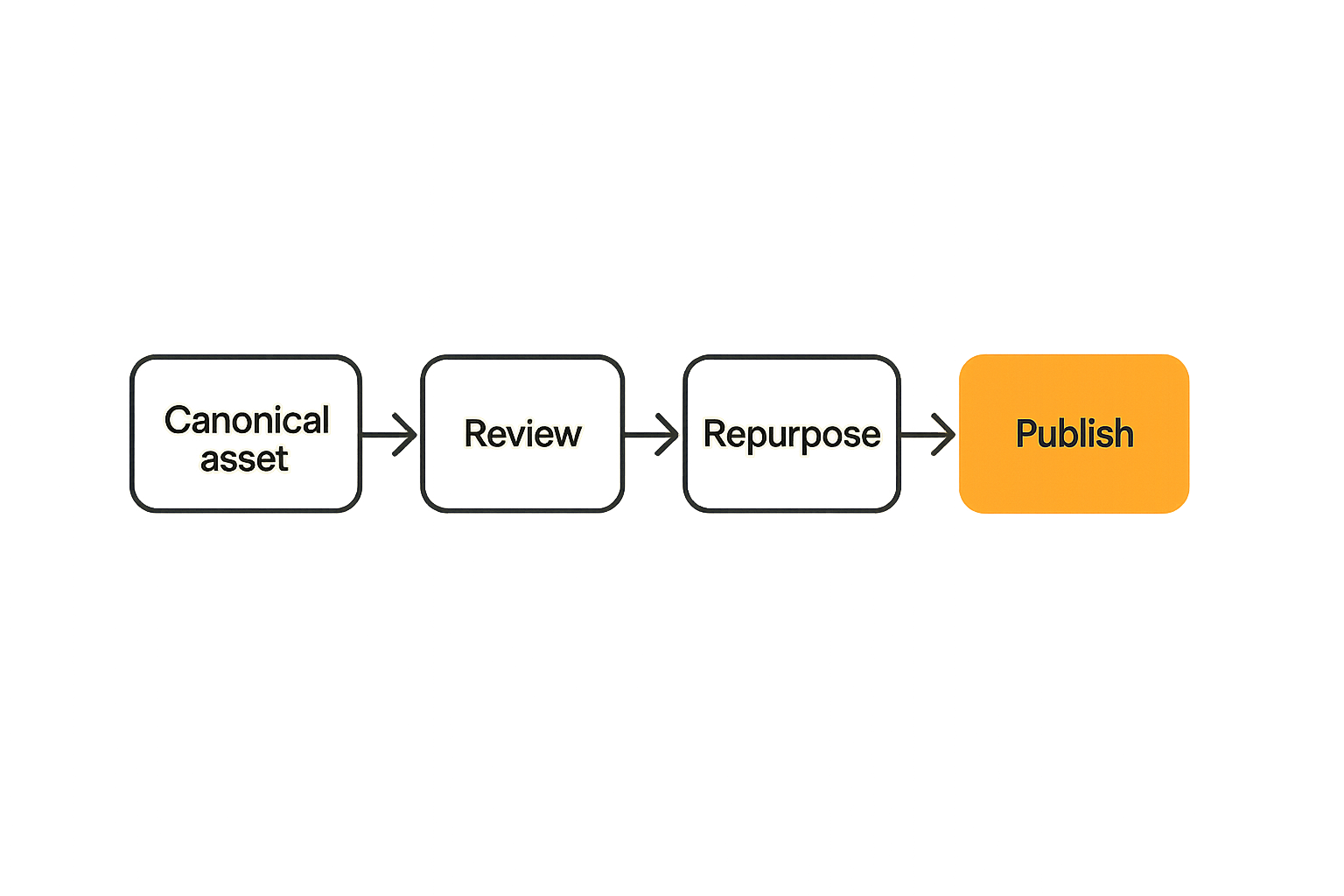
One approved article may become:
- a newsletter edition
- a LinkedIn post
- a podcast outline
- a short video script
- a carousel
- a sales enablement summary
- a partner excerpt
- a regional variation
The UI is not the whole system. The real work is knowing which derivative assets came from which source, what changed, who approved the changes, and whether the underlying source is still current.
If the original article is updated, should the newsletter version change? If a product claim is removed from the blog, should a sales summary also be updated? If a podcast script includes a stronger claim than the original, who approved it?
A useful state model treats the canonical asset as the source of truth and every derivative as a child asset with its own status.
Track publication, refresh, and retirement
Publishing is not the end of the workflow. It is the start of maintenance.
Every AI-assisted content system should track:
- publication date
- source brief
- reviewer
- approval state
- channels published
- derivative assets
- refresh date
- owner
- performance notes
- retirement or redirect decision
This matters more as content volume increases. A small team can remember ten pages. It cannot remember two hundred AI-assisted assets across blog, newsletter, podcast, and social.
Related reading from our network: if your AI-scaled publishing business includes paid access, subscriptions, or crypto settlement, the operational patterns around webhooks, entitlements, and support in AI Publishing Cryptocurrency are adjacent to the same state-management problem.
Measurement closes the loop
Measure decisions, not just traffic
Traffic matters, but traffic is a lagging and incomplete signal. AI generated content best practices should include measurement that improves future editorial decisions.
Track signals such as:
- which briefs produce approved drafts fastest
- which content types require the most revision
- which prompts create recurring errors
- which reviewers are overloaded
- which topics produce qualified engagement
- which articles generate newsletter signups or replies
- which assets need frequent updates
- which distribution channels produce useful readers
This helps you improve the system, not just judge individual articles.
A simple measurement table can be enough:
| Signal | Why it matters | Workflow response |
|---|---|---|
| High revision rate | Brief or prompt is weak | Improve template or source inputs |
| Long approval time | Reviewer bottleneck | Split lanes or assign backup owner |
| Low engagement | Wrong topic or weak angle | Revisit audience intent |
| Frequent corrections | Accuracy gate is failing | Add SME review earlier |
| Good traffic, poor conversion | Search intent mismatch | Rewrite CTA or content job |
The practical question is not whether AI content performed. The better question is what the performance tells you to change in the workflow.
Feed results back into briefs
Measurement only matters if it changes inputs. If analytics live in one dashboard and briefs live in another tool, teams forget to connect them.
Make feedback part of the brief lifecycle:
- Publish the asset.
- Capture early editorial issues.
- Review performance after a defined window.
- Add notes to the topic, persona, or prompt module.
- Update the brief template if the pattern repeats.
- Retire, refresh, or expand the asset based on evidence.
This is where AI can compound. Not because the model magically gets smarter inside your account, but because your workflow captures what worked and what failed.
Common failure modes in AI generated content best practices
What fails
The most common failure mode is unmanaged speed. The team celebrates output, then drowns in review debt.
Other failure modes show up quickly:
- no clear owner for generated drafts
- prompts stored in private documents
- briefs skipped because the model seems good enough
- reviewers asked to fix strategy problems after generation
- no distinction between low-risk and high-risk assets
- weak source material
- AI used to create claims nobody would defend
- derivatives published without tracking the canonical source
- performance data ignored during future planning
- old content left live after product or market changes
What breaks in practice is not usually the model. It is the handoff. A draft moves from AI to editor with no context. An editor changes it without updating the brief. A marketer publishes it without recording approval. A social manager repurposes it with a stronger claim. A support lead later finds customers quoting a stale article.
That is how AI content creates hidden operational debt.
What works
What works is less glamorous and more durable.
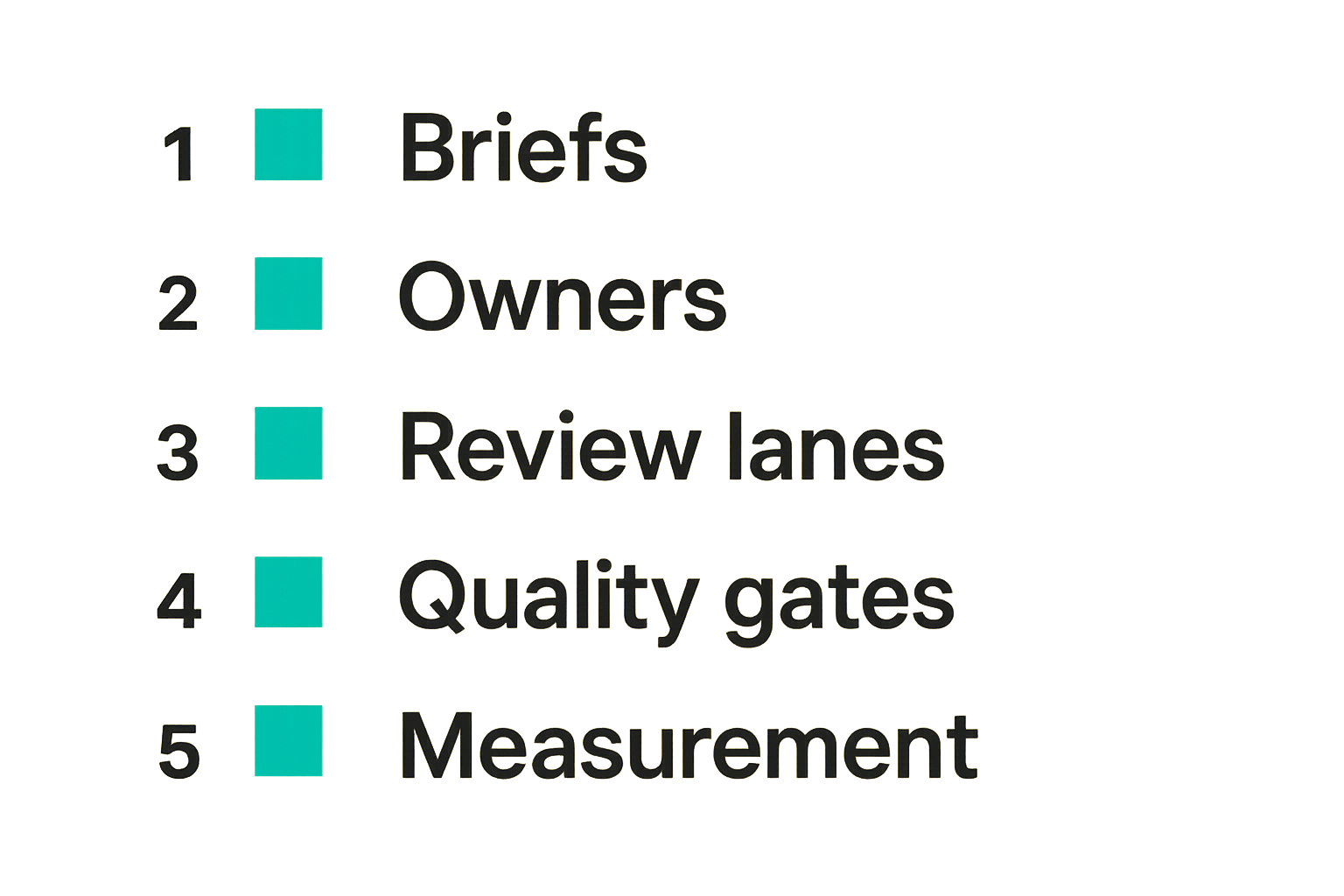
Strong teams define the job, generate from a real brief, route by risk, use visible states, enforce quality gates, approve with named owners, publish with metadata, and measure the workflow.
A practical implementation sequence looks like this:
- Inventory your current content types and channels.
- Assign each content type a job, risk level, and owner.
- Create one brief template per major content type.
- Build prompt modules from those briefs.
- Define approval states before increasing volume.
- Create review lanes for fast, editorial, expert, and executive review.
- Add quality gates for accuracy, voice, usefulness, and risk.
- Track canonical assets and derivatives.
- Review workflow metrics monthly.
- Update briefs and prompt modules based on real failures.
This is not complicated, but it requires discipline. AI removes some production friction. It does not remove the need for editorial judgment.
Where bl0ggers.com fits in the publishing stack
The useful product boundary
A useful AI publishing platform should not pretend to replace your editorial brain. It should give your team a controlled way to turn research and inputs into publishable formats while preserving review, approvals, and human judgment.
That is the product boundary that matters. Generation is useful. But the higher-value work is routing generated content through review queues, supporting multiple formats, keeping persona journeys consistent, publishing to owned surfaces, and letting teams decide where automation ends.
bl0ggers.com is built around that premise: human-in-the-loop AI publishing for content teams, creators, and publishers who want more output without giving up control. The relevant architecture is not just draft creation. It is the path from idea to reviewed asset to blog, podcast, newsletter, or subdomain publishing workflow.
For teams comparing options, the main question should be: does this system help us run the workflow, or does it only create more text?
A simple implementation sequence
If you are starting from a messy AI content process, do not rebuild everything at once. Start with one repeatable lane.
For example:
- Choose one content type, such as weekly operator blog posts.
- Define the brief fields and approval owner.
- Generate drafts only from approved briefs.
- Route every draft through editorial review.
- Require SME review only when risk rules trigger it.
- Publish approved assets to a controlled destination.
- Repurpose only from the approved canonical version.
- Review performance and revision notes after thirty days.
- Update the brief and prompt modules.
- Expand the workflow to newsletters, podcasts, or additional sites.
This keeps the system observable. You can see where drafts improve throughput, where editors spend time, which gates catch issues, and which content jobs deserve automation.
If you need to discuss a more specific workflow, integration, or review queue, the bl0ggers.com contact page is the right path for that conversation.
The closing point is simple: AI generated content best practices are not a list of prompt tricks. They are the operating rules for producing, reviewing, publishing, maintaining, and measuring AI-assisted content without losing trust.
Try bl0ggers.com
bl0ggers.com is for content teams, creators, and publishers who want to use AI to increase output without giving up editorial control. Try bl0ggers.com.