
AI writing assistance tools are easy to buy and surprisingly hard to operate.
A content lead signs up for a tool, gives the team access, and expects output to increase. For a week, it does. Drafts appear faster. Headlines get easier. Outlines stop blocking the calendar. Then the review queue gets messy, facts drift, tone becomes inconsistent, and nobody is sure which draft is approved for publishing.
Teams think the problem is writing speed. The real problem is workflow control.
That changes the conversation. The practical question is not which AI writing tool has the flashiest editor. It is which system lets a publisher move from idea to draft to review to approval to distribution without losing ownership, accuracy, brand voice, or measurement.
Table of contents
- Why AI writing assistance tools are an operating system decision
- The architecture of a reliable AI writing workflow
- Compare categories of AI writing assistance tools
- Build the editorial control layer
- Make prompts and briefs operational
- Implementation workflow from idea to publish
- What breaks when teams implement badly
- What works in production
- Metrics that prove assistance is helping
- Security privacy and governance
- Product fit for bl0ggers.com
Why AI writing assistance tools are an operating system decision
AI writing assistance tools sit in the middle of your content operation. They touch research, positioning, drafts, review, approvals, SEO, newsletters, social distribution, and sometimes customer-facing claims.
The mistake teams make is treating them like better autocomplete. That view is too small. In a real publishing workflow, AI assistance changes how work enters the system, who reviews it, which parts are automated, and how the final asset is trusted.
The problem is not drafts
Most teams already have too many draftable ideas. They do not have enough cleanly packaged, reviewed, approved, and distributed assets.
A weak process turns AI into a pile of half-finished text. A strong process turns it into leverage. The difference is not the model. The difference is the operating layer around the model.
If an AI tool produces ten articles but your editor spends two days untangling sources, voice, claims, and duplicate angles, you did not scale publishing. You moved the bottleneck downstream.
Practical rule: Do not measure AI writing assistance by draft count alone. Measure whether approved, useful content reaches the audience faster with less rework.
Why 2026 changes the workflow
By 2026, content teams are not asking whether AI can write paragraphs. That question is settled enough for production use. The harder question is whether AI can fit inside a controlled publishing operation without creating risk.
Search quality pressure is higher. Audiences are more sensitive to generic content. Internal stakeholders want more output, but legal, compliance, and brand teams still need confidence. Newsletter operators need cadence without filler. Creators need leverage without sounding cloned.
That creates a workflow problem: how do you increase output while keeping editorial judgment visible?
Treat the tool as infrastructure
A useful way to think about it is this: your AI writing layer is part of your publishing infrastructure. It should have inputs, states, permissions, logs, and quality checks.
If you would not run paid acquisition without campaign ownership and conversion tracking, do not run AI publishing without review ownership and content performance tracking.
The tool should answer operational questions:
- What brief created this draft?
- Which sources were used?
- Who reviewed the claim-heavy sections?
- Which persona is the article written for?
- What changed between draft and approved version?
- Where was it published and distributed?
- Did it perform well enough to influence the next brief?
The architecture of a reliable AI writing workflow
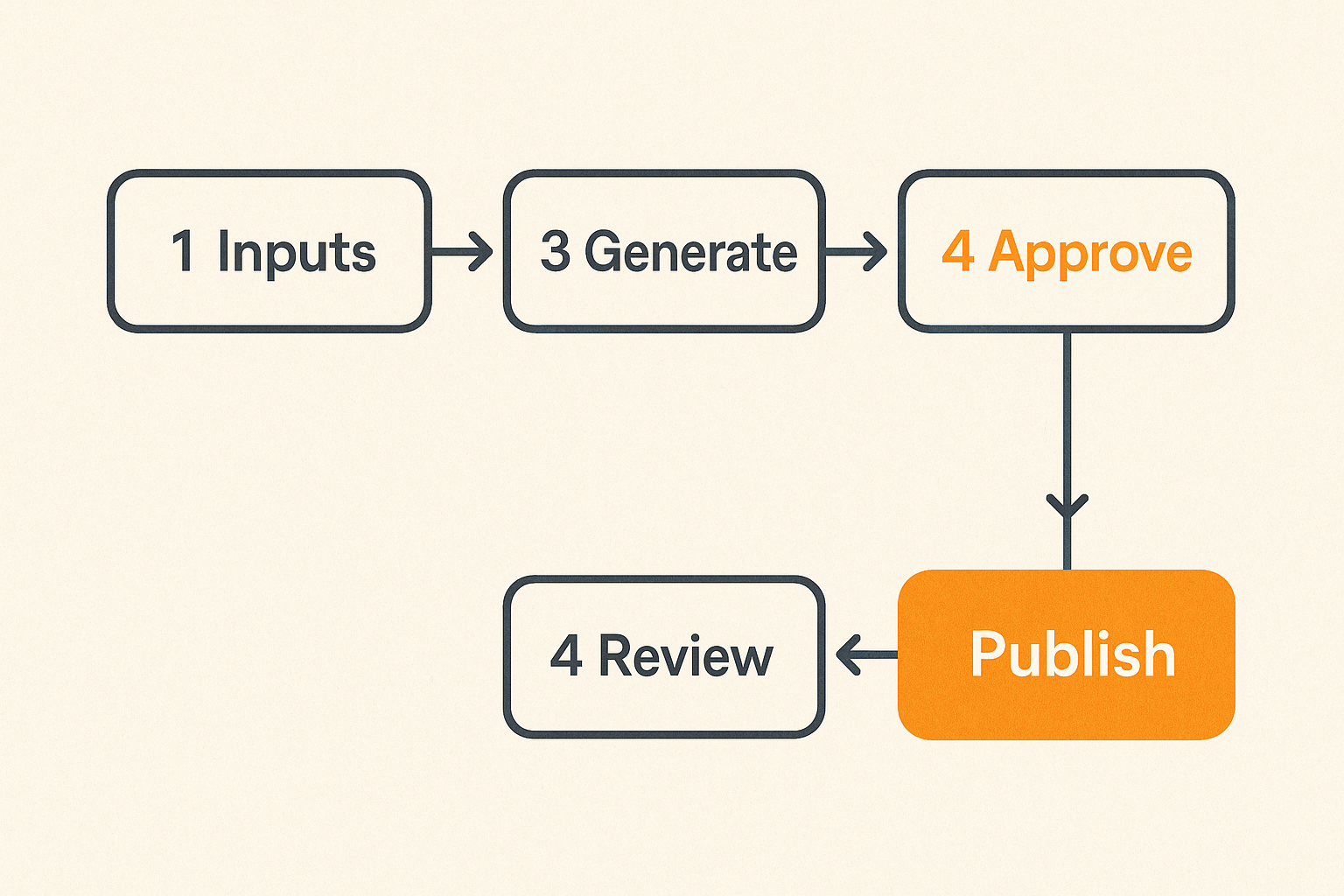
A reliable workflow has three parts: inputs, generation, and review. Most teams over-invest in generation and under-invest in the other two.
Inputs define the ceiling
AI writing quality is capped by the quality of the brief. If the brief says write a blog post about productivity, the system has to guess audience, angle, expertise level, examples, objections, and conversion intent.
Good inputs make the work narrower and more useful:
- Audience: content marketers, newsletter operators, publishers, creators
- Intent: compare tools, design workflow, reduce review chaos
- Angle: AI writing tools are an operations problem, not just a writing problem
- Required sections: workflow, governance, failure modes, metrics
- Exclusions: no fake statistics, no unsupported claims, no generic hype
- Sources: internal product notes, interviews, docs, prior articles
- CTA: soft product fit near the end
Related reading from our network: teams making role and workflow decisions face a similar design problem in SaaS hiring, where the work must be defined before adding headcount: Software Engineer Jobs in 2026.
Generation is only one state
Generation should not be a black box. It should be a state in a larger content pipeline.
For example:
| State | Owner | Output | Risk if skipped |
|---|---|---|---|
| Idea accepted | Content lead | Approved topic and intent | Random content calendar |
| Brief ready | Strategist or editor | Structured input | Generic drafts |
| AI draft created | Writer or system | First draft | No review context |
| Editorial review | Editor | Revised article | Weak voice and structure |
| Fact review | Specialist | Validated claims | Trust damage |
| Approval | Publisher | Publishable asset | Confusion over final version |
| Distribution | Marketer | Newsletter, social, syndication | Content sits idle |
| Measurement | Operator | Performance notes | No learning loop |
The AI tool matters, but the state machine matters more.
Review turns text into publishable work
Review is where AI output becomes editorial work. The reviewer should not be asked to fix everything at once. That is how queues get slow and inconsistent.
Split review into lanes:
- Structural review: Does the piece make the right argument?
- Editorial review: Does it sound like us?
- Accuracy review: Are claims supportable?
- SEO review: Does it match search intent without stuffing?
- Conversion review: Is the CTA useful and properly placed?
When teams separate these lanes, review becomes faster because each pass has a purpose.
Compare categories of AI writing assistance tools
Not all AI writing assistance tools solve the same problem. Some help an individual write faster. Others help a team publish more reliably. Confusing those categories causes bad buying decisions.
Assistant first tools
Assistant first tools are good at helping one person draft, rewrite, summarize, brainstorm, or edit. They usually live in a document editor, browser extension, chat interface, or writing canvas.
They are useful when:
- A creator owns the entire publishing process
- The team publishes low-risk content
- Review is informal
- The main bottleneck is blank-page drafting
- Content volume is moderate
What fails is assuming an assistant first tool will manage the operation. It usually will not handle assignment, review states, approvals, source tracking, publishing destinations, or team-level measurement without additional systems.
Workflow first platforms
Workflow first platforms treat AI writing as one part of a publishing pipeline. They care about briefs, queues, reviewers, personas, approvals, distribution, and automation.
They are useful when:
- Multiple people touch each piece
- The brand publishes across blogs, newsletters, podcasts, or social channels
- Editorial control matters
- There are recurring formats or series
- The team wants repeatability more than one-off drafting speed
This category is where many content teams end up after the first AI experiment. The first phase proves AI can help. The second phase asks how to make it safe and repeatable.
When a general chatbot is enough
A general chatbot is enough when the task is temporary, low-risk, and owned by one person. Examples include outlining an internal memo, rewriting a paragraph, brainstorming subject lines, or summarizing notes.
The practical question is whether the work needs governance. If it does, a chat window becomes insufficient quickly.
| Need | General chatbot | Assistant first tool | Workflow first platform |
|---|---|---|---|
| Brainstorming | Strong | Strong | Good |
| Long draft support | Good | Strong | Strong |
| Team review queues | Weak | Limited | Strong |
| Approval tracking | Weak | Limited | Strong |
| Multi-channel publishing | Weak | Limited | Strong |
| Governance | Manual | Partial | Strong |
| Performance feedback | Manual | Partial | Strong |
Practical rule: Buy for the bottleneck you actually have. If your bottleneck is approval and distribution, a better drafting box will not fix it.
Build the editorial control layer
The editorial control layer is the difference between AI-assisted publishing and AI-generated clutter. It defines who can change what, who approves what, and what quality means before a draft goes live.
Review lanes
Review lanes prevent every reviewer from trying to solve every problem. A strategist should not have to proofread commas while checking positioning. A legal reviewer should not be rewriting introductions. A publisher should not be hunting for source gaps minutes before scheduling.
A practical review lane setup:
- Editor lane: structure, clarity, voice, flow
- Expert lane: domain accuracy and missing nuance
- SEO lane: search intent, internal links, headings, metadata
- Brand lane: claims, tone, examples, CTA fit
- Final publisher lane: formatting, scheduling, distribution readiness
For a deeper breakdown of review routing and human oversight, the adjacent guide on human-in-the-loop AI publishing workflow architecture covers the operating model behind controlled AI publishing.
Quality gates
A quality gate is a decision point. It should be binary enough to operate: pass, revise, reject, or escalate.
Useful gates include:
- Brief accepted: topic, audience, angle, and CTA are clear
- Draft complete: required sections are present
- Source check passed: unsupported claims are removed or validated
- Editorial pass complete: voice and structure are acceptable
- SEO pass complete: title, slug, metadata, and search intent are aligned
- Approval complete: named owner approves publishing
- Distribution ready: newsletter, social, and repurposing notes are prepared
What breaks in practice is vague review. Comments like make this better or sounds off do not create a repeatable system. They create reviewer fatigue.
Approval rights
Approval rights should be explicit. If everyone can approve, nobody owns risk. If only one person can approve everything, throughput collapses.
Define approval by content type:
- Low-risk educational post: editor approves
- Product claim article: product marketing approves
- Legal or compliance-sensitive post: specialist approves
- Founder POV: founder or delegated editor approves
- Partner content: relationship owner approves
Practical rule: Approval should match risk, not hierarchy. High-risk claims need expert review. Routine content needs fast editorial control.
Make prompts and briefs operational
Prompts are not magic. They are reusable instructions wrapped around a clear business goal. Briefs are the source of truth. When teams confuse the two, prompts become long, fragile, and hard to maintain.
Brief templates
A brief template should make the desired article hard to misunderstand. It should reduce interpretation, not add ceremony.
A workable template:
topic: ai writing assistance tools
audience: content marketers, publishers, creators, newsletter operators
intent: help teams choose and implement tools as a workflow system
angle: drafting speed is not the bottleneck, editorial control is
format: long-form operator guide
must_include:
  - review lanes
  - quality gates
  - approvals
  - failure modes
  - metrics
  - soft product fit
avoid:
  - fake statistics
  - generic hype
  - unsupported tool comparisons
cta: Try bl0ggers.com
The template keeps the writer, AI system, reviewer, and publisher aligned.
Prompt libraries
Prompt libraries should be versioned and tied to content types. A newsletter prompt, SEO article prompt, podcast summary prompt, and product update prompt should not be the same thing.
Keep prompts modular:
- Research prompt: extract angles, questions, objections
- Outline prompt: organize the argument
- Draft prompt: write from the approved brief
- Revision prompt: improve clarity without changing claims
- SEO prompt: check intent, headings, metadata, internal links
- Repurposing prompt: create newsletter and social variants
Related reading from our network: AI agent builders face a similar problem when local tools, prompts, credentials, and events need predictable handoffs; the workflow framing in Mac Tools for AI Agent Builders is useful context for teams automating content operations.
Source discipline
Source discipline is where many AI writing workflows become risky. The model can produce fluent text that feels researched even when the support is thin.
Set rules:
- Claims must be tied to provided sources or marked as opinion
- No invented statistics
- No fabricated customer examples
- No unsupported legal, medical, financial, or security claims
- No competitor claims unless reviewed
- Dates and product details must be checked before publishing
This is not about mistrusting AI. It is about making trust operational.
Implementation workflow from idea to publish
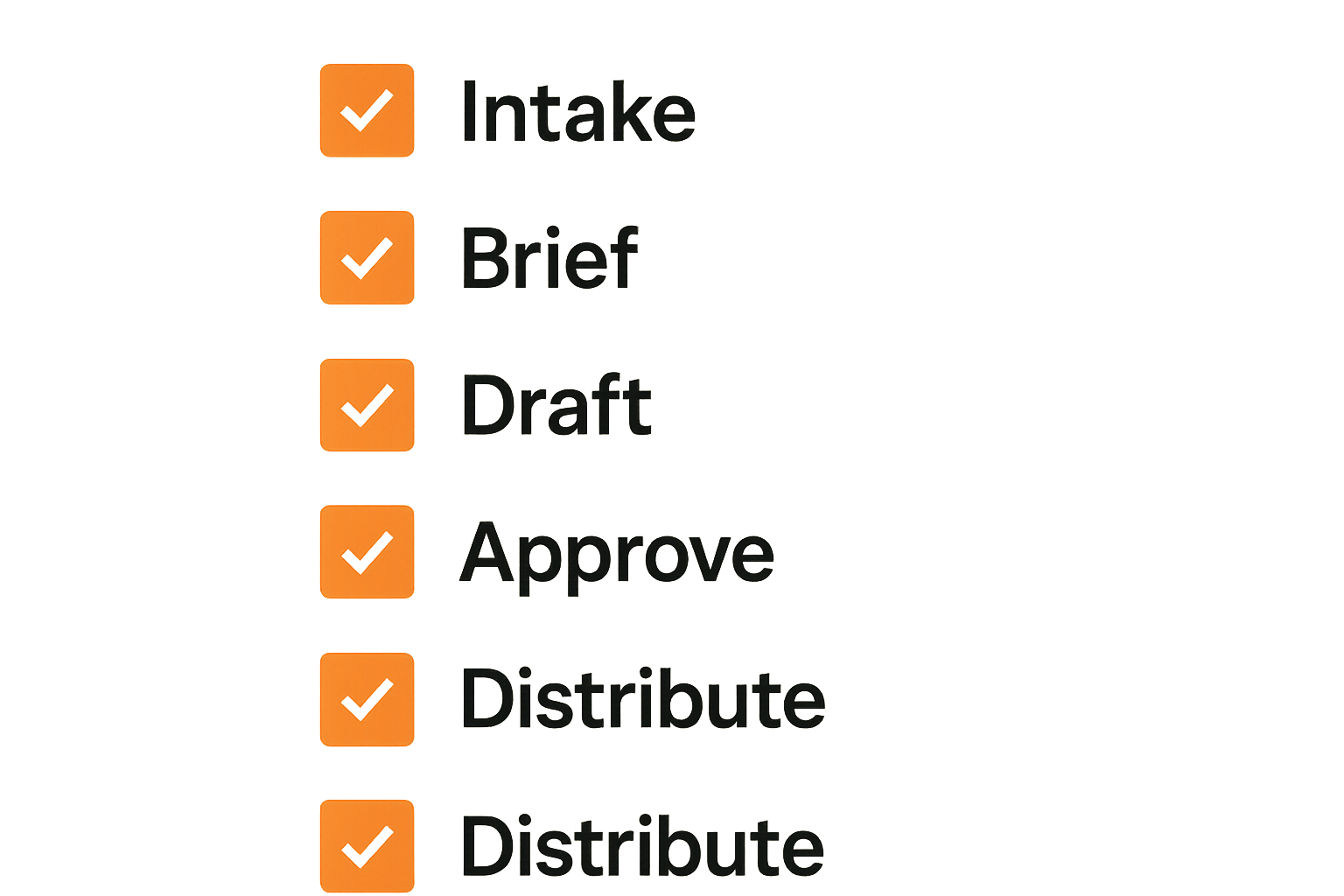
The implementation should be boring. If it feels like a creative experiment every time, it will not scale.
Intake and prioritization
Start with intake. Every content request should enter the same queue, even if it comes from a founder, sales call, keyword list, customer question, or newsletter idea.
A simple intake form should capture:
- Topic
- Audience
- Business reason
- Search or distribution intent
- Desired format
- Source material
- Deadline
- Owner
- Risk level
Then prioritize. Not every idea deserves AI generation. Some ideas need research first. Some need a subject-matter interview. Some should be rejected because they duplicate existing content.
Drafting and revision
A practical sequence:
- Accept the topic into the calendar.
- Create a structured brief.
- Attach source material and internal context.
- Generate an outline.
- Review the outline before drafting.
- Generate the draft from the approved outline.
- Run editorial review.
- Run fact or expert review where needed.
- Revise with tracked changes or clear versioning.
- Approve for publishing.
- Publish, distribute, and measure.
This sequence prevents the common failure where teams generate a full article from a weak idea and then ask editors to rescue it.
For teams formalizing this path, the earlier guide to an AI generated content publishing workflow goes deeper on queues, automation, QA, and governance.
Publishing and distribution
The UI is not the whole system. The published asset has to move into the CMS, newsletter platform, social scheduler, podcast notes, or partner channels. If that handoff is manual and inconsistent, the content operation still depends on heroics.
Define distribution at the brief stage:
- Blog post only
- Blog plus newsletter
- Blog plus LinkedIn thread
- Blog plus podcast outline
- Newsletter-first edition
- Repurposed evergreen guide
Related reading from our network: remote teams run into the same ownership and collaboration issues when tool stacks are not designed around handoffs, which is why Cloud Based Productivity and Collaboration Tools is an adjacent workflow reference.
What breaks when teams implement badly
Bad AI writing implementation does not usually fail loudly. It fails through slow erosion: weaker voice, reviewer fatigue, duplicated topics, factual cleanup, and a content library that feels bigger but less useful.
Generic brand voice
Generic voice happens when every article is generated from the same vague instruction: write in a professional tone. That produces content that sounds acceptable and forgettable.
Brand voice needs operational examples:
- Approved introductions
- Banned phrases
- Preferred sentence length
- Point-of-view rules
- Example claims and how they are supported
- Product language that must stay consistent
- Strong opinions the brand actually holds
The goal is not to make every piece sound identical. The goal is to make every piece sound owned.
Hidden factual risk
Hidden factual risk is worse than obvious error. An obvious error gets caught. A plausible unsupported claim may survive review because it sounds right.
This is common in tool comparisons, trend articles, medical or financial topics, legal-adjacent content, technical tutorials, and product claim pages.
What fails:
- Asking AI to cite sources it was not given
- Letting reviewers assume claims are checked
- Publishing dated product details without verification
- Reusing old briefs after market conditions change
- Treating summaries as evidence
The fix is not more paranoia. The fix is a clear source check gate.
Approval bottlenecks
Many teams create a single approval bottleneck because they are nervous about AI output. Every article goes to one senior person. That person becomes the queue.
A better model is risk-based routing. Low-risk content moves quickly. High-risk content gets expert review. Strategic POV gets leadership review. This protects quality without freezing production.
Practical rule: If every AI-assisted article needs executive approval, the workflow is not designed yet. It is just centralized anxiety.
What works in production
In production, the best AI writing systems are not the most dramatic. They are the ones that make the next step obvious.
Human judgment in the right places
Humans should spend less time producing first-pass text and more time making judgment calls:
- Is this topic worth publishing?
- Is the angle differentiated?
- Is the claim true?
- Is the example useful?
- Is the CTA appropriate?
- Is the piece saying something the audience will trust?
AI is strong at expansion, variation, summarization, and structured drafting. Humans are still better at taste, accountability, positioning, and risk decisions.
Repeatable states
Repeatable states reduce confusion. Everyone should know whether a piece is in brief, draft, review, revision, approved, scheduled, published, or measured.
A small team can track this in a spreadsheet or project board. A larger team needs workflow software. The point is not the tool. The point is shared state.
Useful states:
- Backlog
- Briefing
- Outline review
- Drafting
- Editorial review
- Expert review
- Revision
- Approved
- Scheduled
- Published
- Measured
Feedback loops
Feedback loops make the system smarter. Without them, each article starts from scratch.
Capture:
- Which prompts produced heavy edits
- Which brief fields were missing
- Which reviewers created recurring comments
- Which topics performed
- Which formats drove newsletter signups or conversions
- Which articles needed factual correction
Then update templates, prompts, review rules, and topic selection. That is how AI assistance becomes operational leverage rather than a novelty.
Metrics that prove assistance is helping
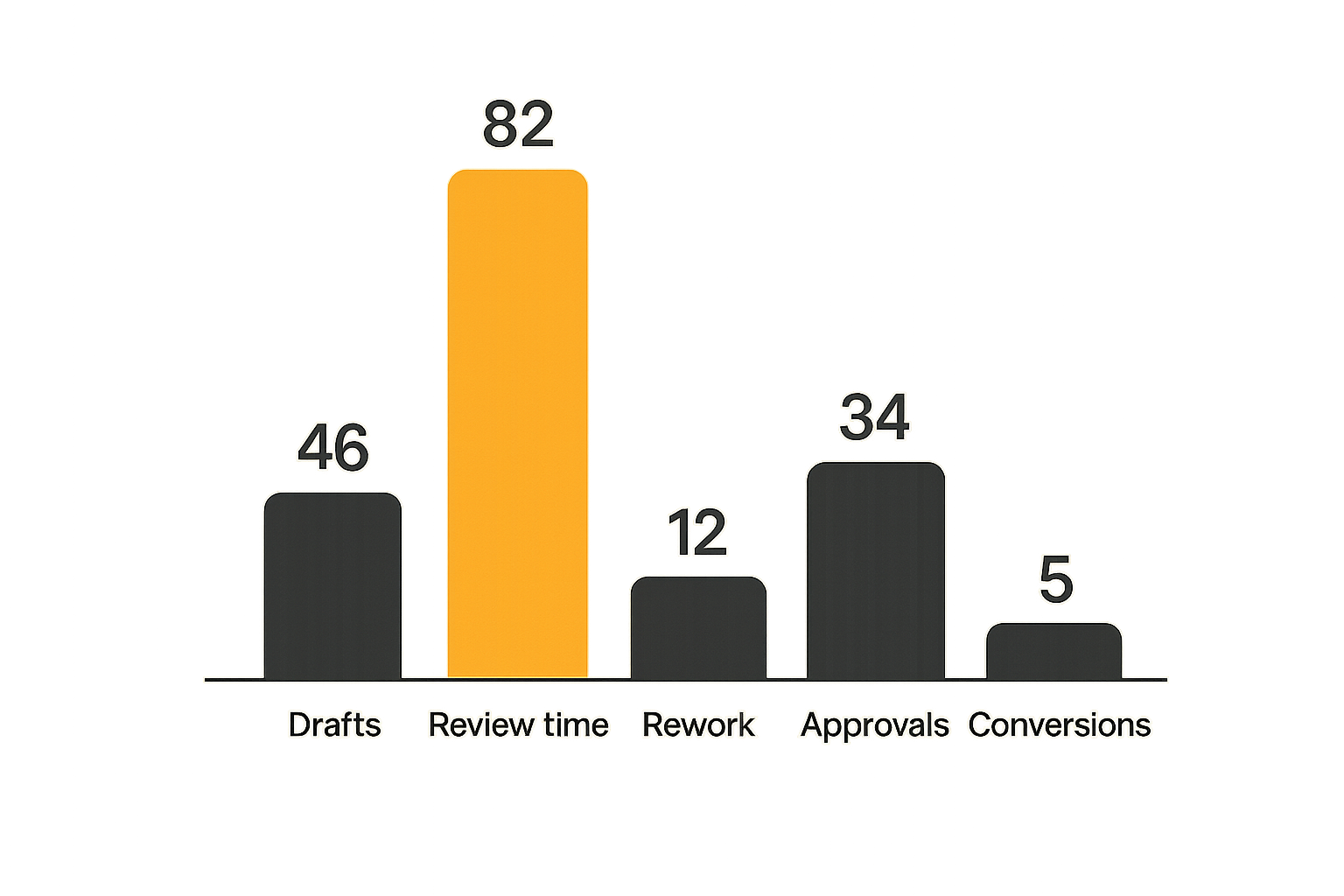
If you do not measure the workflow, the loudest signal will be volume. Volume is useful, but only when it is paired with quality, cycle time, and business outcome.
Throughput metrics
Throughput metrics show whether the system is moving.
Track:
- Ideas accepted per week
- Briefs completed per week
- Drafts created per week
- Articles approved per week
- Average time from idea to publish
- Average time in review
- Rework cycles per article
The most useful metric is often time in review. If AI increases drafts but review time doubles, the system is not healthier.
Quality metrics
Quality is harder to measure, but not impossible.
Track operational proxies:
- Percent of drafts approved with minor edits
- Number of factual corrections after review
- Number of unsupported claims removed
- Editor time per article
- Readability and structure checks
- Internal stakeholder satisfaction
- Subscriber complaints or replies
Do not pretend these are perfect. They are directional. Directional is enough if the team uses the signal.
Business metrics
Business metrics connect publishing to outcomes.
Depending on your model, track:
- Organic sessions
- Newsletter signups
- Trial starts
- Demo requests
- Affiliate clicks
- Reader replies
- Returning visitors
- Content-assisted pipeline
- Paid subscriber conversions
The mistake teams make is expecting every AI-assisted article to become a winner. Publishing still has portfolio dynamics. The goal is to increase the number of useful attempts without lowering the quality bar.
Security privacy and governance
AI writing assistance tools often touch sensitive material: customer interviews, product roadmaps, unpublished announcements, internal strategy, transcripts, and draft positioning. That makes governance a real operating concern.
Data boundaries
Define what can and cannot be placed into AI tools.
Common restrictions:
- No private customer data without approval
- No confidential financials
- No unreleased product details unless the tool is approved for that use
- No employee personal data
- No legal documents without counsel-approved process
- No customer names unless they are public references
This should be written down. Verbal policy does not survive a busy publishing week.
Access and audit trails
Access should follow role and need. A freelancer may need draft access but not strategy documents. A reviewer may need commenting rights but not publishing rights. A publisher may need CMS access but not prompt library admin rights.
Audit trails matter because content moves through many hands. You should know who changed the brief, who approved the draft, and who published it.
A lightweight governance model:
| Control | Small team version | Larger team version |
|---|---|---|
| Access | Shared workspace with roles | SSO and role-based permissions |
| Approval | Named editor approval | Workflow approvals by content type |
| Source tracking | Links in brief | Required source fields |
| Versioning | Document history | Versioned content states |
| Publishing | One publisher | CMS role separation |
| Audit | Manual notes | Activity logs and exports |
Vendor risk
Vendor risk is not only about data. It is also about operational dependency.
Ask:
- Can you export drafts and metadata?
- Can you keep your prompt and brief templates?
- Does the tool support human review before publishing?
- What happens if generation quality changes?
- Can you integrate with your CMS or newsletter system?
- Are permissions granular enough?
- Does the tool fit your support process?
A shiny editor is not enough. The tool has to survive production.
Product fit for bl0ggers.com
bl0ggers.com is built around a simple assumption: AI publishing works best when automation and human review are part of the same workflow.
Where bl0ggers.com fits
The fit is strongest for content teams, creators, publishers, and newsletter operators who want more output but do not want to give up editorial control.
That usually means:
- You publish recurring content
- You care about review queues
- You want generated research to become blogs, newsletters, or podcast assets
- You need persona-led content journeys
- You want optional human review before publishing
- You care about subdomain or media network publishing
- You want webhook-based automation instead of manual copy-paste
In that architecture, AI writing assistance tools are not isolated drafting apps. They become part of a publishing system with states, owners, review lanes, and distribution.
When it is not the right fit
It is probably not the right fit if you only need occasional brainstorming, one-off rewrites, or a personal writing assistant. A general chatbot or lightweight writing tool may be enough.
It is also not the right fit if nobody owns editorial review. No platform can compensate for a team that refuses to define quality, approval, or accountability.
The practical question is whether you are building a content operation. If yes, the workflow matters as much as the writing model.
Try bl0ggers.com
bl0ggers.com is for content teams, creators, and publishers who want to use AI to increase output without giving up editorial control. If you are designing AI writing assistance tools into a real publishing workflow, Try bl0ggers.com.