
Publishing automation software sounds like a simple fix when the content calendar is late, the newsletter needs another issue, and the team is tired of copying drafts between tools. Buy the platform, connect the CMS, let AI help, ship more. That is the pitch.
In production, the pain is different. The draft is not the bottleneck for long. The bottleneck becomes review, approval, routing, distribution, and knowing which automated output is safe to publish without creating cleanup work for editors.
Teams think the problem is content generation. The real problem is content operations. Publishing automation software only works when it becomes part of the editorial architecture, not when it sits beside the workflow as another disconnected AI toy.
That changes the conversation. The practical question is not which tool can generate the most words. It is which system can move ideas from brief to approved asset to published page to measured outcome without losing ownership, context, or trust.
Table of contents
- Why publishing automation software is really workflow architecture
- What publishing automation software must coordinate
- The operating model: states, queues, and quality gates
- Human review lanes that keep AI useful
- Implementation workflow for 2026 content teams
- Integration points that matter more than features
- What breaks when teams implement publishing automation software badly
- Measurement: prove automation is helping
- What works and what fails
- How bl0ggers.com fits into the architecture
Why publishing automation software is really workflow architecture
The UI is the smallest part
Most publishing automation software is evaluated through the front door: the editor, the prompt box, the calendar view, the publish button. Those matter, but they are not where the system wins or fails.
What breaks in practice is the handoff. A draft exists, but no one knows whether it has been checked. The content lead comments in a doc, the SEO manager edits the title in the CMS, the founder approves in Slack, and the newsletter operator still sends the wrong version because the source of truth was never clear.
A useful way to think about it is this: the interface creates assets, but the workflow creates trust. If the workflow cannot prove status, ownership, version, risk level, and destination, the team will keep asking the same questions manually.
Practical rule: Do not buy publishing automation software because it can produce drafts. Buy it only if it can reduce uncertainty between draft, approval, publish, and measurement.
The asset is not an article, it is a state machine
An article is not just text. It moves through states: idea, briefed, generated, edited, fact checked, SEO reviewed, approved, scheduled, published, repurposed, measured, refreshed.
Those states are where content operations live. They decide who sees the work, what automation is allowed to do next, and when distribution can safely happen. Without explicit states, every piece becomes a one-off project.
This matters more as AI publishing becomes normal. When the cost of creating a first draft drops, the number of drafts increases. If the state model is weak, the team drowns in partially reviewed assets.
Automation changes ownership, not just speed
The mistake teams make is assuming automation removes ownership. It does not. It moves ownership to a different layer.
Instead of asking an editor to write every paragraph, you ask the editor to define the quality gate. Instead of asking a marketer to manually format every newsletter, you ask the marketer to approve the distribution rules. Instead of asking a publisher to copy content into multiple channels, you ask the publisher to govern where each version is allowed to go.
That is a healthier operating model, but only if the software supports it. Otherwise automation becomes a shadow process that editors do not trust and operators cannot debug.
What publishing automation software must coordinate
Inputs, briefs, and persona context
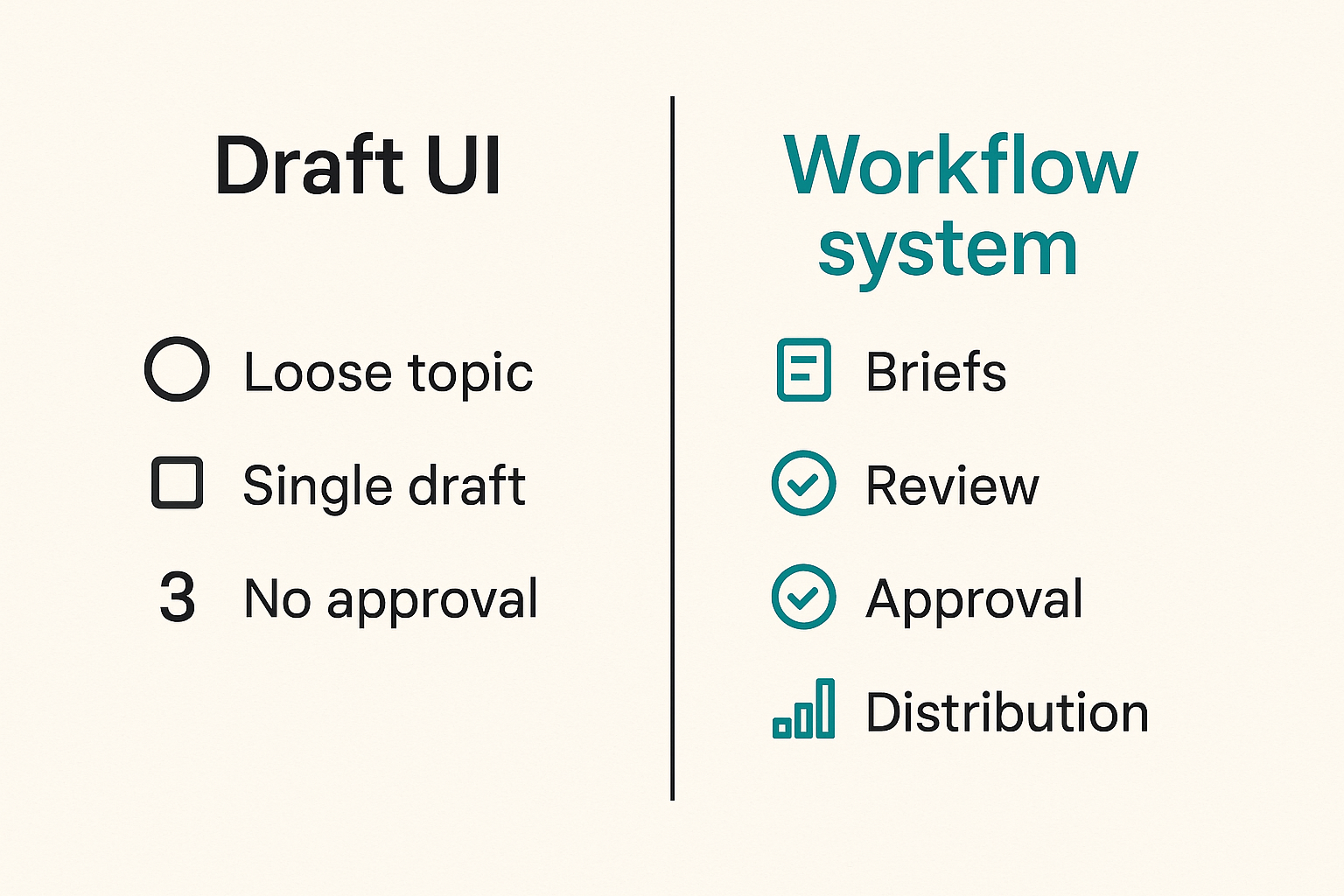
Good automation starts before generation. If the system only receives a loose topic, it will create generic output. If it receives audience, intent, offer, angle, editorial constraints, internal links, exclusion rules, and distribution targets, it has a chance to produce something usable.
For content marketers, the brief is the control plane. For publishers, it is the editorial assignment. For creators and newsletter operators, it is the difference between sounding like yourself and sounding like every AI summary on the internet.
A practical brief object should include:
- Target reader and job to be done
- Primary topic and secondary angles
- Editorial voice and prohibited claims
- Required links, offers, or references
- Review lane and approver
- Publish destinations and formats
- Measurement goal after publish
The brief does not need to be complicated. It needs to be structured enough that the rest of the workflow can route the work correctly.
Drafting, enrichment, and source handling
AI drafting is useful when it is constrained. It becomes risky when the system treats every paragraph as equally reliable.
Publishing automation software should separate raw generation from enrichment. A draft may be generated from a prompt, but the workflow may also need to attach source notes, product facts, transcript excerpts, interview highlights, customer language, or previous article context.
The practical question is not whether AI can write. It is whether the system can show what the draft was based on and what still needs review. Many teams skip this step and then ask editors to reverse engineer the source trail.
Review, approvals, and exceptions
Review is not a single action. It is a set of lanes. A low-risk roundup post may need light editorial review. A product comparison may need SEO and legal review. A founder-led opinion piece may need final approval from one person but not from a committee.
The workflow should support exceptions without becoming chaotic. If a content asset fails a quality gate, it should move backward with a reason. If it is blocked by missing data, it should not sit in an editor inbox as if it is ready.
This is where human-in-the-loop systems matter. We covered the review-routing model in more depth in human-in-the-loop AI publishing workflow architecture, but the short version is simple: humans should review the risky decisions, not babysit every mechanical step.
Distribution, repurposing, and measurement
Publishing does not end at the CMS. A single approved asset may become a blog post, newsletter section, LinkedIn post, podcast outline, short-form clip script, or sales enablement snippet.
The mistake teams make is automating generation but leaving distribution manual. That creates a new bottleneck downstream. The content is approved, but someone still has to remember which audience gets which version.
Distribution rules should be part of the asset state. A post that is approved for the blog is not automatically approved for the newsletter. A newsletter intro is not automatically approved as a social post. Each channel has different context, risk, and audience expectation.
The operating model: states, queues, and quality gates
Define states before tools
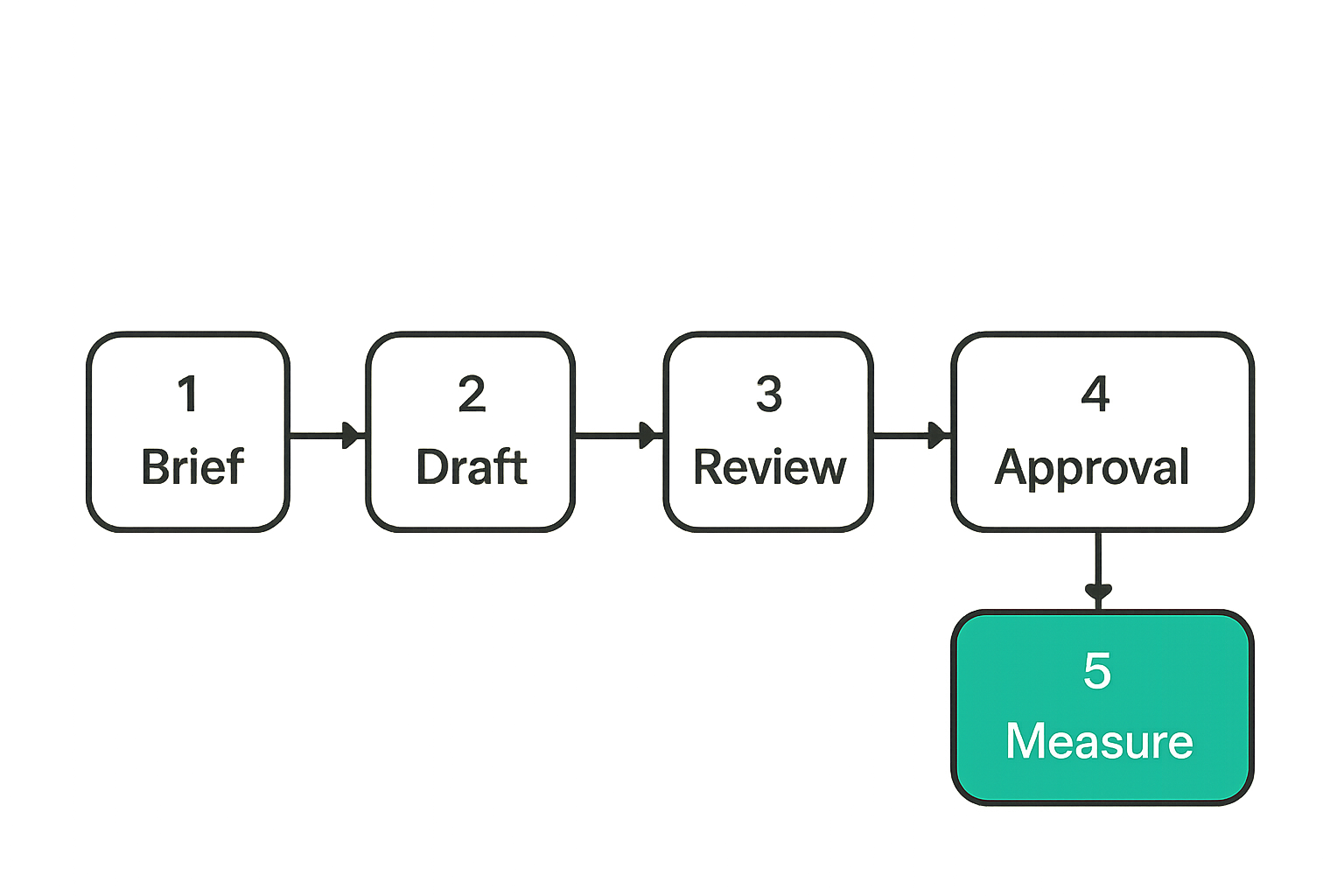
Before choosing publishing automation software, draw the current path from idea to outcome. Do not start with vendor features. Start with the messy reality.
A basic state model might look like this:
- Idea captured
- Brief assigned
- Draft generated
- Editorial review requested
- Revision needed or approved
- SEO and metadata checked
- Final approval complete
- Scheduled or published
- Distributed to selected channels
- Performance reviewed
This sequence is not universal. A solo creator may compress several states. A publisher with multiple brands may add compliance review, sponsor approval, or translation. The point is to make the states visible.
Practical rule: If a content item can be in a state, name the state. If no one owns the transition out of that state, the workflow is not ready for automation.
Build queues around risk
Not every article deserves the same review cost. Publishing automation software should help route work by risk, not by who happens to be online.
Risk can come from several places:
- Claims about pricing, legality, health, finance, or security
- Product positioning that affects sales or customer support
- Brand voice sensitivity
- Sponsored or partner content
- New authors, new personas, or new markets
- High-traffic pages that are difficult to correct quietly
Low-risk pieces can move through faster lanes. High-risk assets need named approvers and stronger audit trails. This is not bureaucracy. It is how automation stays safe enough to scale.
Make quality gates explicit
A quality gate is a rule that must pass before the asset moves forward. Examples include internal link present, title under a character limit, no unsupported claims, target reader named, CTA approved, metadata present, and distribution channels selected.
Some gates can be automated. Some require humans. The important part is that they are visible and consistent.
A simple quality gate config might look like this:
- gate: brief_complete owner: content_ops blocks: draft_generation
- gate: source_notes_present owner: editor blocks: approval
- gate: final_cta_approved owner: marketing_lead blocks: publish
- gate: channel_variants_ready owner: distribution blocks: newsletter_send
You do not need a complex rules engine on day one. You need agreement on what cannot be skipped.
Human review lanes that keep AI useful
Low risk content should not wait for senior editors
If every AI-assisted draft goes to the most senior editor, automation will fail politically and operationally. The senior editor becomes the bottleneck, and the team concludes that AI did not help.
Low-risk content should have a lighter lane. Examples include glossary updates, event summaries, podcast show notes, newsletter link blurbs, basic evergreen refreshes, and internal campaign recaps. These still need standards, but they usually do not need executive review.
The goal is not to remove judgment. The goal is to apply judgment where it matters.
High risk content needs named approvers
High-risk content cannot be handled by vague review ownership. Someone must be responsible for the decision to publish.
For a content marketing team, that might be the product marketer for positioning claims, the SEO lead for search intent, and the editorial lead for voice. For a publisher, it might be a section editor, sponsor manager, and managing editor. For a creator, it might simply be the creator as final approver.
Related reading from our network: teams choosing operational tools face similar ownership problems, and this workflow-first view of remote access software is a useful adjacent example of evaluating systems by security, support, and responsibility instead of surface features.
Feedback must update the system
The most expensive editorial feedback is feedback that disappears after one draft. If an editor repeatedly fixes the same tone issue, the brief template should change. If a reviewer keeps flagging unsupported claims, the source requirement should become a quality gate. If newsletter intros always need shortening, the distribution template should learn that constraint.
The mistake teams make is treating review as cleanup. Review should also be training data for the workflow, even when you are not fine-tuning a model. Templates, prompts, checklists, routing rules, and examples all improve when feedback is captured structurally.
Practical rule: Every recurring edit should become a rule, template change, or review gate. Otherwise automation just creates recurring cleanup.
Implementation workflow for 2026 content teams
Step 1 map the current publishing path
Start with a real asset, not an ideal diagram. Pick a recent article or newsletter issue and trace what actually happened.
Document:
- Who requested it
- Where the brief lived
- Who drafted it
- Which tools touched it
- Who reviewed it
- What caused delays
- Where the final version lived
- How it was distributed
- How performance was checked
The output should be uncomfortably specific. If approvals happened in Slack, write that down. If the final draft was copied from a doc into the CMS by memory, write that down. This is not blame. It is input for automation design.
Step 2 choose automation boundaries
Automation boundaries decide what the system can do without human approval. This is where teams should be conservative at first.
Good first boundaries include:
- Generate first drafts from approved briefs
- Create metadata suggestions
- Produce newsletter variants after article approval
- Prepare CMS drafts without publishing
- Notify reviewers when their queue changes
- Generate performance summaries after publish
Riskier boundaries include auto-publishing without review, rewriting product claims, creating source citations without verification, or distributing to high-trust channels without approval.
Related reading from our network: operators selling content-adjacent products run into the same boundary problem between checkout, delivery, support, and measurement; this guide to selling digital products frames it as a system, not a button.
Step 3 connect approvals and distribution
Approval should unlock distribution. It should not be a comment that someone interprets manually.
A practical implementation sequence:
- Create structured briefs with required fields.
- Generate drafts only from approved briefs.
- Route drafts into review lanes based on risk.
- Block publishing until required gates pass.
- Push approved assets to the CMS as drafts or scheduled posts.
- Generate channel variants only after article approval.
- Send notifications when distribution assets are ready.
- Capture publish URLs and performance data back into the content record.
This is the point where publishing automation software becomes operational infrastructure. The system is no longer only producing text. It is coordinating the work around the text.
Step 4 measure cycle time and rework
Do not measure success only by number of articles published. That will encourage the wrong behavior.
Measure cycle time from idea to publish, time spent in review, number of revision loops, percentage of assets blocked by missing brief data, and how often channel variants require manual rewriting. These numbers reveal whether automation is reducing friction or moving it somewhere else.
If you cannot measure rework, you cannot tell whether the software is helping editors or simply creating more editorial debt.
Integration points that matter more than features
CMS publishing and canonical ownership
The CMS should remain the canonical publishing destination for most teams. Publishing automation software can generate, prepare, and push content, but the CMS controls URLs, categories, authors, canonical tags, redirects, and on-site structure.
The integration should answer practical questions:
- Does it create drafts or publish directly?
- Can it preserve authorship and taxonomy?
- Can it update metadata without overwriting manual edits?
- Does it capture the final publish URL?
- Can it handle failed publish attempts cleanly?
Direct auto-publish can work for low-risk media networks, but most teams should start with draft creation plus approval gates.
Newsletter and social distribution
Newsletter operators know the blog post is not the whole asset. The same idea needs a subject line, preview text, intro, sponsor placement, CTA, link tracking, and sometimes segmentation.
Social distribution has its own constraints. A thread, short post, or creator note should not read like a pasted blog summary. The distribution layer needs channel-native templates and approval states.
Related reading from our network: community operators deal with similar follow-up and trust problems, and this guide to community building software for local groups is a useful adjacent look at how queues, asks, offers, and follow-through break when they are not owned.
Webhooks, APIs, and failure recovery
The less glamorous integration details matter. Webhooks should tell the rest of the stack when a draft is ready, when approval is complete, when publishing fails, and when an asset goes live. APIs should allow content records to move without manual copying.
Failure recovery is the test most teams forget. What happens if the CMS rejects a post? What happens if a newsletter integration times out? What happens if a webhook fires twice? What happens if an editor approves the wrong version?
At minimum, the workflow needs idempotent actions, logs, retry behavior, and a visible error state. A failed publish should not look like an unpublished draft. A duplicate webhook should not create two newsletter campaigns.
What breaks when teams implement publishing automation software badly
Draft spam replaces editorial judgment
The most obvious failure mode is volume without value. The team produces more drafts, but the content calendar does not improve because the briefs are weak and the review system cannot keep up.
This is especially dangerous for SEO programs. More pages do not automatically mean better topical authority. Thin variations, repeated intros, unsupported claims, and vague summaries can dilute the site. Editors then spend their time deciding what to delete instead of improving what matters.
Review queues become invisible work
Automation often creates hidden labor. A tool says the draft is ready, but ready for whom? The editor checks facts. The marketer fixes positioning. The operator formats the newsletter. The founder rewrites the intro. None of this shows up as automation cost unless the workflow tracks it.
Invisible review work creates resentment. Writers think editors are slow. Editors think AI made their job worse. Leadership thinks the team is resisting change. In reality, the system pushed work into an unmanaged queue.
Distribution runs ahead of approval
Another failure mode is premature distribution. A blog draft gets approved for structure, then a social post goes out with a claim that was not final. A newsletter variant uses an old title. A podcast description references an offer that changed.
This happens when distribution tools listen to asset creation instead of asset approval. The event that should unlock distribution is not draft created. It is approved for that channel.
Metrics reward volume over usefulness
If leadership only tracks output, teams will optimize for output. That means more drafts, more posts, more newsletters, and more noise. It does not necessarily mean better audience trust, higher conversion, stronger retention, or more useful media assets.
Publishing automation software should make volume cheaper, but it should not make quality optional. The measurement layer needs to keep the team honest.
Measurement: prove automation is helping
Operational metrics for publishing teams
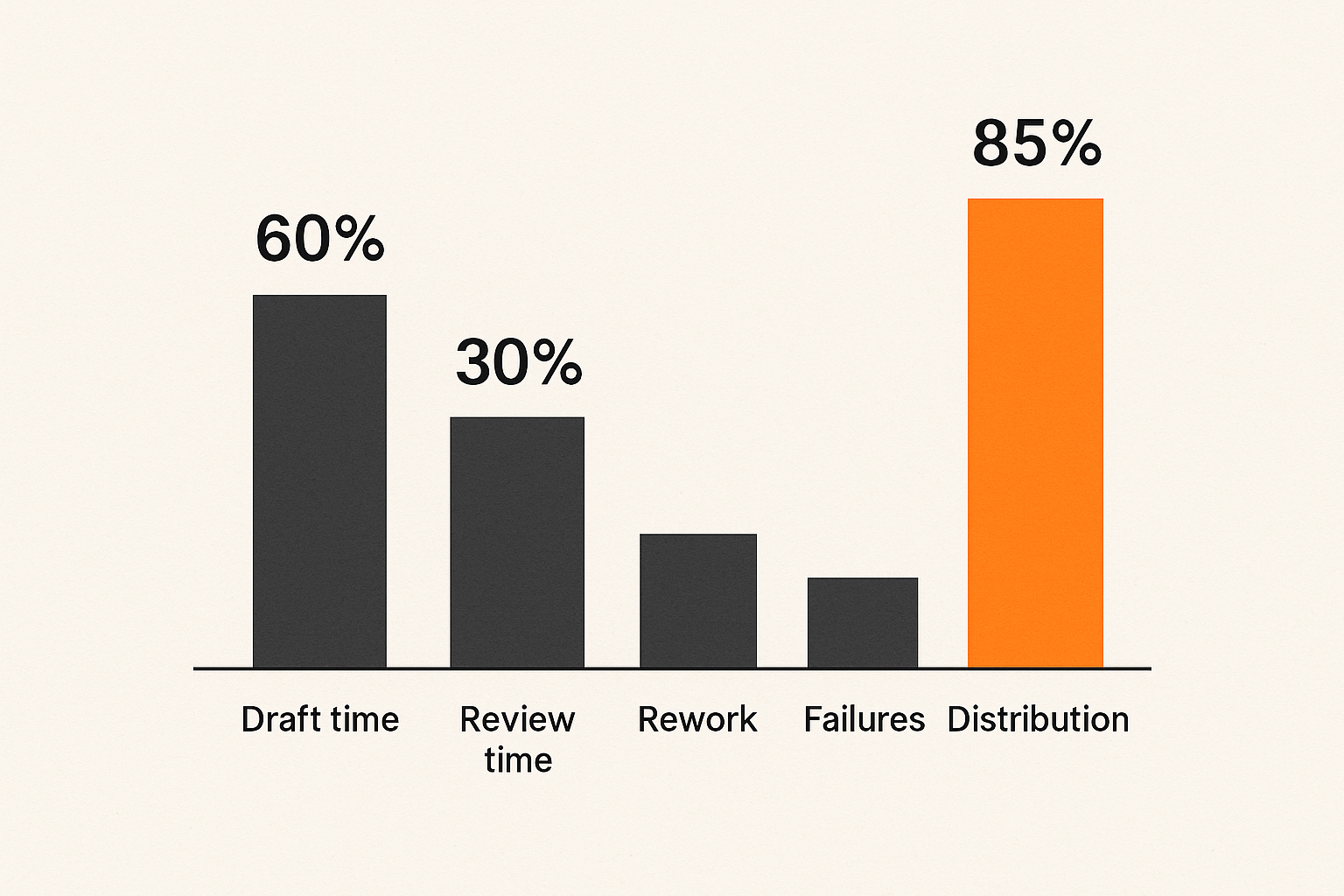
Operational metrics show whether the workflow is improving. They are not vanity metrics. They answer whether the system is removing drag.
Track:
- Brief completion rate
- Draft cycle time
- Time in review
- Revision loops per asset
- Blocked assets by reason
- Publish failures
- Distribution completion rate
- Percentage of assets refreshed after performance review
These metrics expose bottlenecks. If drafts are fast but review is slow, the answer is not more generation. If distribution completion is low, the answer is not another writing model. The answer is workflow repair.
Editorial metrics that prevent drift
Editorial metrics protect quality. They are harder to automate perfectly, but they can still be tracked.
Useful signals include editor rewrite severity, recurring style violations, unsupported claim flags, source gap frequency, title rewrite rate, duplicate angle detection, and percentage of assets needing tone correction.
A simple scoring model can help, as long as it does not pretend to be objective truth:
- 1 means publishable with minor edits
- 2 means useful but needs revision
- 3 means structurally wrong or off-brand
- 4 means unsafe, unsupported, or misleading
The score is not the point. The trend is the point. If scores worsen as volume increases, the automation boundary is too loose.
Business metrics that matter after publish
Eventually, publishing has to serve the business or the audience. The right metrics depend on the model.
Content marketers may care about qualified visits, assisted pipeline, demo intent, email signups, or sales enablement usage. Publishers may care about subscriber growth, retention, sponsorship performance, engagement depth, and repeat readership. Creators may care about audience replies, product sales, community growth, or paid subscription conversion.
The practical question is whether automation helps create more useful assets for the audience you actually serve. If the answer is no, the workflow is optimized for the wrong thing.
Practical rule: Separate operational speed, editorial quality, and business outcome metrics. If you collapse them into one output number, the system will game itself.
What works and what fails
What works in production
What works is boring in the best way. Structured briefs. Clear states. Risk-based review lanes. CMS drafts instead of blind publishing. Distribution rules tied to approval. Metrics that show rework. Templates that improve after repeated edits.
Teams that succeed usually start with one repeatable workflow. For example, weekly newsletter plus companion blog post, or podcast transcript to article to email, or SEO refreshes for an existing library. They prove the lane, then add more formats.
They also keep humans in the right places. Editors define standards, review risky decisions, and improve the system. Operators own routing, integrations, and measurement. Creators preserve voice and final judgment where it matters.
What fails in production
What fails is also predictable. Unstructured prompts. No brief owner. Auto-publishing too early. One review queue for every asset. No record of who approved what. Distribution triggered by draft creation. Metrics that celebrate volume while editors quietly clean up the mess.
Another common failure is over-customizing too soon. Teams try to automate every edge case before one core workflow is stable. The result is a fragile system that no one trusts.
Start narrow. Make the workflow observable. Then expand.
A simple comparison table
| Decision area | Weak implementation | Strong implementation |
|---|---|---|
| Briefing | Topic entered as a loose prompt | Structured brief with audience, angle, links, and risk |
| Drafting | AI generates without context | AI drafts from approved briefs and source notes |
| Review | Everyone reviews everything | Risk-based lanes with named approvers |
| Publishing | Tool publishes when draft exists | CMS draft or schedule after gates pass |
| Distribution | Same copy pushed everywhere | Channel variants created after approval |
| Measurement | Counts posts shipped | Tracks cycle time, rework, quality, and outcome |
| Feedback | Edits disappear in comments | Recurring edits become rules and templates |
The difference is not cosmetic. The strong implementation gives the team a system it can operate. The weak implementation creates more content objects than the team can responsibly manage.
How bl0ggers.com fits into the architecture
Where the platform belongs
bl0ggers.com belongs in the part of the stack where AI-generated research, editorial workflow, and publishing operations meet. It is not useful to treat it as a magic writer. The better use is as a workflow layer for teams that want more output while keeping review lanes, persona context, and approvals intact.
That matters for content teams, creators, and publishers who operate across blogs, newsletters, podcasts, and subdomain media properties. The content object needs to carry context from research through distribution. The review lane needs to be optional for low-risk items and strict for important ones.
If you want the broader platform framing, the bl0ggers.com human-in-the-loop AI publishing overview explains the product direction around persona-led blogs, podcasts, newsletters, and publishing networks.
When to use it
Use publishing automation software when the workflow is repeatable enough to benefit from structure. That might be a weekly founder newsletter, a content marketing program with SEO briefs, a creator turning research into multiple formats, or a publisher running several niche sites.
Do not use it to avoid editorial decisions. Use it to make those decisions easier to apply consistently.
A good product fit usually has these traits:
- The team already publishes regularly
- There is a known audience or persona
- Review matters, but not every task needs senior review
- Distribution happens across more than one channel
- The team wants AI leverage without giving up control
- Measurement and refreshes are part of the plan
Publishing automation software should make the operating model clearer. If it makes ownership blurrier, stop and fix the workflow before scaling.
Try bl0ggers.com
bl0ggers.com is for content teams, creators, and publishers who want to use AI to increase output without giving up editorial control. If you are building a human-in-the-loop publishing workflow, Try bl0ggers.com and design publishing automation software around review, approval, distribution, and measurement from the start.