
A managed ai content platform sounds like a procurement category until your content calendar starts breaking.
The drafts are not the hard part anymore. Many teams can generate ten article outlines before lunch. The pain starts after that: who checks the angle, who verifies the claims, who approves the brand voice, who pushes to CMS, who rewrites the intro when the AI says something bland, and who owns the piece after it goes live.
Teams think the problem is content generation. The real problem is publishing control.
That changes the conversation. A managed ai content platform is not just a better prompt box. It is an operating layer for briefs, AI-assisted drafts, review lanes, approvals, distribution, updates, and measurement. The practical question is whether your team has a repeatable system for moving AI-assisted content from idea to published asset without turning editors into janitors.
Table of contents
- Why a managed AI content platform is a workflow system
- Managed AI content platform vs generic AI writing tools
- The content operating model before prompts
- The operating workflow for a managed AI content platform
- Quality gates that keep AI publishing usable
- Human-in-the-loop review lanes
- Integrations APIs and distribution
- Metrics for managing output without rewarding junk
- What breaks when teams implement AI content badly
- Where bl0ggers.com fits in the publishing architecture
Why a managed AI content platform is a workflow system
A useful way to think about it is simple: AI creates drafts, but publishing creates liabilities. The article represents your brand, your editorial judgment, your SEO footprint, your customer education, and sometimes your legal exposure.
A managed AI content platform exists because the middle of the process is messy. It has to handle the work between idea and publication, not just produce text.
The wrong buying question
The mistake teams make is asking which AI writer produces the best first draft.
That matters, but only up to a point. A decent draft that enters a clean review workflow will usually beat a better draft that disappears into Slack, Google Docs, and someone’s memory.
The better buying question is: can this system move content through our actual publishing process without creating hidden work?
That includes:
- Brief intake and topic assignment
- Persona and audience mapping
- Source collection and context attachment
- Draft generation with controlled instructions
- Human review lanes
- Revision requests
- Approval tracking
- CMS or newsletter publishing
- Performance feedback
If the platform only helps with one of those steps, it may be useful. But it is not really managed.
The real decision
A managed AI content platform is an operating decision. It defines how your team treats AI-assisted publishing as a repeatable production system.
The real decision is about control points:
- Where does the topic come from?
- What context is allowed into the draft?
- Who can approve publication?
- What happens when the article is wrong, weak, duplicated, or off-brand?
- How does learning from published content improve future content?
Practical rule: do not buy AI content software until you can describe the approval path for a risky article.
If the approval path is vague, the platform will not fix it. It will amplify the ambiguity.
What changes in 2026
By 2026, the novelty of AI-generated content is mostly gone. The market has moved from can we generate to can we govern.
Content teams now face more channels, more formats, and more pressure to publish consistently. Search, newsletters, social clips, podcasts, and partner distribution all want different versions of the same underlying idea.
That is why a managed ai content platform needs to work more like content operations infrastructure than a writing assistant. Related reading from our network: Charles Babbage Analytical Engine as an architecture lesson for answer-ready content systems is a useful adjacent reminder that architecture beats isolated cleverness.
Managed AI content platform vs generic AI writing tools
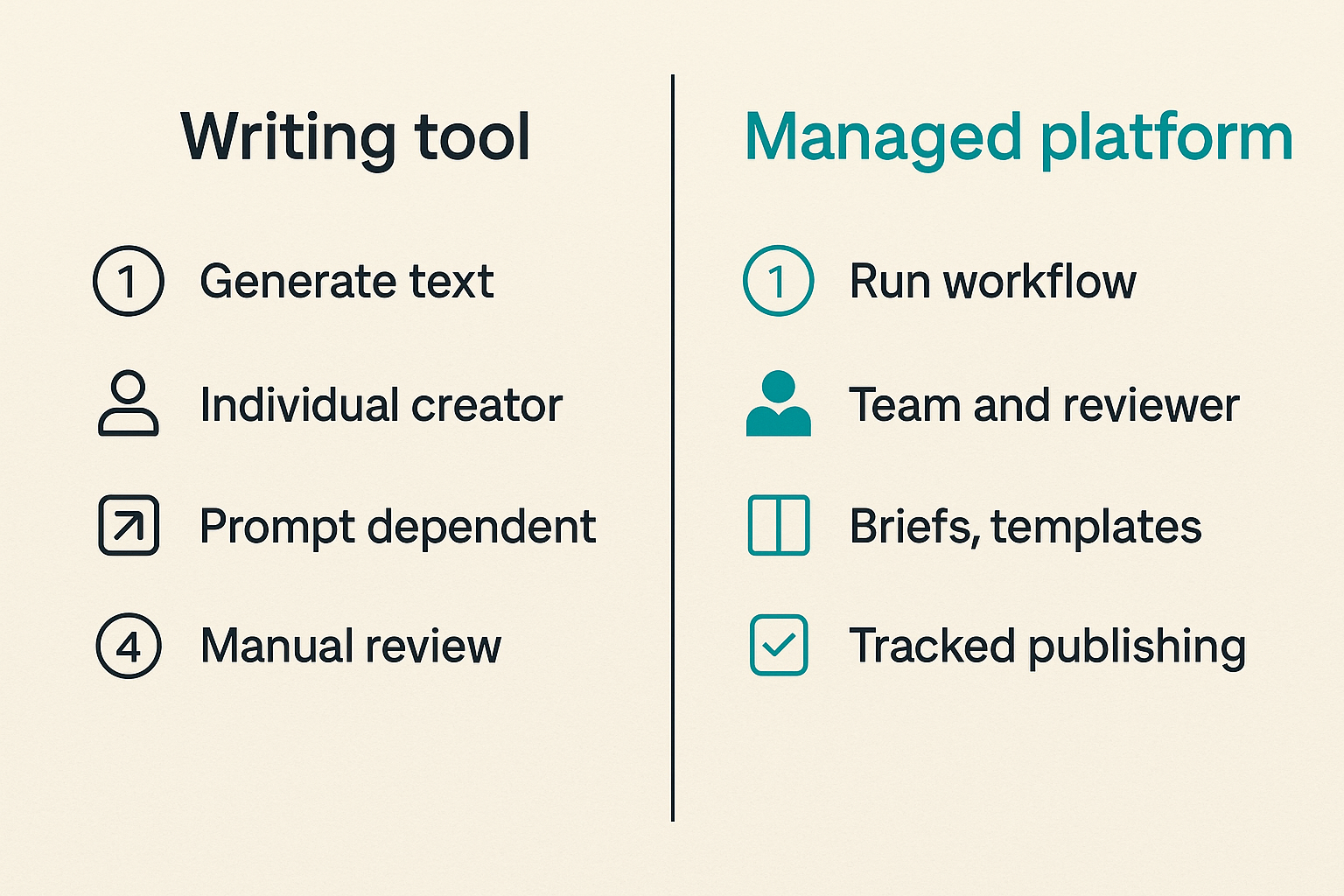
Generic AI writing tools are fine for individuals. They are less fine when a team needs auditability, repeatability, and publishing discipline.
The practical comparison
Here is the operator-level difference:
| Capability | Generic AI writing tool | Managed AI content platform |
|---|---|---|
| Primary job | Generate or edit text | Run a publishing workflow |
| User model | Individual creator | Team, reviewer, publisher, operator |
| Context control | Prompt dependent | Briefs, personas, sources, templates |
| Review process | Manual and informal | Routed, tracked, and enforceable |
| Publishing | Copy and paste | CMS, newsletter, webhook, or subdomain output |
| Governance | Mostly user discipline | Roles, gates, approvals, history |
| Measurement | External reporting | Feedback into the workflow |
The table is not about good versus bad. It is about fit.
A freelancer writing one personal essay does not need enterprise-style content operations. A publisher managing multiple writers, topics, newsletters, and review requirements probably does.
When a tool is enough
A simple AI writing tool is enough when:
- One person owns the topic, draft, edit, and publish step
- The stakes are low
- The content is not tied to regulated claims or sensitive brand positioning
- Volume is moderate
- Publication happens manually and infrequently
In that setup, workflow overhead can slow the creator down. The person doing the work has all context in their head.
What breaks in practice is when that individual process becomes a team process without being redesigned. The same prompt that worked for one creator becomes tribal knowledge. Nobody knows which version is approved. Nobody knows why one article performed and another failed.
When a managed platform is right
A managed platform is right when content becomes operational.
Signals include:
- You publish across more than one channel
- Multiple people touch each asset
- Editors need to approve before publish
- You reuse topics across blog, newsletter, and podcast
- You need consistent persona or brand logic
- You care about production throughput and quality gates
- You need to know where each asset is in the pipeline
Practical rule: if content status lives in someone’s memory, you do not have a publishing workflow. You have a bottleneck.
The content operating model before prompts
Before the first prompt, the team needs an operating model. Otherwise AI just makes the mess faster.
A managed AI content platform should encode that operating model, not force every editor to reinvent it per article.
Define lanes
Lanes are not bureaucracy. They are how you prevent every asset from requiring the same level of attention.
Common lanes include:
- Low-risk educational content
- Product-led content
- Executive thought leadership
- SEO refreshes
- Customer-facing help content
- Sponsored or partner content
- Legal or compliance-sensitive content
Each lane should have different review requirements. A glossary update should not need the same process as a pricing comparison or medical, financial, legal, or security-related claim.
Assign ownership
Ownership has to be explicit.
For each content lane, define:
- Content owner
- Draft reviewer
- Final approver
- Distribution owner
- Performance owner
Those may be the same person in a small team. That is fine. The point is that the system knows who owns the next action.
The practical question is not whether AI can write the article. The question is whether the platform can tell the right human what needs review and why.
Separate velocity from publishing rights
One of the fastest ways to lose editorial control is to confuse draft generation with publishing permission.
AI can generate quickly. That does not mean everything should ship quickly.
A healthy model separates:
- Create permission
- Edit permission
- Approve permission
- Publish permission
- Archive or update permission
This matters especially for teams running multiple personas or publications. The system should let output increase without giving every operator the keys to every channel.
The operating workflow for a managed AI content platform
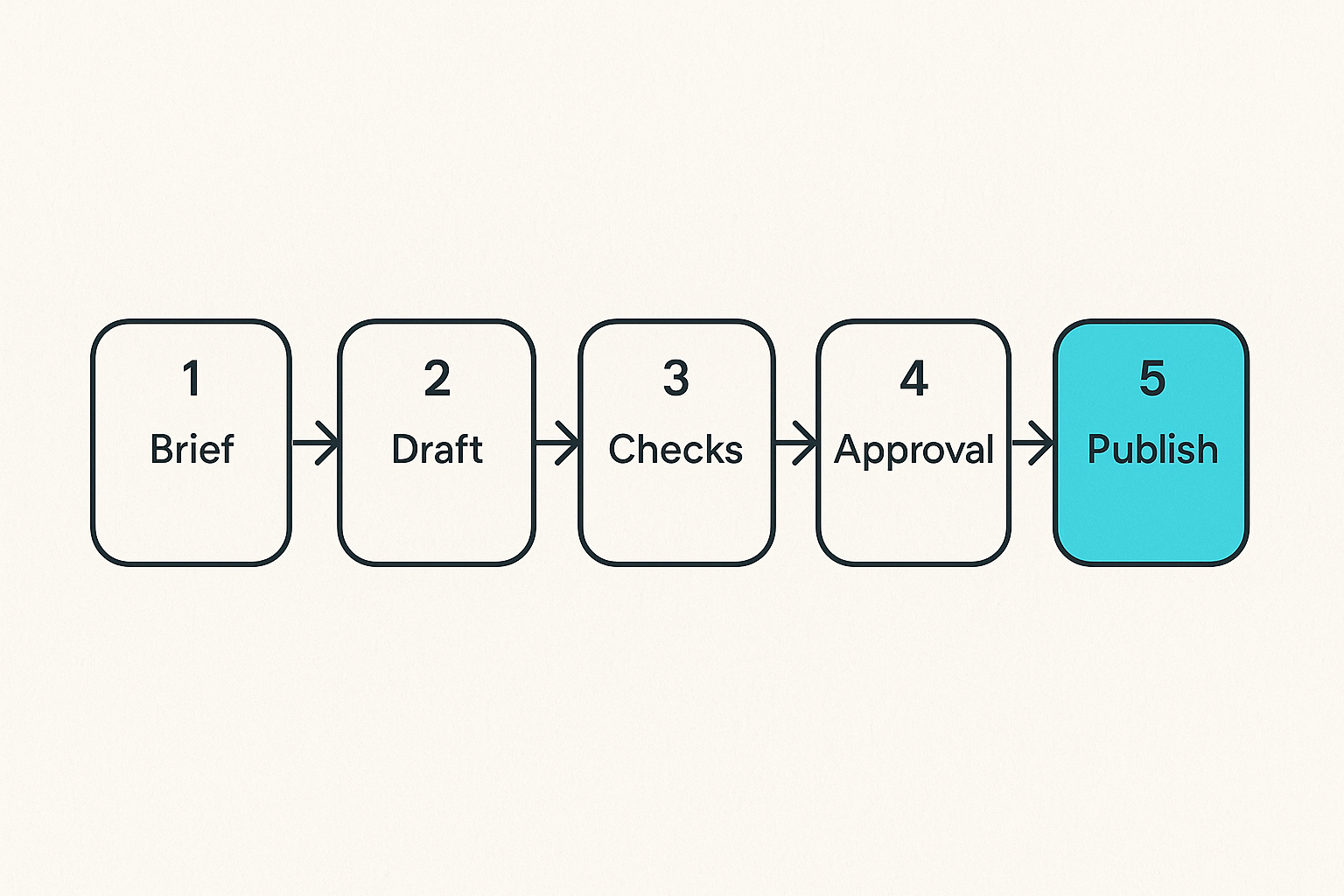
The workflow is where the platform earns its keep. If the process still depends on copy-paste, ad hoc review, and manual status tracking, the platform is only partially solving the problem.
Intake and briefing
Start with intake, not generation.
A useful brief includes:
- Target audience
- Search intent or reader job
- Primary topic and angle
- Required sources or internal context
- Claims to avoid
- Product references allowed or prohibited
- Desired format
- Distribution channel
- Reviewer or approval lane
A simple intake object can look like this:
content_request:
  topic: managed ai content platform
  audience: content marketers and publishers
  intent: practical buying and implementation guide
  lane: product-education
  format: blog-post
  review_required: editorial
  publish_target: blog
  status: brief-approved
This is not about YAML specifically. The point is that the platform should capture structured intent before it asks a model to generate anything.
Draft generation and enrichment
Once the brief is approved, generation becomes safer.
The platform can enrich the draft with:
- Persona instructions
- Brand voice rules
- Internal product context
- Previously approved examples
- Source material
- SEO structure
- Required calls to action
- Exclusion rules
The mistake teams make is stuffing all of that into one giant prompt and hoping the model remembers. A managed platform should separate reusable context from asset-specific instructions.
A practical generation sequence looks like this:
- Validate the brief has required fields.
- Select the correct template and persona.
- Attach approved sources and internal context.
- Generate outline first.
- Route outline for optional review when risk is high.
- Generate draft.
- Run automated checks.
- Send to the correct human review lane.
- Approve, revise, or reject.
- Publish and record the final state.
This is also where prior workflow thinking matters. If your team is designing a broader system, the article on human-in-the-loop AI publishing workflow architecture goes deeper on routing, review queues, and control points.
Review approval and distribution
Review is not one step. It is a set of decisions.
An editor may approve the structure but reject the claims. A product marketer may approve positioning but ask for stronger examples. A publisher may approve the article for the blog but not the newsletter.
A managed platform should preserve those distinctions. Useful statuses include:
- Draft generated
- Automated checks passed
- Needs editorial review
- Needs subject review
- Changes requested
- Approved for publish
- Published
- Needs refresh
- Archived
Practical rule: every content item should have one current state, one next action, and one accountable owner.
Quality gates that keep AI publishing usable
AI quality is not a vibe. It has to be operationalized.
Quality gates are the checks that prevent content from becoming expensive after it is published.
Brand and factual review
Brand review asks whether the piece sounds like it came from the company.
Factual review asks whether the piece is true, supportable, and safe to publish.
Do not collapse those into one generic edit. They require different judgment.
Brand checks may include:
- Does the article match our point of view?
- Does it avoid banned phrases?
- Does it use the correct product language?
- Is the intro concrete instead of generic?
- Does it make a clear argument?
Factual checks may include:
- Are claims sourced or framed as opinion?
- Are dates current?
- Are product capabilities accurate?
- Are comparisons fair?
- Are technical details correct?
The platform should make these checks visible rather than relying on heroic editors.
SEO and structure checks
SEO checks should support the reader, not turn the article into keyword paste.
For a managed ai content platform article, the checks might include:
- Topic appears naturally in the opening
- Headings map to practical questions
- Internal links support adjacent reading
- Excerpt and meta description are present
- Slug is readable
- Schema or metadata is available where needed
- The piece avoids thin repetition
This is where an automated blog pipeline can help, if it is governed properly. The related guide on automated blog posting platform architecture is useful for teams connecting generation, approvals, and publishing targets.
Legal and risk sensitivity
Some content lanes require heavier control.
Anything touching pricing, compliance, medical advice, financial claims, security posture, employment, contracts, or customer data should have stricter gates.
Related reading from our network: security license architecture for CI/CD is not a content article, but the principle is the same: sensitive systems need gates, ownership, and policy enforcement before output moves forward.
A useful risk policy can be simple:
review_policy:
  low_risk:
    automated_checks: true
    human_review: optional
  product_claim:
    automated_checks: true
    editorial_review: required
    product_review: required
  regulated_or_sensitive:
    automated_checks: true
    editorial_review: required
    subject_matter_review: required
    final_approval: required
The practical question is how often the platform can apply the right policy without manual chasing.
Human-in-the-loop review lanes
Human-in-the-loop is not a slogan. It is a routing problem.
The human should enter where judgment matters, not where software failed to pass a file from one place to another.
Route by risk not ego
Many teams route everything to the most senior editor. That creates a bottleneck and trains the team to wait.
Route by risk instead:
- Low-risk evergreen content can get light editorial review
- Product content needs product validation
- Executive content needs voice approval
- Sensitive content needs subject-matter review
- Repurposed content may only need format review
This keeps senior people focused on decisions that actually require senior judgment.
Use checklists not opinions
Unstructured review creates noisy feedback.
One editor says the piece feels generic. Another says it needs more punch. A third rewrites the whole article because that is faster than explaining the issue.
A managed platform should force clearer review language:
- Pass
- Pass with minor edits
- Changes requested
- Needs subject review
- Reject and regenerate
Reviewers should attach reasons:
- Weak angle
- Unsupported claim
- Off-brand phrasing
- Missing example
- Wrong audience
- Duplicate topic
- Poor structure
This creates data the system can use later.
Escalation and exception handling
What breaks in practice is not the happy path. It is the exception.
Examples:
- The reviewer is out for a week
- The article references a deprecated product feature
- The draft duplicates a post from last month
- The piece is approved for blog but not newsletter
- Legal review blocks one section but not the whole article
The platform should support reassignment, partial approval, hold states, and revision history. Otherwise the team falls back to Slack archaeology.
Practical rule: if exceptions require private messages to resolve, the workflow is not managed yet.
Integrations APIs and distribution
The UI is not the whole system. Publishing teams live across CMS tools, newsletter platforms, analytics dashboards, podcast workflows, project boards, and spreadsheets that refuse to die.
A managed AI content platform has to integrate with the operational reality.
CMS newsletter and podcast endpoints
The platform should know where content goes.
Typical outputs include:
- Blog post draft in CMS
- Published article on a subdomain
- Newsletter issue draft
- Podcast script
- Social post variants
- RSS or feed item
- Webhook payload for downstream tools
The more channels you support, the more important state management becomes. A blog article can be approved while the newsletter version still needs editing. A podcast script can be ready while the article waits on images.
Related reading from our network: information technology for streaming and home media operations covers a different niche, but the same operational lesson applies: distribution systems fail at the handoffs.
Webhooks and state transitions
Webhooks are useful when they represent real workflow events, not random notifications.
Good events include:
- content.created
- brief.approved
- draft.generated
- review.requested
- review.completed
- publish.approved
- content.published
- content.refresh_due
Each event should include enough context for downstream systems:
event: review.completed
content_id: post_48291
status: changes_requested
reviewer: editorial_lane_1
reason: unsupported_claim
next_owner: content_operator
The practical question is not whether the platform has an API. The question is whether its API exposes the states your team actually manages.
Metadata and schema
Metadata is what keeps content findable and maintainable.
At minimum, track:
- Title
- Slug
- Meta description
- Excerpt
- Tags
- Persona
- Funnel stage
- Content lane
- Reviewer
- Approval status
- Source context
- Publish date
- Refresh date
- Distribution targets
Without metadata, the content library becomes a pile. You may still publish, but you cannot manage the portfolio.
Metrics for managing output without rewarding junk
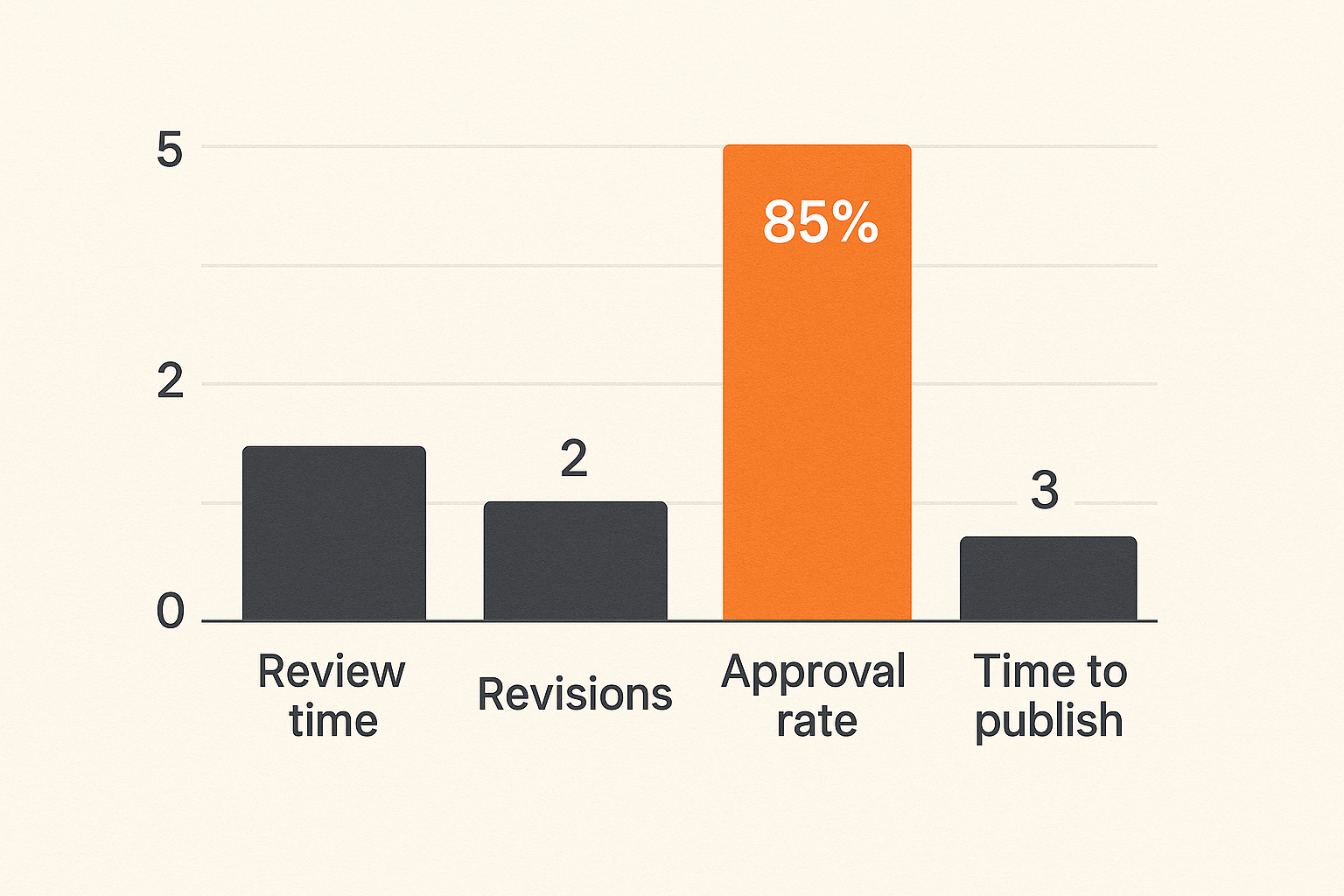
The mistake teams make is measuring volume first. Volume is easy to game. AI makes it even easier.
Measure the system instead.
Measure flow quality and outcomes
A managed platform should show both production flow and content outcomes.
Flow metrics:
- Briefs created
- Drafts generated
- Review time
- Revision count
- Approval rate
- Time to publish
- Refresh backlog
Outcome metrics:
- Organic impressions
- Search clicks
- Newsletter signups
- Assisted conversions
- Reader engagement
- Internal reuse
- Content decay
A high-output system that produces low-quality assets is not efficient. It is just moving cleanup costs into the future.
Watch bottlenecks
Bottlenecks usually appear in predictable places:
| Bottleneck | Symptom | Likely fix |
|---|---|---|
| Brief quality | Drafts miss the angle | Improve intake fields |
| Editorial review | Queue grows weekly | Route by risk and add checklists |
| Subject review | Experts delay approvals | Use narrower review scopes |
| Publishing | Approved drafts sit idle | Automate CMS handoff |
| Refreshes | Old posts decay | Schedule update states |
The best metric is often not how many posts were generated. It is how many approved assets are waiting for a human or system handoff.
Close the feedback loop
Publishing data should change future production.
If certain templates produce weak engagement, revise them. If a reviewer rejects drafts for the same reason repeatedly, update the generation rules. If a persona performs well in newsletters but poorly in search, route that format differently.
This is where managed platforms become valuable over time. They create an operational memory.
What breaks when teams implement AI content badly
Bad AI publishing usually does not fail dramatically. It drifts.
The team publishes more. The average article gets weaker. Editors become overloaded. Search performance is inconsistent. Nobody can explain which content was reviewed properly.
Prompt sprawl
Prompt sprawl happens when every team member maintains their own private prompt library.
Symptoms include:
- Inconsistent tone
- Repeated mistakes
- Conflicting instructions
- No version control
- No shared learning
- Editors fixing the same issue repeatedly
What works is centralizing reusable instructions while still allowing asset-specific briefs.
What fails is treating prompts as personal productivity hacks when the business needs a publishing system.
Silent approvals
Silent approvals happen when content moves forward because nobody objected.
This is common in busy teams. A draft lands in a shared doc. A few comments appear. Someone assumes it is fine. The post goes live.
That is not approval. That is absence of resistance.
A managed AI content platform should require explicit approval states for defined lanes. Low-risk content can have a lightweight process, but it should still be clear who approved publication.
Orphaned content operations
Orphaned content is content nobody owns after it ships.
AI increases this risk because the cost of producing new assets drops. Teams keep publishing instead of maintaining.
Symptoms include:
- Old articles with outdated claims
- No refresh schedule
- Broken internal links
- Duplicate topics
- Newsletter content not reused
- High-performing posts not expanded
What works is assigning post-publication ownership. Every meaningful asset should have a refresh policy, performance owner, and archive path.
Where bl0ggers.com fits in the publishing architecture
A managed ai content platform should help content teams scale output while keeping humans in control of editorial judgment. That is the point of the category.
bl0ggers.com is built around that practical publishing problem: AI-assisted production with review queues, persona-led content, newsletters, podcasts, subdomain publishing, and webhook-friendly automation.
Product fit without handing over the newsroom
The right fit is not a team that wants to fire editors and publish everything automatically.
The right fit is a team that wants to:
- Increase article, newsletter, or podcast output
- Keep human review where it matters
- Run multiple personas or publications
- Move from draft generation to managed workflow
- Publish to controlled destinations
- Maintain editorial approval before distribution
- Build repeatable content operations instead of ad hoc AI experiments
That changes the conversation from AI as a shortcut to AI as production infrastructure.
Implementation path
Do not migrate everything at once. Start with one lane.
A practical rollout looks like this:
- Pick one repeatable content type, such as SEO blog posts or newsletter summaries.
- Define the intake fields and approval owner.
- Create the persona and voice rules.
- Set automated checks for structure, metadata, and required fields.
- Route drafts to a small review group.
- Publish to one destination.
- Measure review time, revision rate, and performance.
- Add more lanes only after the first lane is stable.
The mistake teams make is starting with maximum automation. Start with maximum clarity. Then automate the stable parts.
A managed ai content platform is not valuable because it removes humans. It is valuable because it stops humans from doing low-leverage coordination work while preserving editorial control.
Try bl0ggers.com
bl0ggers.com is for content teams, creators, and publishers who want to use AI to increase output without giving up editorial control. Try bl0ggers.com.