
Most content teams do not have a writing problem anymore. They have an operating problem. A managed ai content platform can generate drafts, but the hard part is deciding what should be created, who approves it, how it gets published, and whether it actually supports the business.
Teams think the problem is faster content production. The real problem is controlled throughput.
That changes the conversation. The question is not whether AI can write a blog post, newsletter, podcast script, or social summary. It can. The practical question is whether your publishing system can handle more output without turning your editors into cleanup staff, your brand into a generic voice, and your CMS into a warehouse of unreviewed drafts.
In 2026, the useful version of AI content is not a blank text box. It is a workflow: inputs, personas, briefs, source checks, review lanes, approvals, distribution, and measurement. If those pieces are disconnected, the team gets more content activity and less publishing leverage.
Table of contents
- Why a managed AI content platform is not just a generator
- The operating model: ideas to assets to distribution
- Editorial control: review lanes and quality gates
- Workflow architecture for a managed AI content platform
- Integration: CMS, newsletters, podcasts, and webhooks
- What breaks in practice
- Measurement: quality, velocity, and business impact
- Governance, rights, and brand risk
- Buy, build, or stitch tools together
- Implementation plan for 2026
- Where bl0ggers.com fits in the stack
Why a managed AI content platform is not just a generator
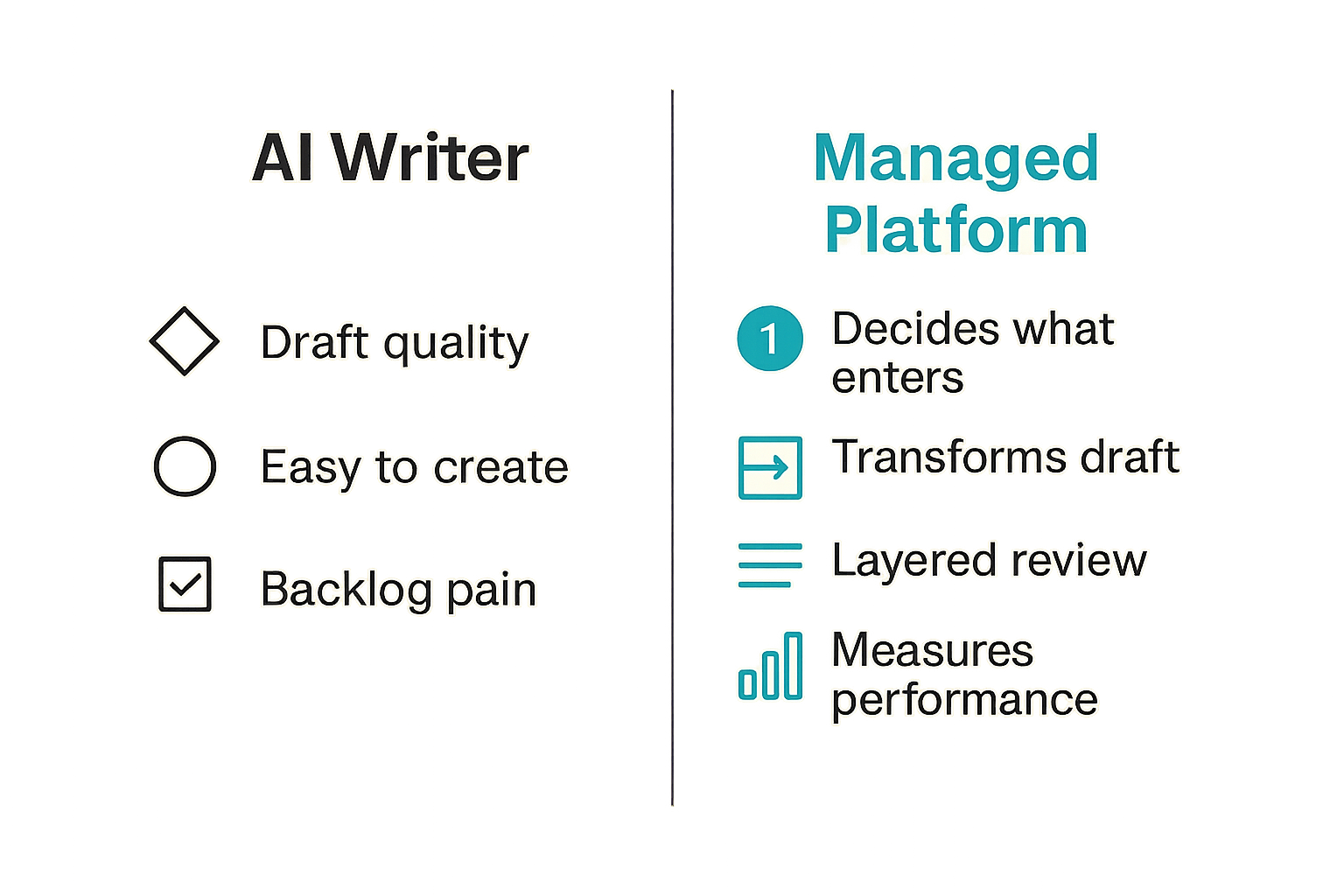
A managed AI content platform is closer to a publishing operations layer than a writing assistant. The writing model is one component. The larger system decides what content enters production, how it is transformed, who reviews it, where it goes, and how performance feeds back into the next cycle.
The mistake teams make is evaluating AI content tools by draft quality alone. Draft quality matters, but it is not enough. In production, the draft is usually the easiest artifact to create and the hardest artifact to trust at scale.
Content demand changed faster than editorial operations
Content teams are expected to support search, newsletters, social channels, partner content, sales enablement, product launches, community updates, and executive thought leadership. Publishers have more formats to maintain. Creators have more surfaces where audience attention fragments.
AI increased draft supply. It did not automatically increase editorial capacity, distribution discipline, or brand judgment.
A useful way to think about it is this: AI lowered the cost of generating words, which raised the importance of deciding which words deserve to exist.
Teams think the problem is drafting
The visible pain is usually a backlog: too many ideas, too few writers, not enough calendar coverage. So the team buys a tool that creates drafts faster.
What breaks in practice is everything around the draft:
- Briefs are inconsistent.
- Sources are not captured.
- Editors do not know what level of review is required.
- Approvals happen in Slack threads.
- CMS publishing is copied manually.
- Newsletter variants are created late.
- Performance data does not change the next brief.
That is not a drafting problem. It is a workflow design problem.
Managed means operational accountability
Managed does not need to mean fully outsourced. In a strong managed AI content platform, managed means the system owns repeatability: prompts, personas, review states, templates, routing, integrations, and publication handoff.
The team still owns strategy and editorial judgment. The platform should reduce coordination drag, not replace accountability.
Practical rule: If your AI content process cannot show who approved an asset, what sources informed it, and where it was published, you do not have a managed workflow. You have faster drafting.
The operating model: ideas to assets to distribution
The practical question is how content moves. A platform should make the content supply chain visible enough to manage.
A basic operating model has three layers:
- Inputs: ideas, keywords, audience needs, source material, product context, campaign goals.
- Assets: articles, newsletters, podcast outlines, social posts, summaries, briefs, updates.
- Distribution: CMS, email service provider, podcast tools, social scheduling, internal enablement, analytics.
The platform is valuable when it connects these layers without making every handoff manual.
Inputs need structure before generation
Bad inputs produce expensive review work. The platform should capture the fields that editors need before the model starts drafting:
- Audience or persona.
- Search intent or content job.
- Primary topic and related angles.
- Required sources or internal notes.
- Product or brand constraints.
- Format and channel.
- Approval owner.
- Deadline and priority.
This is where many teams underinvest. They create long prompt documents but no intake structure. Then every article starts differently, which makes quality inconsistent.
Assets need lanes, not piles
A managed system should separate content by lane. A low-risk weekly roundup should not follow the same review path as a regulated product comparison or founder POV piece.
Common lanes include:
- SEO article lane.
- Newsletter issue lane.
- Podcast script lane.
- Thought leadership lane.
- Product update lane.
- Refresh and republish lane.
Each lane needs its own brief template, review criteria, and distribution destination.
Publishing needs a state machine
The state of an asset should be obvious. If the team has to ask where something stands, the workflow is leaking.
A practical state machine might look like this:
| State | Owner | Exit condition |
|---|---|---|
| Idea captured | Strategist | Approved for brief |
| Brief ready | Editor | Inputs complete |
| Draft generated | Platform | Draft meets format rules |
| Editorial review | Editor | Approved or returned |
| SME review | Expert | Risk issues resolved |
| Ready to publish | Producer | Metadata and assets complete |
| Published | System or producer | URL or send confirmed |
| Measured | Operator | Performance logged |
This sounds basic. It is also where many teams lose days.
Editorial control: review lanes and quality gates
Editorial control is not a vibe. It is a set of routing decisions and acceptance criteria.
If every generated article receives the same review, editors drown. If nothing receives review, quality drifts. The goal is risk-based review, not review theater.
Route review based on risk
A human-in-the-loop process should route assets based on the cost of being wrong. A tactical how-to post may need a light editorial pass. A legal, medical, financial, or product-claim article needs more scrutiny. A newsletter in the founder voice may need tone review even if the facts are simple.
For a deeper architecture view, the earlier guide to human-in-the-loop AI publishing workflow breaks down review routing, approvals, and quality gates in more detail.
A useful routing matrix:
| Content type | Risk level | Review lane |
|---|---|---|
| Evergreen glossary | Low | Editorial spot check |
| SEO comparison | Medium | Editorial plus source review |
| Product claims | High | Product or legal approval |
| Founder POV | Medium | Voice and strategy review |
| Newsletter send | Medium | Editorial plus final send approval |
| Sponsored content | High | Editorial, partner, compliance |
Make quality gates explicit
Quality gates are checks that happen before content advances. They should be specific enough that different reviewers make similar decisions.
Examples:
- Does the piece match the assigned intent?
- Are claims supported by provided sources?
- Are product mentions accurate?
- Is the voice consistent with the persona?
- Are internal links relevant and not forced?
- Is the headline aligned with the asset goal?
- Are metadata, excerpt, tags, and slug complete?
Practical rule: A reviewer should not be asked whether a piece is good. They should be asked whether it passes defined gates for accuracy, usefulness, voice, and publication readiness.
Approvals should create memory
Approvals should improve the system. If an editor repeatedly fixes the same issue, that correction should become part of the workflow: template guidance, blocked phrase, persona note, source rule, or model instruction.
Without memory, every review cycle becomes a tax. With memory, review becomes training for the operation.
Workflow architecture for a managed AI content platform
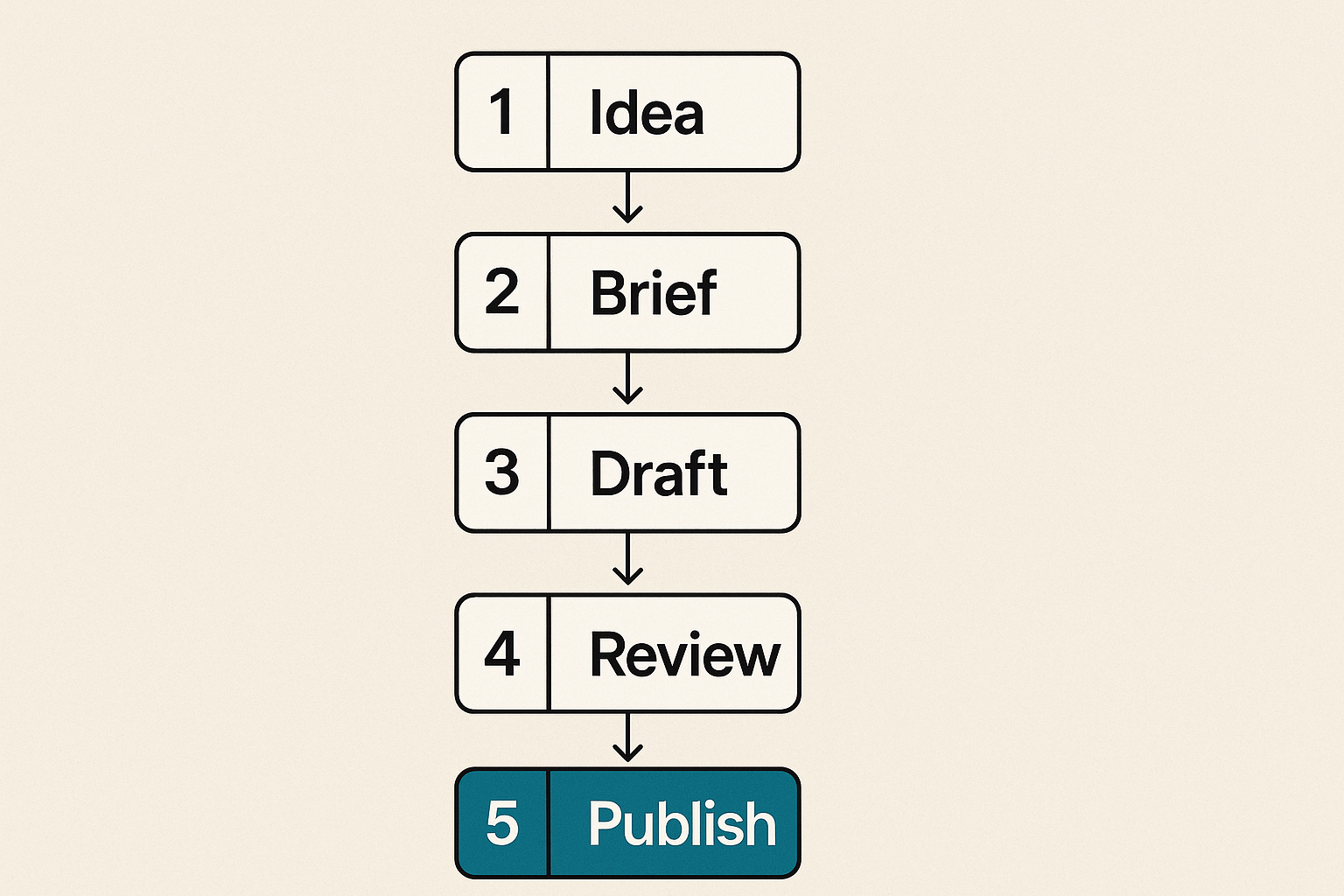
A managed AI content platform needs architecture, not just prompts. The architecture defines how information enters, how content is generated, how review happens, how assets are delivered, and how results return to planning.
The best systems are boring in the right places. They make repeatable actions repeatable. They leave judgment to humans where judgment matters.
Keep one source of truth
Content operations break when briefs live in one tool, drafts in another, approvals in chat, and publishing metadata in a spreadsheet. You do not need one monolithic application for everything, but you do need one canonical record for each asset.
That record should include:
- Asset ID.
- Topic and brief.
- Persona or audience.
- Source set.
- Status.
- Owner.
- Review history.
- Channel destinations.
- Publication URL.
- Performance notes.
The asset record is what allows automation to work without confusion.
Separate enrichment from drafting
Generation should not start with a blank prompt. A better workflow enriches the brief first.
Enrichment may include:
- Pulling recent product notes.
- Attaching approved references.
- Expanding keyword variants.
- Selecting persona guidance.
- Adding examples from previous winners.
- Flagging sensitive claims.
Only after enrichment should the platform draft. This reduces hallucinated context and makes review easier.
Related reading from our network: teams thinking about AI discoverability can compare this with insight engine architecture for AEO, where the same issue appears in a different form: structured inputs make content easier for machines and humans to understand.
Use a repeatable production sequence
A practical workflow looks like this:
- Capture the idea with audience, purpose, and channel.
- Convert the idea into a structured brief.
- Enrich the brief with sources, persona notes, and constraints.
- Generate the draft and companion assets.
- Run automated checks for format, metadata, links, and missing sections.
- Route to the correct human review lane.
- Apply revisions and record decisions.
- Publish or schedule through the relevant integration.
- Capture performance and editorial notes.
- Feed learnings into the next brief.
This is not complicated. The discipline is making the sequence default instead of optional.
Integration: CMS, newsletters, podcasts, and webhooks
The UI is not the whole system. A nice editor does not solve publishing operations if the final asset still needs to be copied into five tools.
A managed platform should understand where content goes after approval.
CMS publishing is not the finish line
For a blog post, the CMS destination requires more than body copy:
- Title.
- Slug.
- Meta description.
- Excerpt.
- Tags or categories.
- Author.
- Internal links.
- Featured image instruction.
- Canonical or syndication rules.
- Publish status.
If these fields are not produced consistently, someone becomes the cleanup layer. That person will eventually become the bottleneck.
Newsletter and podcast workflows need derived assets
One article can become several assets, but only if the workflow plans for it. A long-form post might produce:
- Newsletter intro.
- Short email subject options.
- Podcast segment outline.
- Social snippets.
- Internal sales summary.
- Republish note for a future update.
The mistake teams make is treating these as afterthoughts. Then distribution becomes improvisation. A managed workflow generates or requests derived assets while the context is still fresh.
Webhooks keep operations from becoming manual glue
Webhooks matter because publishing is event-driven. When an article is approved, something should happen. When a newsletter is ready, someone should be notified. When a post is published, the URL should return to the asset record.
Useful events include:
- Brief approved.
- Draft ready.
- Review requested.
- Changes required.
- Final approved.
- Published.
- Performance update received.
Without events, every workflow becomes a checklist someone has to remember.
What breaks in practice
AI content programs rarely fail because the model cannot write a paragraph. They fail because the operating system around the model is weak.
Prompt libraries become shelfware
Prompt libraries look organized in week one. By week eight, half the prompts are outdated, nobody knows which version was used, and editors are still fixing the same problems.
Prompts are useful, but they are not a workflow. They need ownership, versioning, and connection to outcomes.
A better pattern is to convert reusable prompt logic into platform settings:
- Persona profiles.
- Brief templates.
- Tone rules.
- Source requirements.
- Output schemas.
- Review checklists.
Voice drift turns scale into sameness
AI often makes content more grammatically consistent and less distinct. That is not always an improvement.
Voice drift happens when the model optimizes toward safe averages. The result is content that sounds competent but interchangeable. For publishers and creator-led brands, this is especially dangerous because audience trust is tied to point of view.
What works:
- Persona-specific examples.
- Approved phrases and banned phrases.
- Strong editorial notes.
- Human review for voice-sensitive assets.
- Explicit POV in the brief.
What fails:
- Asking the model to make it engaging.
- Using one brand prompt for every format.
- Removing all sharp opinions during review.
- Publishing without comparing against prior voice.
Review queues become the new bottleneck
If AI triples draft volume and review capacity stays flat, the team has not scaled. It has moved the bottleneck.
The solution is not to remove review. The solution is to route review intelligently and automate low-judgment checks.
Automate checks for:
- Missing metadata.
- Broken structure.
- Required sections.
- Word count range.
- Link presence.
- Duplicate titles.
- Empty source fields.
Reserve humans for:
- Accuracy.
- Judgment.
- Voice.
- Strategy.
- Sensitive claims.
- Final approval.
Practical rule: Do not spend human review time on problems a checklist or schema can catch before the editor sees the draft.
Measurement: quality, velocity, and business impact
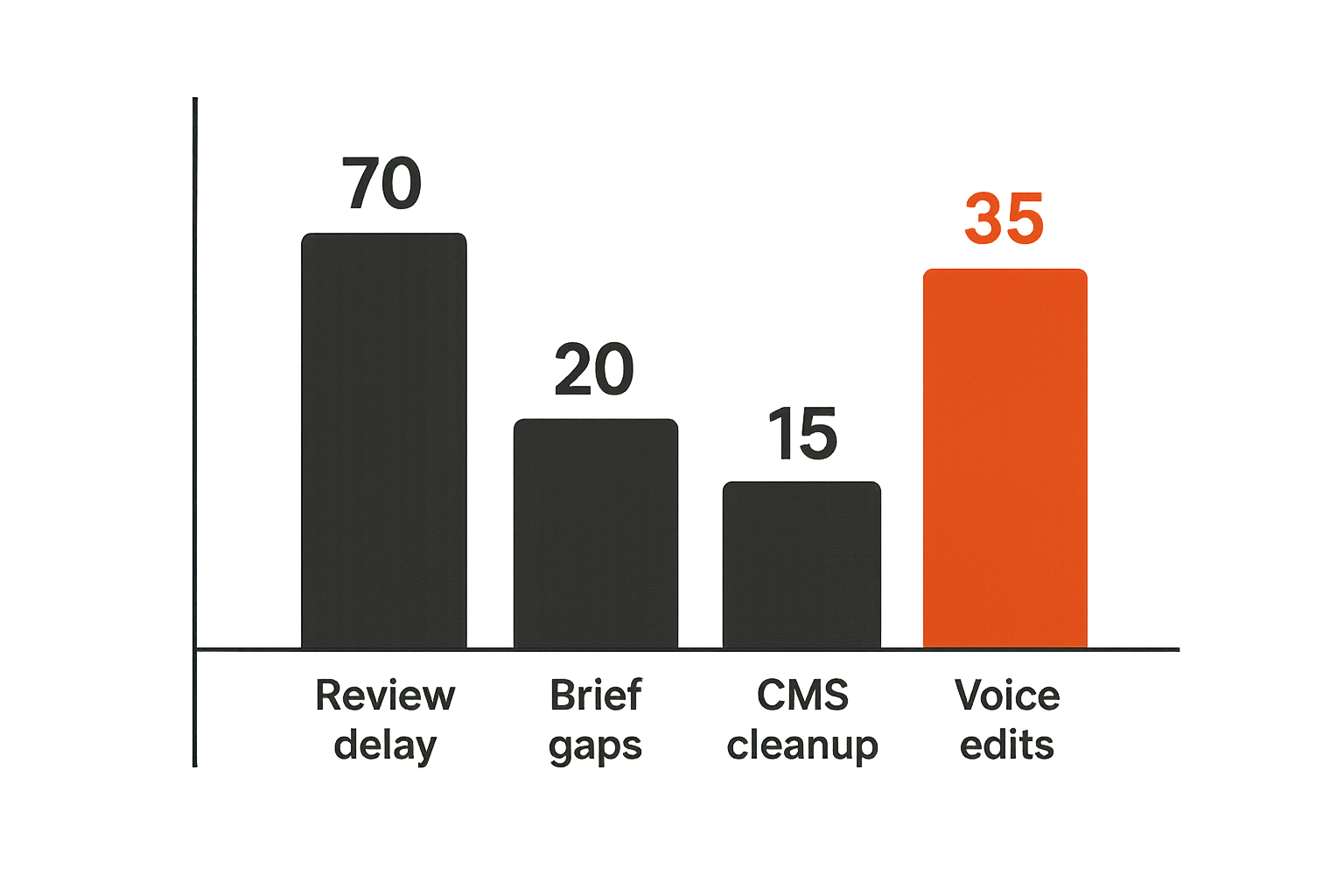
A managed AI content platform should make the system measurable. Otherwise, the team debates anecdotes: the drafts feel better, the editor feels overloaded, traffic seems uneven.
Measurement should cover workflow health and publishing outcomes.
Measure the workflow, not just the article
Article performance matters, but operational metrics explain why the system is or is not scaling.
Track:
- Idea-to-brief time.
- Brief-to-draft time.
- Draft-to-approval time.
- Revision count.
- Review turnaround by lane.
- Publish delay after approval.
- Percent of drafts returned for major changes.
- Percent of assets published without manual metadata cleanup.
These metrics show where the system is constrained. If draft time is two minutes and approval time is seven days, buying more generation capacity will not help.
Feedback loops should update the system
Performance data should not sit in dashboards nobody checks. It should influence future briefs and templates.
For example:
- Articles with stronger examples may earn better engagement.
- Newsletter issues with clearer subject lines may drive more replies.
- Product-led posts may require more SME review but create better sales utility.
- Certain personas may need shorter intros and more tactical sections.
A managed system should capture these notes where planning happens.
Related reading from our network: freelancers face a similar platform-selection problem when they compare channels, positioning, and AI assistance; this Freelancer.com vs Upwork in 2026 guide is adjacent if your content operation relies on external writers or creator collaborators.
Use metrics to find constraints
A simple constraint table can be more useful than a complicated dashboard:
| Symptom | Likely constraint | Fix |
|---|---|---|
| Many drafts, few publishes | Review capacity | Risk-based lanes |
| High revision count | Weak briefs | Better intake and enrichment |
| Slow newsletter production | Derived assets late | Generate channel variants earlier |
| Low search traction | Poor topic strategy | Improve planning inputs |
| Brand complaints | Voice drift | Persona examples and voice review |
| CMS delays | Manual metadata | Structured publishing fields |
The point is not to measure everything. The point is to find the part of the workflow that limits output quality.
Governance, rights, and brand risk
Governance sounds like a legal department concern until a low-quality AI article makes a claim the company cannot support. Then it becomes everyone’s problem.
The practical question is what the platform is allowed to use, say, publish, and automate.
Define data and source boundaries
A managed workflow should define source rules clearly:
- Which internal documents can be used?
- Which documents are off limits?
- Are customer examples anonymized?
- Are unpublished product details allowed?
- Are third-party sources required for certain claims?
- Can the model use web research, uploaded sources, or only approved material?
If this is not defined, reviewers have to guess whether a claim is acceptable.
Decide what requires human judgment
Some decisions should not be automated away. For many teams, human judgment is required for:
- Legal or compliance claims.
- Competitive comparisons.
- Pricing and discount statements.
- Medical, financial, or safety advice.
- Brand-sensitive executive content.
- Customer stories.
- Sponsored content.
Related reading from our network: even a consumer workflow like a Walgreens coupon code checkout process shows the same operational lesson in a lighter context: exclusions, validation, and final review matter more than the visible interface.
Escalation is part of the architecture
When a reviewer flags a risk, the platform should know what happens next. Escalation cannot depend on someone remembering who owns the issue.
A basic escalation path:
- Editorial issue goes to editor.
- Product claim goes to product owner.
- Legal risk goes to legal or compliance.
- Brand voice issue goes to content lead.
- Technical accuracy issue goes to SME.
Escalation should preserve context: brief, draft, source material, comments, and requested decision.
Buy, build, or stitch tools together
Most teams have three options: build an internal workflow, stitch together generic tools, or use a managed platform. None is automatically right. The decision depends on volume, risk, team size, integration needs, and editorial maturity.
The comparison that matters
| Approach | Best for | Strength | Weakness |
|---|---|---|---|
| Generic AI writer | Solo drafts and experiments | Fast text generation | Weak workflow and review control |
| Prompt library plus docs | Small teams with low volume | Cheap and flexible | Hard to govern and measure |
| Custom internal build | Large teams with engineering support | Deep customization | Expensive to maintain |
| Managed AI content platform | Teams scaling repeatable publishing | Workflow, review, integrations | Requires process clarity |
| Agency-only model | Teams outsourcing strategy and production | Human ownership | Can be slow and costly |
The mistake teams make is choosing based on the best demo. Choose based on the workflow you need to run every week.
When a managed platform fits
A managed platform usually fits when:
- You publish across multiple channels.
- You need human review without constant coordination.
- You operate several personas, brands, or content lanes.
- You need consistent metadata and publishing handoff.
- You want AI output but cannot accept brand drift.
- You need approval history and operational visibility.
- You want content variants for blogs, newsletters, podcasts, or subdomains.
It may not fit if you only need occasional ad copy or one-off brainstorming. In that case, a lightweight AI assistant is probably enough.
Questions to ask before choosing
Before choosing a platform, ask operational questions:
- How does intake work?
- Can we define different review lanes?
- Can the platform preserve source context?
- What happens when a reviewer rejects a draft?
- Can it generate metadata and channel variants?
- Does it integrate with our publishing stack?
- Can approvals and publication status be tracked?
- How do editorial corrections improve future outputs?
- Can we separate automation from human judgment?
If the vendor only talks about model quality, keep going. Model quality matters, but publishing operations determine whether the system survives contact with the team.
Implementation plan for 2026
Implementation should start narrow. The goal is not to automate the entire content department in a month. The goal is to prove one lane can move faster with better control.
Start with one publishing lane
Pick a lane with enough repetition to learn from, but not so much risk that every decision becomes political.
Good first lanes:
- SEO refreshes.
- Weekly newsletter support.
- Podcast show notes.
- Low-risk educational articles.
- Internal content summaries.
Avoid starting with the most sensitive content. Founder essays, compliance-heavy articles, and major product announcements should come later once the workflow is stable.
A practical rollout sequence
Use this sequence:
- Select one content lane and define its business goal.
- Document the current workflow from idea to publish.
- Identify where time is lost today.
- Create a structured brief template.
- Define quality gates and review owners.
- Configure generation for that lane only.
- Run a small batch through human review.
- Record edits and recurring issues.
- Update templates, persona notes, and checks.
- Connect publishing or notification integrations.
- Measure turnaround, revisions, and publish rate.
- Expand to a second lane only after the first is predictable.
This approach is slower than a big launch. It is also more likely to work.
What works and what fails
What works:
- Clear lane ownership.
- Structured briefs.
- Risk-based review.
- Automated metadata checks.
- Source-aware generation.
- Human judgment for sensitive content.
- Performance notes attached to future planning.
What fails:
- Open-ended generation.
- One prompt for every asset.
- Approval by chat reaction.
- Manual CMS cleanup forever.
- No distinction between low-risk and high-risk content.
- Measuring volume without measuring usefulness.
Practical rule: Scale the lane only when the review pattern is predictable. If every draft creates a new exception, the workflow is not ready for volume.
Where bl0ggers.com fits in the stack
A managed ai content platform should not ask teams to choose between automation and editorial control. The useful middle ground is managed automation with human review where it matters.
Product fit: managed AI with human review
bl0ggers.com is built around human-in-the-loop AI publishing for persona-led blogs, podcasts, newsletters, and subdomain media networks. The important part is not just generation. It is the operating layer around generated content: review queues, persona journeys, publishing workflows, and automation handoff.
That makes it relevant for teams that want more output but still need editors, creators, or operators to control what goes live.
Operational handoff matters
The handoff is where many AI content systems fail. A draft sitting in a workspace is not a published asset. A newsletter concept is not a send. A podcast outline is not a distribution workflow.
The right platform should help content move from research to draft to review to publication without forcing the team to rebuild the same process manually every week.
For content marketers, publishers, creators, and newsletter operators, that is the real leverage: not replacing the editorial function, but removing the coordination work that keeps it stuck.
A managed ai content platform is useful when it behaves like publishing infrastructure. It should make the work more visible, more reviewable, and more repeatable without flattening the human point of view that made the content worth publishing in the first place.
Try bl0ggers.com
bl0ggers.com is for content teams, creators, and publishers who want to use AI to increase output without giving up editorial control. Try bl0ggers.com.