
AI can now produce drafts faster than most teams can brief, review, approve, and publish them. That sounds like leverage until the editorial queue turns into a pile of half-trusted content nobody wants to own.
Teams think the problem is generation. The real problem is control.
Human in the loop AI publishing is not a philosophical compromise between humans and machines. It is an operating model for deciding where AI should move fast, where humans must slow the system down, and how published work stays useful, accurate, and on-brand at scale.
The mistake teams make is treating AI publishing like a better writing assistant. In production, the practical question is not whether AI can write. It is whether your workflow can route, review, correct, log, and improve AI-assisted content without turning your editors into exhausted gatekeepers.
Table of contents
- Why human in the loop AI publishing is an operating model
- Map the publishing pipeline before you automate it
- Build the workflow around content states
- Decide what humans must review
- Design AI prompts as production assets
- Use automation for routing not blind publishing
- What breaks when human review is implemented badly
- Measure quality as an operating system
- Governance brand safety and legal boundaries
- Product fit: where bl0ggers.com belongs
- Closing: human in the loop AI publishing that survives production
Why human in the loop AI publishing is an operating model
Human in the loop AI publishing fails when it is treated as a vague promise that a person will check the work later. Later is not a workflow. Later is where errors hide.
A useful way to think about it is this: AI is a production engine, but publishing is a trust system. The article, newsletter, podcast brief, or social post is only the visible output. Behind it are decisions about sources, audience, claims, tone, ownership, timing, and accountability.
The wrong problem: more generation
Most teams start with a simple goal: create more content. They test prompts, compare model outputs, and ask whether AI can match their style. That work matters, but it is not the bottleneck for long.
Once generation becomes cheap, the constraint moves downstream. Editors need to know what is ready. Marketers need to know what is approved. Founders need to know what represents the company. Publishers need to know whether a claim should have been checked before it went live.
That changes the conversation. You are no longer buying speed. You are designing controlled throughput.
The real problem: controlled throughput
Controlled throughput means more content can move through the system without losing visibility or judgment. It requires clear states, explicit review rules, and feedback loops that make the AI system better over time.
The goal is not to put a human in every step. That usually creates drag. The goal is to put the right human at the right decision point, with enough context to make a fast call.
Practical rule: Human review should exist where judgment changes the outcome, not where habit makes the team feel safer.
Why 2026 makes this urgent
In 2026, AI content is no longer unusual. The differentiator is not whether a creator or publisher uses AI. It is whether the system produces work that feels intentional, current, and accountable.
Search visibility, answer engines, newsletters, podcasts, and niche media all reward consistency. But consistency without review creates brand risk. Review without automation creates missed cadence. Human in the loop AI publishing is the middle architecture: automation for scale, humans for judgment, and workflow for repeatability.
Related reading from our network: AI publishing schema markup is a useful adjacent topic because structured data only works when the publishing workflow can produce consistent metadata and trustworthy article context.
Map the publishing pipeline before you automate it
Before adding tools, draw the pipeline. Most AI publishing problems are not model problems. They are hidden process problems.
If your current process is founder writes idea, freelancer drafts, editor comments in a doc, someone copies into CMS, and another person schedules, automation will magnify the ambiguity. It will not remove it.
Start with the content state machine
Every content asset needs a state. Not a vibe. Not a Slack message. A state.
Common states include:
- Idea captured
- Brief approved
- Draft generated
- Needs editorial review
- Needs factual review
- Needs brand review
- Approved for publishing
- Scheduled
- Published
- Update required
- Retired
The state machine prevents the most common failure: nobody knows whether a piece is still being edited, waiting on review, or already approved.
Separate creation from approval
AI can generate a draft, outline, headline set, summary, transcript adaptation, or newsletter version. None of those actions should automatically mean the piece is approved.
Creation is an input. Approval is a decision.
The mistake teams make is letting convenience collapse those two steps. A draft lands in the CMS, looks finished, and gets scheduled because the team is busy. What breaks in practice is accountability. When something is wrong, nobody can tell whether the issue came from the prompt, the reviewer, the editor, or the publishing step.
Assign ownership at each boundary
Each transition should have an owner. The owner is not always the person doing the work. It is the person accountable for the decision.
| Boundary | Typical owner | Decision being made |
|---|---|---|
| Idea to brief | Content lead | Is this worth producing? |
| Brief to draft | Editor or strategist | Is the input specific enough? |
| Draft to review | Automation or producer | Is the draft complete enough to inspect? |
| Review to approval | Human reviewer | Is this safe and useful to publish? |
| Approval to publish | Publisher or system | Is timing, format, and metadata correct? |
| Published to update | Content owner | Does the asset need revision? |
This is where human in the loop AI publishing becomes operational instead of theoretical.
Build the workflow around content states
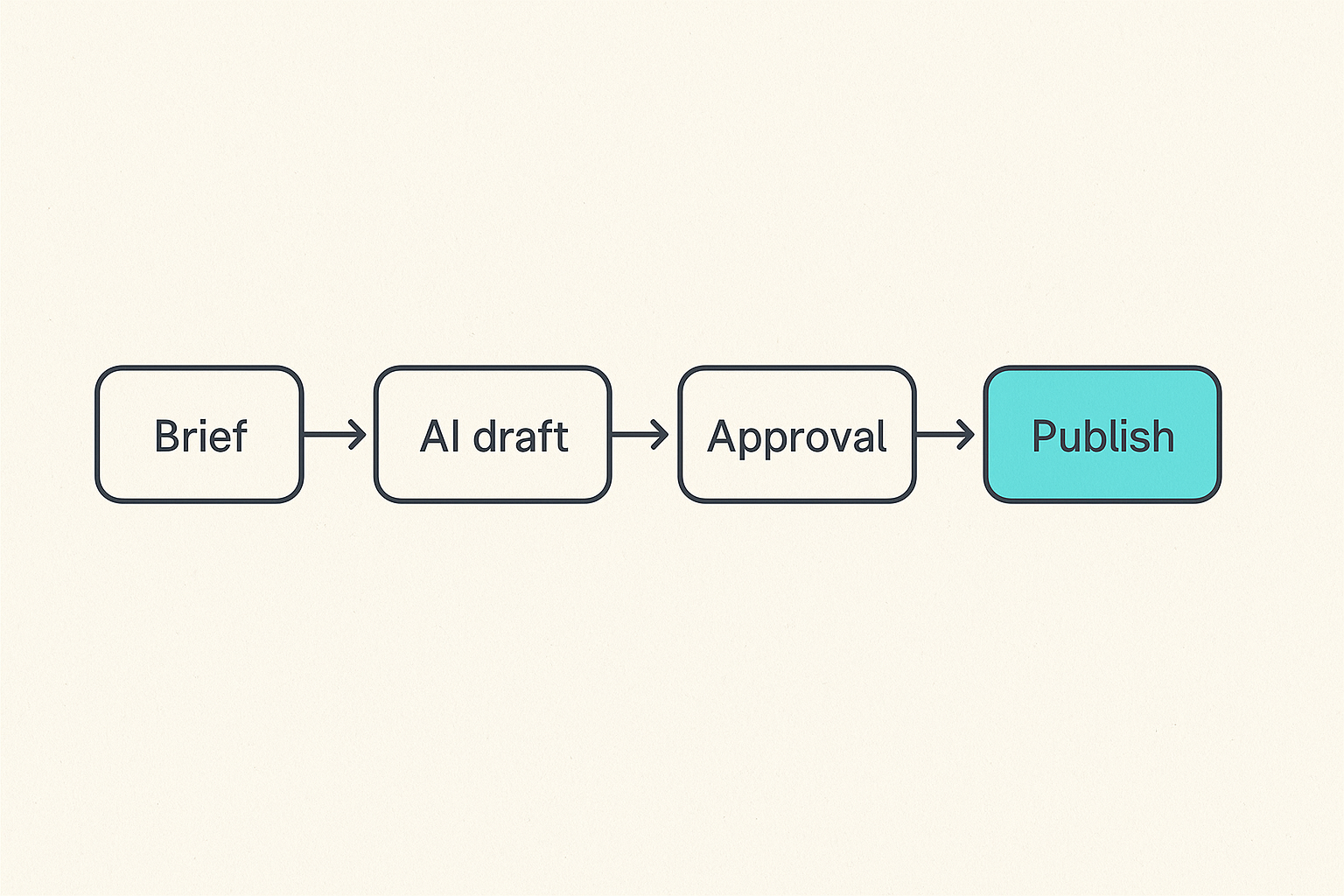
A content state model gives AI a lane. It tells the system what it can do next, what it must wait for, and who needs to act.
Without states, teams build brittle automations: generate draft, send notification, publish when ready. Those flows work in demos. They fail when priorities change, reviewers are unavailable, or a high-risk article needs extra attention.
A practical content lifecycle
A practical lifecycle for AI-assisted publishing looks like this:
- Capture topic, audience, goal, and source requirements.
- Generate a brief or outline from approved inputs.
- Human approves or edits the brief.
- AI generates the first draft and metadata.
- Automation classifies the piece by risk, format, and channel.
- Human reviewer checks the assigned criteria.
- AI applies approved edits or creates derivative formats.
- Final human approval happens only if required by policy.
- System publishes, schedules, or exports.
- Performance and defects feed back into prompts and policies.
The practical question is not how many steps you can remove. It is which steps can be automated without removing judgment.
The minimum metadata model
You do not need an enterprise content system to start. You do need metadata that makes routing possible.
A useful minimum model:
content_id: post_2026_05_30_001
persona: indie_creator
topic_cluster: ai_publishing
format: blog_post
risk_tier: medium
source_requirement: internal_knowledge_plus_web_research
review_required: editorial
owner: content_lead
status: needs_review
prompt_version: blog_v3.2
model_output_version: draft_1
publish_channel: blog_and_newsletter
This gives your automation something to act on. It also gives your reviewers context without forcing them to reconstruct the assignment.
Where automation should pause
Automation should pause when the next step requires judgment, context, or accountability. Examples:
- A post makes a claim about a competitor.
- A newsletter includes pricing or legal guidance.
- A draft references current events or regulatory issues.
- A podcast script uses a founder persona.
- A blog targets a sensitive audience or industry.
Practical rule: If the cost of being wrong is reputational, legal, financial, or strategic, the workflow needs an explicit human decision.
Decide what humans must review
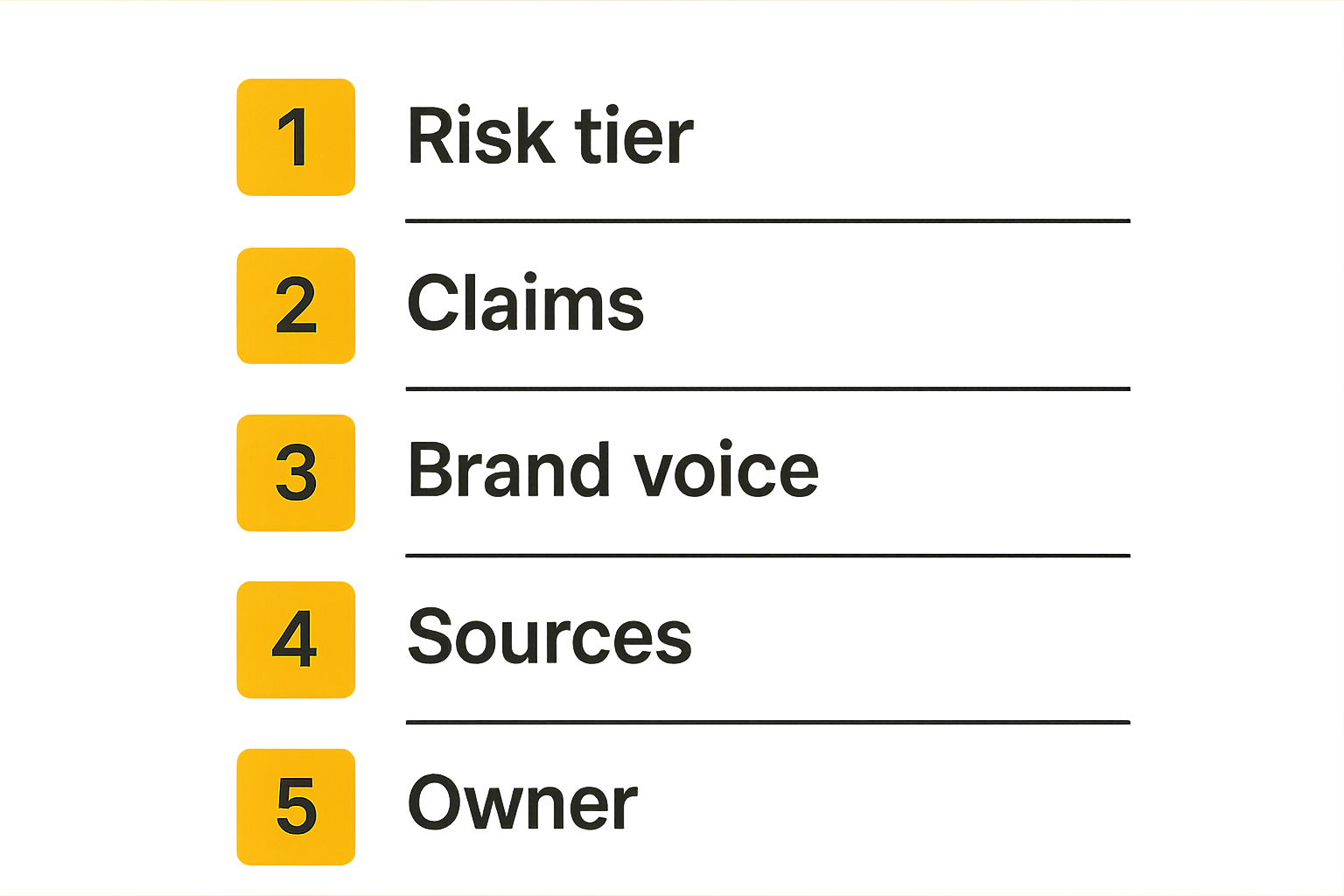
Human review is expensive. Not only in money, but in attention. If every output needs a full review, your AI publishing system becomes a faster way to create editorial backlog.
The solution is risk-based review.
Use risk tiers instead of gut feel
Not every content asset deserves the same level of scrutiny. A low-risk glossary update is different from a thought leadership post about healthcare compliance or financial advice.
| Risk tier | Example content | Human review level | Automation allowed |
|---|---|---|---|
| Low | Internal recap, simple summary, evergreen list | Spot check | Generate and queue for scheduled publish |
| Medium | SEO article, newsletter, comparison post | Editorial review | Draft, format, suggest links and metadata |
| High | Legal, medical, finance, brand position, sensitive claims | Expert review | Draft only, no publish action |
| Critical | Crisis response, public statement, regulated claim | Named approver | Research support only |
This table is not universal. The point is to stop treating review as a feeling. Define the tier, then define the routing.
Create a review matrix
A review matrix tells people what they are checking. It also prevents senior editors from doing low-value cleanup that the system should handle.
A practical matrix includes:
- Accuracy: Are facts, dates, names, and claims correct?
- Brand voice: Does this sound like the publisher or creator?
- Audience fit: Is it useful for the intended reader?
- Source integrity: Are citations, examples, and references acceptable?
- Originality: Does it add perspective or just summarize common knowledge?
- Compliance: Does it avoid restricted claims or required disclosures?
- Conversion fit: Does the CTA match the content and audience stage?
What works is giving each reviewer a narrow job. What fails is asking every reviewer to check everything.
What can safely bypass review
Some AI outputs can bypass full human review if the workflow has guardrails. Examples include:
- Formatting approved drafts into newsletter versions.
- Creating social snippets from already approved articles.
- Suggesting internal links for editor confirmation.
- Producing meta descriptions from final copy.
- Generating image alt text for human spot checks.
Bypass does not mean invisible. It means the system can continue while logging what happened.
Related reading from our network: teams building trust-heavy local platforms face similar routing and follow-up problems, which is why this architecture guide to the best platform for local community building is a useful comparison outside publishing.
Design AI prompts as production assets
Prompts are not throwaway instructions once they start driving publishing volume. They are production assets.
If a prompt produces ten articles a month, a weak prompt is annoying. If it produces hundreds of drafts across multiple personas, a weak prompt becomes an operational risk.
Prompts need version control
Every prompt that affects publishing should have a version. When output quality changes, you need to know whether the cause was the prompt, model, input data, reviewer feedback, or topic mix.
At minimum, track:
- Prompt name
- Prompt version
- Intended content type
- Required inputs
- Forbidden outputs
- Review criteria
- Last changed by
- Change note
This does not require heavyweight engineering. A spreadsheet can work early. A database is better once the workflow becomes repeatable.
Grounding beats clever wording
Many teams over-optimize prompt phrasing and under-invest in inputs. A clever prompt cannot rescue vague positioning, outdated source material, or unclear audience intent.
Good grounding includes:
- Persona notes
- Editorial style guide
- Approved claims
- Product descriptions
- Customer pain points
- Internal research
- Source URLs or excerpts
- Examples of accepted output
- Examples of rejected output
The best prompt is often less magical than teams expect. It is specific, bounded, and connected to approved context.
Capture reviewer feedback
Human review should improve the system. If editors keep making the same corrections and those corrections never flow back into prompts, style guides, or routing rules, the workflow is leaking value.
A simple feedback taxonomy helps:
| Feedback type | Example | System response |
|---|---|---|
| Factual error | Wrong product capability | Update grounding source |
| Voice issue | Too generic or inflated | Update persona guide |
| Structure issue | Weak intro, no operator angle | Update prompt template |
| Risk issue | Unsupported legal claim | Update risk rules |
| Formatting issue | Bad headings or metadata | Update output schema |
Practical rule: If a human corrects the same issue three times, it should become a system change, not a permanent editing chore.
Use automation for routing not blind publishing
The best use of automation is not pressing publish faster. It is routing the right asset to the right place with the right context.
Blind publishing is attractive because it looks efficient. In reality, it moves risk from the workflow into the public channel.
Webhooks and queues matter
A durable AI publishing workflow needs events. Draft generated. Review requested. Review approved. Metadata missing. Publish scheduled. Update required.
Events let you connect systems without relying on people to remember handoffs. They also allow your workflow to support multiple outputs: blog posts, newsletter editions, podcast outlines, social posts, and subdomain publications.
If your team wants to integrate generated articles, podcast flows, newsletters, or review queues, the bl0ggers.com contact page is the right place to start that conversation.
Idempotency for content operations
Publishing systems should avoid duplicate actions. If an approval webhook fires twice, the article should not publish twice. If a newsletter export retries, subscribers should not receive two versions.
Borrow a principle from payment and API systems: use idempotency keys.
For publishing, that might look like:
action: publish_post
content_id: post_2026_05_30_001
approved_version: draft_3
idempotency_key: publish_post_001_draft_3
The workflow checks whether that exact action already happened. If yes, it skips. If no, it proceeds and logs the result.
Notifications without chaos
Notifications are not workflow. They are signals inside a workflow.
What works:
- Send one clear action to one accountable owner.
- Include content state, deadline, risk tier, and review criteria.
- Escalate only when a deadline or policy requires it.
- Summarize queues instead of spamming every draft event.
What fails:
- Sending every draft to a shared channel.
- Asking reviewers to infer priority.
- Mixing comments, approvals, and publishing decisions in chat.
- Losing the final decision outside the system of record.
Related reading from our network: the same ownership and escalation problem appears in security operations, and this SaaS incident response architecture is a good parallel for thinking about signals, routing, and accountable response.
What breaks when human review is implemented badly
Human review can make AI publishing safer. It can also make it slower, more political, and harder to scale if the workflow is poorly designed.
The issue is not having humans involved. The issue is involving them without clear decision rights.
Approval queues become bottlenecks
The most common failure mode is the giant approval queue. Every draft waits for the same person. That person becomes the quality department, brand department, legal department, and publishing department at once.
Symptoms include:
- Drafts age before anyone reads them.
- Evergreen content blocks time-sensitive content.
- Reviewers skim because the queue is too large.
- AI output volume gets reduced because review cannot keep up.
The fix is not more pressure. It is better routing, lower-risk bypass rules, and clearer review scopes.
Editors review the wrong things
Senior editors should not spend most of their time fixing formatting, metadata, repeated structure problems, or obvious prompt failures. Those are system problems.
Use human judgment for:
- Positioning
- Reader value
- Claims and nuance
- Voice and taste
- Strategic alignment
- Sensitive topics
Use automation or junior review for:
- Formatting checks
- Metadata completeness
- Broken links
- Basic grammar
- Template compliance
- Duplicate title detection
The mistake teams make is treating human review as a universal cleanup function. That burns the people whose judgment you actually need.
No audit trail means no learning
If approvals happen in comments, chat, email, and memory, you cannot improve the system. You can only hope people keep catching issues.
A useful audit trail records:
- Who reviewed
- What version they reviewed
- What they changed
- Why they rejected or approved
- Which policy or checklist applied
- What happened after approval
This is not bureaucracy for its own sake. It is how the workflow learns.
Measure quality as an operating system
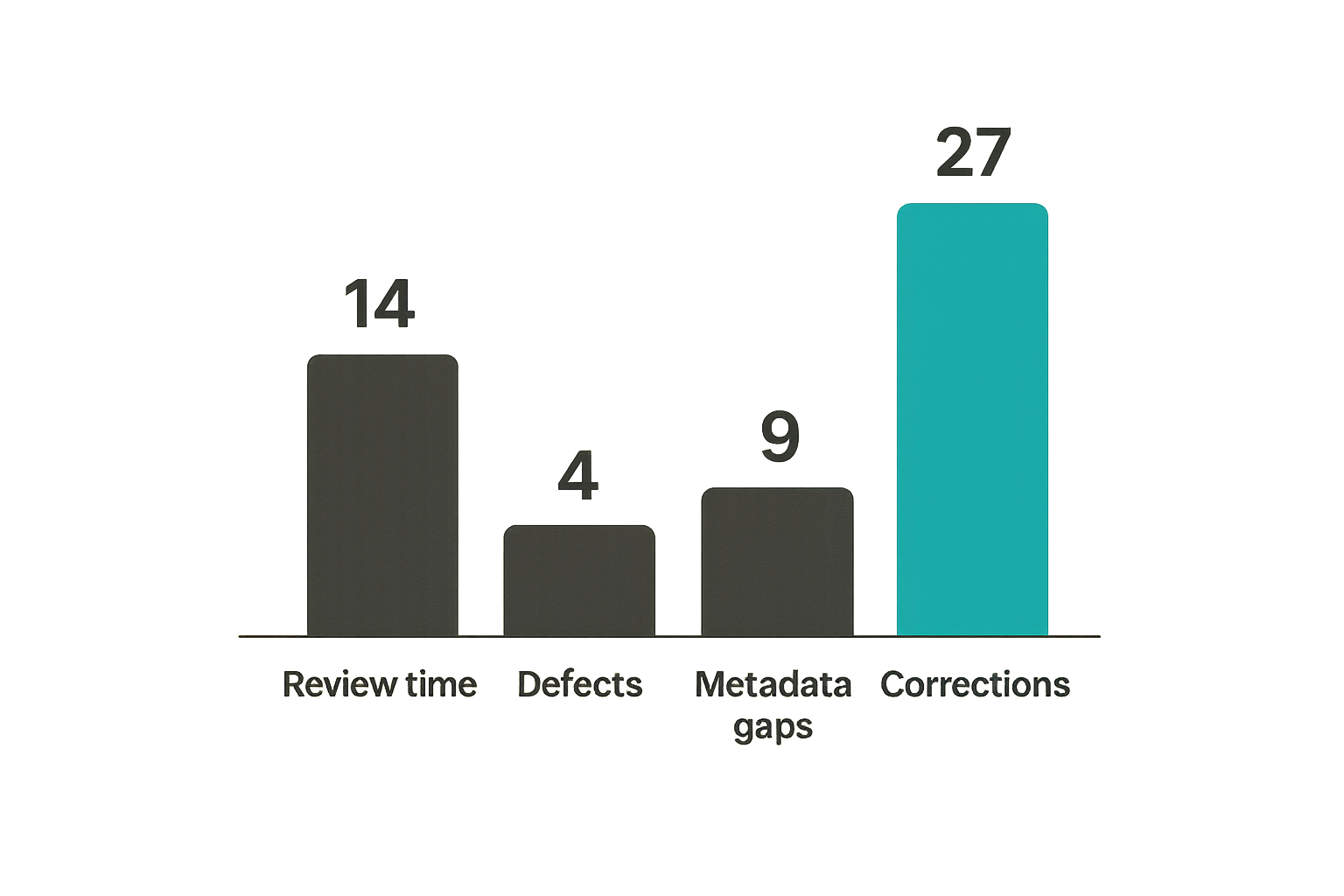
Quality is not a final read-through. It is an operating system that tells you whether the publishing machine is getting better or worse.
Many teams measure only output volume. Articles published. Newsletters sent. Posts scheduled. Those metrics are useful, but incomplete.
Track leading indicators
Leading indicators show friction before it becomes a public problem.
Track metrics like:
- Draft rejection rate
- Average review time by risk tier
- Number of repeated edit types
- Percentage of drafts missing required metadata
- Percentage of content routed to the wrong reviewer
- Number of post-publication corrections
- Time from idea to approved brief
- Time from approved brief to publish
A rising output count with rising correction volume is not success. It means the system is pushing work downstream.
Compare AI assisted and human edited output
Do not assume AI-assisted content is worse or better. Compare it.
| Measurement | AI draft with review | Human-only draft | What to learn |
|---|---|---|---|
| Time to first draft | Usually faster | Usually slower | Is speed creating review debt? |
| Edit depth | Variable | Variable | Are prompts improving? |
| Voice consistency | Strong if grounded | Depends on writer | Is the style guide clear? |
| Fact risk | Depends on source control | Depends on writer | Are sources verified? |
| Publishing cadence | Easier to stabilize | Harder to scale | Is review capacity sufficient? |
This comparison should be honest. AI is not a free content department. It is a production layer that needs operating controls.
Turn defects into workflow changes
A defect is anything that should not have reached its current state. It might be a factual issue, weak angle, missing disclosure, bad internal link, duplicate section, or wrong CTA.
For each defect, ask:
- Could the prompt have prevented this?
- Could grounding have prevented this?
- Could routing have caught this earlier?
- Could a checklist have made review faster?
- Should this content type move to a higher risk tier?
This is how human in the loop AI publishing compounds. Humans do not just approve content. They improve the machine that produces the next piece.
Governance brand safety and legal boundaries
Governance sounds heavy until something goes wrong. Then everyone wishes the rules had been clearer.
For creators and small publishing teams, governance does not need to mean legal department overhead. It means writing down the decisions that should not be improvised every time.
Define non negotiables
Every AI publishing workflow should define non negotiables. Examples:
- Do not invent sources, quotes, customers, or case studies.
- Do not make medical, legal, financial, or regulatory claims without expert approval.
- Do not publish competitor comparisons without review.
- Do not disclose private customer data or internal strategy.
- Do not use a founder voice without approval from the founder or delegate.
- Do not auto-publish high-risk topics.
These rules should be visible inside the workflow, not buried in a policy document nobody opens.
Handle disclosure and provenance
Disclosure requirements vary by context, market, and content type. The practical point is to know your own policy before scaling production.
Provenance is broader than disclosure. It answers where the content came from, which inputs were used, what AI generated, what humans changed, and who approved the final version.
For many publishers, provenance matters more operationally than publicly. It helps resolve disputes, correct mistakes, and improve future output.
Keep policies close to execution
A policy that does not affect routing, prompts, checklists, or approval rules is just a document.
Good policy becomes execution:
- Restricted topics map to high risk tiers.
- Approved claims become grounding snippets.
- Required disclosures become template fields.
- Review requirements become workflow states.
- Legal boundaries become generation constraints.
If your organization needs a shared view of the platform direction and publishing model, the about page for bl0ggers.com explains the human-in-the-loop approach across blogs, podcasts, newsletters, and media networks.
Product fit: where bl0ggers.com belongs
Human in the loop AI publishing becomes hard when teams stitch together prompts, documents, spreadsheets, CMS drafts, chat approvals, and newsletter exports. That can work early. It usually breaks when cadence increases.
The practical question is when the workflow deserves a platform.
When a platform is better than scripts
Scripts are useful when the process is simple and the risk is low. A solo creator can automate outlines, summaries, and drafts with lightweight tools.
A platform starts to make sense when:
- Multiple personas or brands need separate voices.
- Review queues need ownership and status visibility.
- Content needs to become blogs, newsletters, and podcasts.
- Subdomain publishing or multi-site output matters.
- Webhooks need to trigger downstream systems.
- Human review should be optional for some assets and mandatory for others.
- The team needs repeatability more than one-off generation.
What fails is building a fragile stack where every exception requires manual rescue.
How bl0ggers.com fits the workflow
bl0ggers.com is designed for creators and publishers who want AI to scale content production while keeping human oversight in the loop. That means the product fit is not AI writes everything and humans disappear. The fit is AI generates research-backed content assets, then the workflow supports review, publishing, and distribution across formats.
The architectural value is in connecting the pieces: persona-led content, generated articles, optional human review, podcast and newsletter workflows, subdomain publishing, and webhook-based automation.
For teams evaluating whether to build or adopt a workflow, the main site for bl0ggers.com is the best starting point.
Implementation sequence for teams
A practical rollout sequence looks like this:
- Pick one content lane, such as weekly blog posts for one audience.
- Define the content states and owners before generating at volume.
- Create one prompt template and one review checklist.
- Set risk tiers for that lane.
- Run ten pieces through the workflow without auto-publishing.
- Track defects, review time, and repeated edits.
- Update prompts, grounding, and routing rules.
- Add derivative formats such as newsletters or podcast outlines.
- Allow low-risk assets to bypass full review only after the data supports it.
- Expand to more personas, brands, or channels.
This sequence avoids the common trap: launching automation across every channel before the team understands where judgment is required.
Closing: human in the loop AI publishing that survives production
Human in the loop AI publishing is not about slowing AI down to protect old workflows. It is about building a publishing system where speed, quality, and accountability can coexist.
The teams that win will not be the ones that generate the most drafts. They will be the ones that turn human judgment into structured workflow: states, rules, reviews, metadata, approvals, feedback loops, and measured improvement.
The practical takeaway
If you remember one thing, make it this: do not ask whether humans should be in the loop. Ask where human judgment changes the decision, and then design the workflow around those moments.
That is the difference between AI content output and human in the loop AI publishing.
Try bl0ggers.com
bl0ggers.com helps creators and publishers use AI to scale content production while maintaining human oversight. Try bl0ggers.com.