
A content management system for digital publishers usually fails in a boring place: the handoff.
The editor thinks a draft is ready. The SEO lead thinks it still needs internal links. The newsletter operator has already copied an older version into the send tool. The founder asks why the article has the wrong positioning. Nobody is malicious. The system just has no reliable state.
Teams think the problem is choosing a better CMS. The real problem is designing a publishing workflow that survives volume, AI assistance, multiple channels, approvals, and measurement.
That changes the conversation. In 2026, a CMS for digital publishers is less about rich text editing and more about operating control: who creates, who reviews, who approves, where content goes, what changed, and how the team learns from performance without turning the whole operation into a spreadsheet swamp.
Table of contents
- Why a content management system for digital publishers is really an operating system
- The publishing architecture a modern CMS must support
- Build the content lifecycle before you choose software
- AI content belongs in governed lanes, not free text boxes
- Comparison: traditional CMS vs publisher workflow CMS
- Implementation workflow for content teams
- Integrations that matter for newsletters, blogs, and creator teams
- What breaks when teams implement the CMS badly
- What works in production
- Product fit: where bl0ggers.com belongs
- Closing checklist for selecting a content management system for digital publishers
Why a content management system for digital publishers is really an operating system
A useful way to think about a content management system for digital publishers is as an operating system for editorial work. It stores content, but storage is the least interesting part. The important work is routing, validation, approval, packaging, distribution, and learning.
The UI is not the workflow
Many teams buy around the editor screen. They compare blocks, templates, drag-and-drop layouts, preview modes, and theme controls. Those features matter, but they do not answer the operational question.
The practical question is: can the system tell you what should happen next?
If an AI-generated draft enters the system, does it know whether the draft needs source review, brand review, legal review, SEO review, or direct scheduling? If a newsletter version is created from a blog post, does the relationship remain visible? If a creator updates the canonical version after the email has already been prepared, does anybody know?
The mistake teams make is treating the CMS as a publishing surface. For digital publishers, it has to be a coordination layer.
Practical rule: If the CMS cannot show current state, owner, next action, and destination channel, it is not managing publishing. It is only storing text.
AI changed the volume problem
AI did not remove the work of publishing. It moved the bottleneck.
Before AI, the constraint was often drafting capacity. After AI, many teams can create more briefs, outlines, summaries, article drafts, newsletter variations, and social snippets than they can safely review. That is not automatically good. More draft volume without review lanes creates a backlog of almost-ready content that nobody trusts.
This is where the CMS decision becomes architectural. A digital publisher needs to decide how generated material enters the system, what metadata travels with it, who checks it, and when it becomes publishable.
If you want the broader workflow architecture behind this, the prior guide on human-in-the-loop AI publishing breaks down review routing, quality gates, and editorial control in more detail.
Editorial control needs state
Editorial control is not a meeting. It is not a Slack message. It is not a final look by the person with the strongest opinion.
Editorial control is the ability to inspect and enforce state:
- This brief was approved.
- This draft was generated from that brief.
- This claim needs verification.
- This section was rewritten by an editor.
- This version is approved for the blog.
- This shorter version is approved for the newsletter.
- This update must not overwrite the canonical post without review.
Without state, the team invents tribal process. Tribal process works at low volume. It breaks when content scales, people change roles, AI increases draft flow, or publishing expands into newsletters, podcasts, communities, and partner channels.
The publishing architecture a modern CMS must support
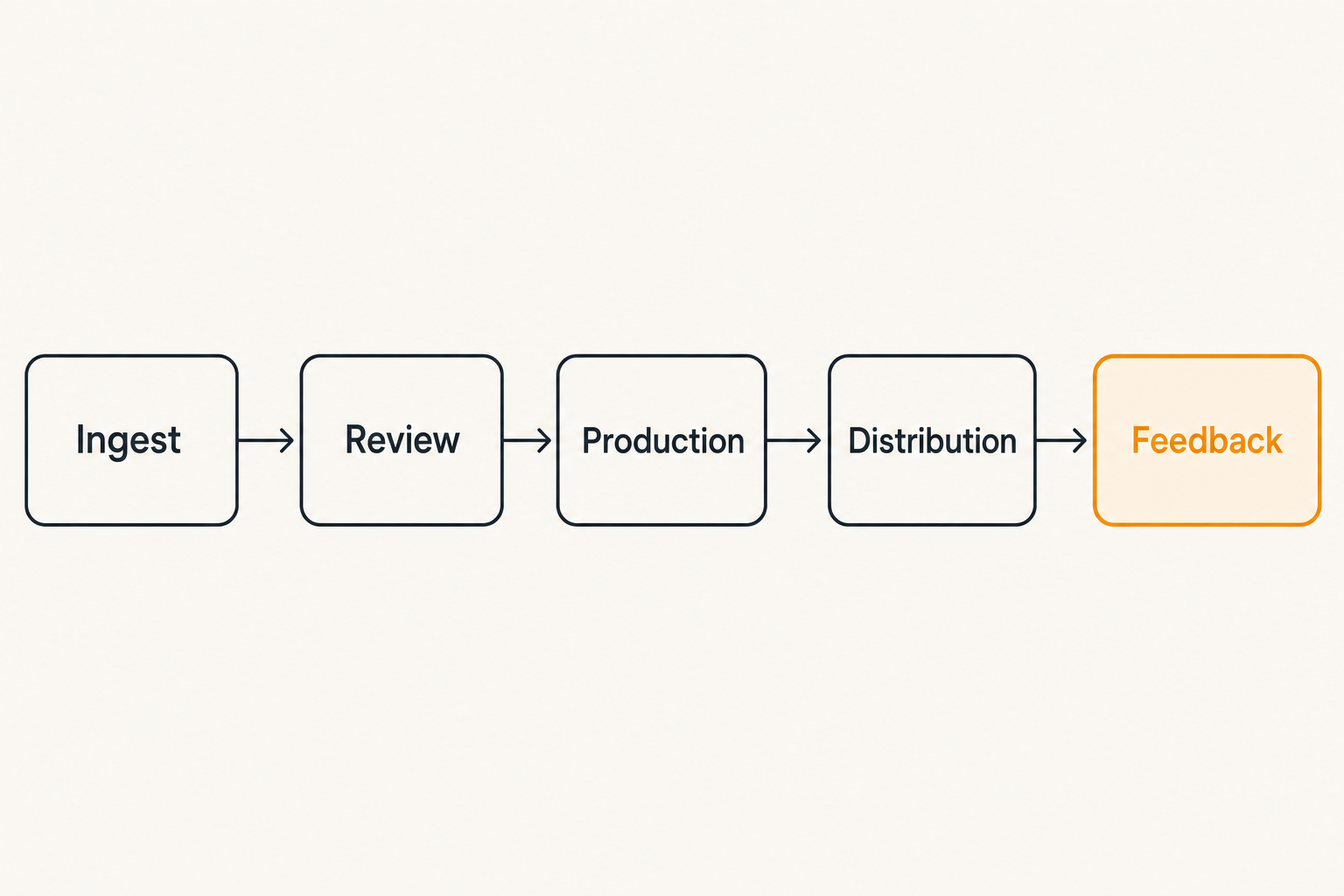
A modern CMS for digital publishers should support the full path from idea to distribution. Not every team needs a complex stack. But every serious publishing team needs an intentional stack.
Ingest is where quality starts
Ingest is the point where ideas, briefs, AI outputs, interviews, transcripts, research notes, customer questions, and campaign requests enter the system.
Bad ingest creates bad publishing. If every idea arrives as an unstructured document, the CMS cannot route it intelligently. If AI drafts appear without source context or target audience, editors waste time reverse-engineering the purpose.
A better ingest object includes:
- Working title
- Target reader
- Search or audience intent
- Content type
- Source material
- Required claims or examples
- Brand or persona
- Distribution targets
- Risk level
- Owner
This is not bureaucracy. It is machine-readable context for the publishing workflow.
Review lanes are the control plane
Review lanes decide what happens before content goes live. They are the control plane of a digital publishing operation.
Common lanes include:
- Editorial accuracy review
- Brand voice review
- SEO review
- Source or fact review
- Compliance or legal review
- Founder or subject-matter review
- Final production review
The trick is not to put every article through every lane. That creates approval theater. The trick is to route based on risk, channel, and purpose.
For example, a low-risk glossary update may need SEO and production review. A thought leadership piece with market claims may need founder review. A sponsored newsletter may need commercial approval. An AI-written comparison article may need a stricter source review.
Distribution is part of the system
Digital publishers rarely publish to one place. A single approved idea may become:
- A blog article
- A newsletter issue
- A podcast outline
- A LinkedIn post
- A short-form video script
- A gated download
- A partner contribution
If the CMS only knows about the blog page, it cannot manage the publishing operation. Distribution should be represented as destinations, variants, and status.
Related reading from our network: teams selling educational products face a similar launch-and-delivery coordination problem in how to sell digital products in 2026, where the offer page is only one part of the operating system.
Build the content lifecycle before you choose software
Software selection usually happens too early. Teams demo platforms before they know their lifecycle. Then they bend the workflow around whatever the tool makes easy.
The better sequence is to define the lifecycle first, then evaluate whether the CMS supports it without hacks.
Draft states should be explicit
At minimum, a digital publisher should define states like:
content_lifecycle:
  - idea
  - brief_requested
  - brief_approved
  - draft_generated
  - editorial_review
  - source_review
  - seo_review
  - ready_for_production
  - scheduled
  - published
  - updated
  - archived
Your exact states may differ. The principle matters more than the labels.
Each state should answer four questions:
- Who owns this now?
- What must be true before it can move forward?
- What automation is allowed at this stage?
- What audit trail is required?
If a state does not answer those questions, it is probably a label, not a workflow control.
Ownership and handoffs need names
What breaks in practice is not usually the first draft. It is the handoff from one function to another.
A creator writes a draft. An editor rewrites the intro. An SEO specialist changes the structure. A newsletter operator repackages the piece. A publisher schedules it. A founder asks for a positioning change after publication.
If ownership is implicit, the team loses time asking who has the ball. That gets worse when AI agents, freelancers, agencies, and internal reviewers all touch the same content.
Every state should have an owner type, not just a person. For example:
- Content strategist owns brief approval.
- AI generation system owns initial draft creation.
- Editor owns editorial review.
- SME owns technical accuracy.
- Producer owns formatting and scheduling.
- Growth owner owns performance review.
This makes the workflow resilient when people change.
Version history is not optional
Version history is often treated as a nice-to-have. For digital publishers, it is operational infrastructure.
You need to know:
- What the AI generated originally
- What the human editor changed
- Which version was approved
- Which version was sent to the newsletter
- Which version was syndicated
- Which version was updated after performance review
Without version history, teams cannot debug quality. They can only argue about it.
Practical rule: If you cannot compare generated, edited, approved, and published versions, you cannot improve the system. You can only judge individual outputs.
AI content belongs in governed lanes, not free text boxes
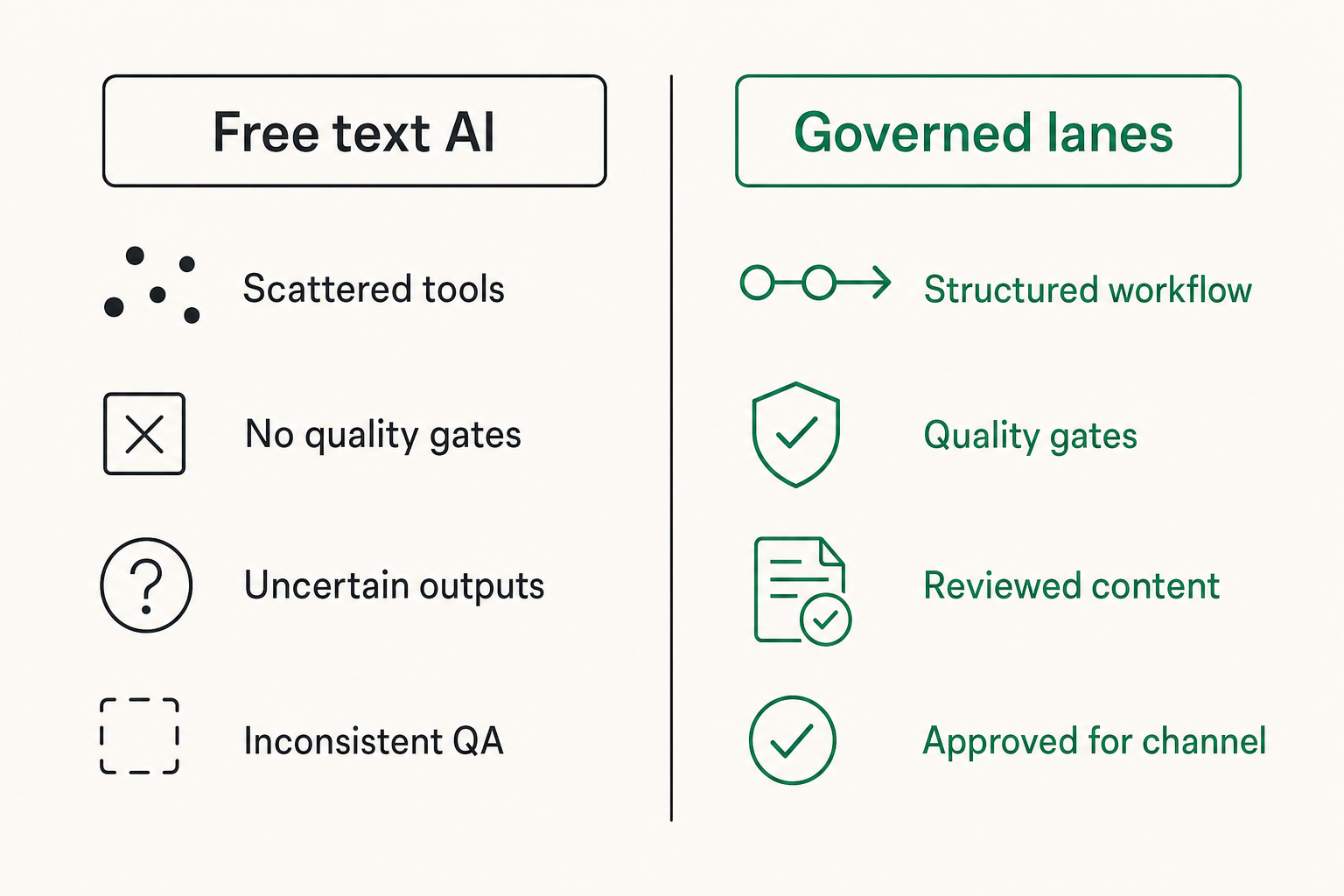
AI publishing becomes risky when generated text is treated as finished content. It becomes useful when generated text is treated as an input to a governed workflow.
Prompting is not governance
Good prompts help. They do not replace workflow.
A prompt can ask for sources, tone, structure, and examples. But the CMS still needs to know whether the output passed review, whether sources were checked, whether the article matches the brand position, and whether it is approved for a specific channel.
The mistake teams make is pushing prompt engineering into every editor and calling that process. That creates inconsistent outputs and impossible QA.
Instead, prompts should be tied to content types, personas, review requirements, and destination channels. A product comparison article should not use the same generation path as a founder essay or a newsletter recap.
Quality gates should be boring
Quality gates should not be dramatic. They should be boring, repeatable, and visible.
Useful gates include:
- Brief completeness
- Source availability
- Claim review
- Brand voice check
- Duplicate angle check
- Internal link review
- Metadata completion
- Channel formatting
- Final approval
The goal is not to make publishing slow. The goal is to prevent avoidable rework.
A good quality gate blocks content only when the missing item matters. A bad quality gate blocks everything because the team never defined risk.
Human-in-the-loop review is a routing problem
Human review is often discussed as if it means every AI draft needs a senior editor reading every word. That does not scale.
Human-in-the-loop review means the system can route the right content to the right human at the right moment. Some drafts need light editorial cleanup. Some need factual verification. Some need positioning review. Some should be rejected before anyone wastes time polishing them.
This is why the CMS needs structured metadata. The system cannot route by risk if risk is not represented.
For teams that want more background on automation without losing editorial control, the prior article on automated blog posting platform architecture covers review gates, approvals, integrations, and measurement patterns.
Comparison: traditional CMS vs publisher workflow CMS
A traditional CMS can still be useful. WordPress, Webflow, headless CMS platforms, and custom publishing stacks all have a place. The issue is not whether they can publish pages. The issue is whether they can manage the work around publishing.
What traditional CMS platforms do well
Traditional CMS platforms are strong at:
- Content storage
- Page editing
- Templates
- Permissions
- Media handling
- SEO fields
- Publishing and scheduling
- Theme or frontend control
For a small team publishing a few human-written articles per month, that may be enough. You can manage the rest in a content calendar and a few checklists.
But once publishing volume increases, the gaps show up.
Where digital publishers outgrow them
Digital publishers outgrow traditional CMS setups when the CMS becomes the final destination instead of the workflow hub.
Common signs:
- Drafts live in docs, but the CMS has only final copy.
- AI outputs are generated elsewhere with no audit trail.
- Review happens in comments, Slack, or email.
- Newsletter copy is manually copied from blog posts.
- Podcast scripts and article versions drift apart.
- Performance data does not connect back to briefs or content types.
- Editors cannot see why a piece was created.
That changes the conversation from CMS features to operating model fit.
Decision table for operators
| Requirement | Traditional CMS focus | Publisher workflow CMS focus |
|---|---|---|
| Primary job | Publish pages | Manage content lifecycle |
| AI support | Often external or plugin-based | Routed through controlled lanes |
| Review process | Draft status and permissions | Multi-stage approvals by risk |
| Distribution | Website-first | Blog, newsletter, podcast, social, syndication |
| Version control | Page revisions | Generated, edited, approved, and channel variants |
| Measurement | Page analytics | Feedback tied to brief, persona, type, and channel |
| Best fit | Low-volume site publishing | High-volume editorial operations |
The table is not an argument that every publisher needs a new platform. It is an argument that the buying criteria should match the work.
Implementation workflow for content teams
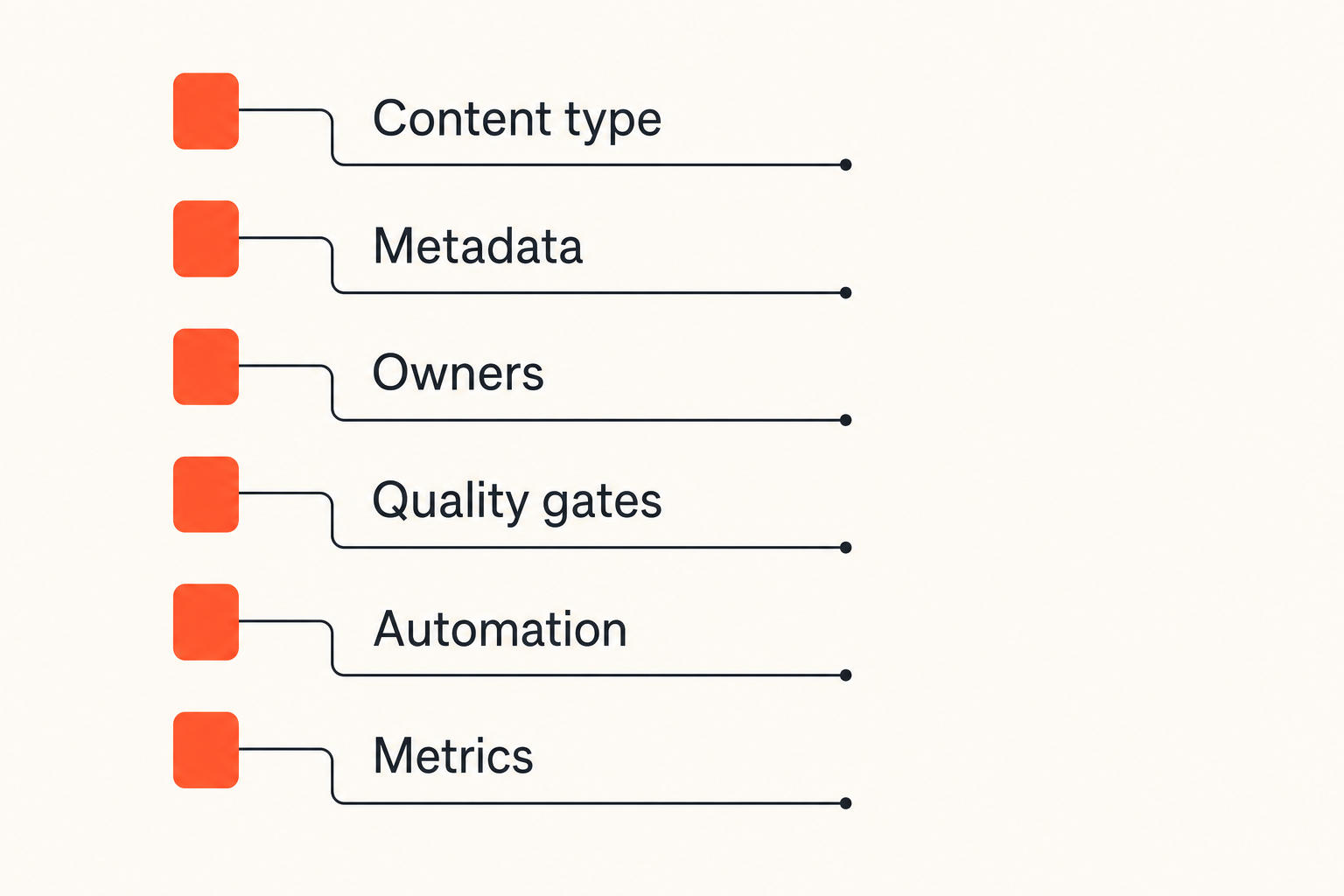
The practical question is not how to migrate everything overnight. It is how to introduce structure without freezing the team.
Start with one repeatable content type
Do not start with the entire editorial operation. Pick one repeatable content type where volume and review pain are visible.
Good candidates:
- SEO blog articles
- Newsletter issues
- Podcast show notes
- Product education posts
- Comparison pages
- Founder-led opinion pieces
Define the lifecycle for that one type. Identify inputs, states, reviewers, approvals, distribution targets, and metrics.
Then run 10 to 20 pieces through the workflow before expanding.
Map review queues before automating
A numbered implementation sequence works better than a tool-first rollout:
- Pick one content type and one owner.
- Define the required metadata for ingest.
- Map lifecycle states from idea to published.
- Assign owner types to each state.
- Define quality gates and rejection reasons.
- Connect AI generation only where inputs are reliable.
- Add distribution destinations.
- Measure cycle time, rework, and content performance.
- Adjust gates that create friction without improving quality.
- Expand to the next content type.
This sequence prevents the common failure where automation accelerates a broken process.
Related reading from our network: workflow design has the same shape in project tooling, and this guide to Asana project management software workflow architecture is useful if your publishing team still manages approvals across boards and tasks.
Automate only after state is clear
Automation should move content between known states. It should not guess what the team meant.
Good automation:
- Creates a draft from an approved brief
- Sends high-risk content to expert review
- Generates newsletter variants after blog approval
- Notifies production when metadata is complete
- Publishes only after final approval
- Sends performance data back to the content record
Bad automation:
- Publishes because a draft exists
- Rewrites approved copy without tracking changes
- Pushes every item to every reviewer
- Creates channel variants before the canonical article is approved
- Treats missing metadata as optional forever
Practical rule: Automate transitions, not intentions. If the state is unclear, automation will make the confusion faster.
Integrations that matter for newsletters, blogs, and creator teams
A CMS for digital publishers should not pretend the website is the whole business. Creator and publishing operations depend on connected systems.
Webhooks and APIs make publishing observable
Webhooks and APIs are not enterprise decorations. They are how publishing events become observable.
Useful events include:
- Brief approved
- Draft generated
- Review requested
- Review completed
- Article scheduled
- Article published
- Newsletter variant created
- Performance threshold reached
- Update requested
When these events are available, teams can connect the CMS to task tools, analytics systems, newsletters, internal dashboards, and AI services.
Without events, every integration becomes polling, copying, or manual checking.
Newsletter and podcast distribution need their own rules
Newsletter operators and podcast teams often work from the same source material as blog teams, but the output rules are different.
A newsletter issue may need:
- Stronger subject-line review
- Sponsorship placement checks
- Segment-specific versions
- Send-time approval
- Link tracking
- Archive formatting
A podcast workflow may need:
- Episode outline
- Host notes
- Guest bio
- Show notes
- Transcript summary
- Newsletter teaser
- Blog recap
The CMS should not flatten these into generic pages. It should preserve the relationship between assets while allowing each channel to have its own workflow.
Related reading from our network: local operators face a similar routing problem when coordinating people and follow-up, which is why this piece on community connections as an operating system is a useful adjacent read for teams thinking beyond simple content calendars.
Analytics and feedback loops close the system
Publishing without feedback is just shipping into fog.
The CMS does not need to replace analytics tools. But it should connect performance signals back to the content record:
- Search impressions
- Click-through rate
- Newsletter opens and clicks
- Subscriber growth
- Assisted conversions
- Content refresh requests
- Topic performance
- Persona performance
The useful question is not just which article performed. It is which brief, angle, persona, review path, and distribution pattern produced the result.
That is how a publishing system learns.
What breaks when teams implement the CMS badly
CMS failure is rarely dramatic at first. It starts as friction. Then the friction becomes normal. Eventually the team accepts bad process as the cost of publishing.
Draft sprawl becomes operational debt
Draft sprawl happens when content exists in too many places with no canonical record.
You see it when:
- Ideas are in spreadsheets.
- Briefs are in docs.
- AI outputs are in chat logs.
- Edits are in duplicated files.
- Final copy is in the CMS.
- Newsletter copy is in another tool.
- Updates are requested in Slack.
The result is not just mess. It is operational debt. Every future update, reuse, audit, and performance review becomes slower.
Approval theater slows everything down
Approval theater happens when every stakeholder gets a chance to comment, but nobody owns a decision.
Symptoms include:
- Too many reviewers on low-risk content
- Vague feedback at the final stage
- Late positioning changes
- Reviewers commenting outside their domain
- No rejection reasons
- No service-level expectations
Approval theater feels safe because many people saw the content. In practice, it reduces accountability.
A useful CMS makes approvals specific. The source reviewer checks claims. The brand reviewer checks positioning. The producer checks formatting. The final approver accepts or rejects against known criteria.
Measurement gaps hide weak content
If performance data is disconnected from the publishing workflow, weak content hides inside averages.
The team may know total traffic is up or down. It may not know whether AI-generated drafts require more editing, whether certain personas perform better, whether long review cycles improve quality, or whether newsletter variants drive more engagement than blog-only publishing.
Measurement gaps make every planning meeting subjective.
What works in production
The teams that make AI-assisted publishing work usually do less magic than outsiders expect. They define a few strong rules and enforce them consistently.
Use explicit queues
Queues are more useful than status labels because they imply action.
Examples:
- Needs brief approval
- Ready for AI generation
- Needs editorial review
- Needs source check
- Needs SEO pass
- Ready for newsletter adaptation
- Ready to schedule
- Needs refresh
Each queue should have an owner and an expected action. If a queue has no owner, it is a parking lot.
Separate generation from publishing
Generation should never equal publishing.
Even if your team uses AI heavily, the CMS should separate:
- Generated draft
- Edited draft
- Approved canonical version
- Channel-specific variants
- Published artifact
This separation protects editorial control. It also makes the operation easier to debug. If quality drops, you can inspect whether the issue came from briefing, generation, review, editing, or distribution.
Review by risk, not ego
Not all content deserves the same review path.
Review by risk means asking:
- Could this make a factual claim that needs verification?
- Could this affect brand positioning?
- Could this create legal or compliance exposure?
- Is this going to a high-value audience?
- Is this evergreen or temporary?
- Is this AI-generated, human-written, or mixed?
Low-risk content should move quickly. High-risk content should get the right review. Senior people should not be bottlenecks for everything.
Practical rule: The best review system is not the one with the most approvals. It is the one that sends each piece to the fewest qualified reviewers needed to make it safe and useful.
Product fit: where bl0ggers.com belongs
A content management system for digital publishers does not have to be a single monolithic product. Many teams will keep their website CMS, newsletter tool, analytics stack, and project tools. The missing layer is often the AI publishing workflow between research and distribution.
Persona-led publishing needs workflow memory
Persona-led publishing gets messy when every content type starts from scratch. A marketer may need one angle for founders, another for operators, another for technical buyers, and another for newsletter subscribers.
The workflow needs memory:
- Which persona is this for?
- What journey stage is it mapped to?
- What voice and depth should it use?
- Which channels should receive variants?
- What review path does that persona require?
This is where bl0ggers.com is designed to fit. The platform focuses on human-in-the-loop AI publishing for blogs, podcasts, newsletters, persona journeys, subdomain publishing, and webhook-based automation. You can read more about the broader platform direction on the bl0ggers.com about page.
Optional human review should be a first-class lane
Some teams want AI-generated drafts queued for review. Some want certain low-risk pieces to move faster. Some want review only for specific personas, topics, or destinations.
Optional human review only works if it is built into the workflow rather than bolted on afterward. The system has to know when a piece is safe to continue, when it needs a person, and what kind of person should review it.
That is the difference between AI-assisted publishing and uncontrolled content generation.
When it is not the right fit
bl0ggers.com is not a replacement for every CMS in every environment.
It is probably not the right fit if:
- You only publish a few manually written pages per year.
- You need deep custom frontend development as the main requirement.
- Your entire workflow is already governed inside a mature editorial platform.
- You do not want AI involved in research, drafting, or repurposing.
It is a better fit when the problem is controlled content volume: more output, more channels, more personas, more review paths, and less tolerance for messy handoffs.
Closing checklist for selecting a content management system for digital publishers
The closing decision is simple, but not easy: select the CMS around the workflow you actually need, not the editor screen you liked most in the demo.
Questions before procurement
Before you buy or rebuild, ask:
- Where do ideas enter the system?
- What metadata is required before drafting?
- Which content types will use AI?
- Who approves briefs?
- Who reviews generated drafts?
- Which review lanes are mandatory by risk?
- How are blog, newsletter, podcast, and social variants connected?
- What is the canonical version?
- What events need webhooks?
- How does performance data return to the content record?
- Who can publish without final approval?
- What happens when a published article needs an update?
If the answer to most of these is a person remembers, the CMS is not the system. The people are.
The final practical test
Here is the practical test for a content management system for digital publishers:
Can a new editor open the system and understand what exists, why it exists, who owns it, what state it is in, what must happen next, where it will be published, and how it performed?
If yes, you have a publishing system.
If no, you have content storage plus human glue.
The mistake teams make is buying storage and expecting operations. The real work is designing the operating layer for digital publishing: state, ownership, review, automation, distribution, and feedback.
That is the CMS conversation that matters in 2026.
Try bl0ggers.com
bl0ggers.com is for content teams, creators, and publishers who want to use AI to increase output without giving up editorial control. Try bl0ggers.com.