
AI has made it cheap to create drafts. It has not made it cheap to trust them. That is why ci/cd security ai content is becoming a real operating problem for publishers, newsletter teams, and content marketers in 2026.
The old workflow was simple enough to manage with folders, comments, and a final editor pass. A writer drafted. An editor reviewed. Someone scheduled. If a mistake slipped through, the blast radius was usually one article.
Now the workflow looks more like software delivery. Prompts, source packs, model outputs, human edits, enrichment tools, CMS permissions, newsletters, social schedulers, and analytics all sit in the same production chain.
Teams think the problem is AI quality. The real problem is pipeline control. Who can introduce an input? Which checks run before publication? What evidence proves a human approved the final version? What happens when a bad claim is syndicated to five channels before anyone notices?
That changes the conversation. AI content governance is not just an editorial preference. It is an architecture and workflow decision.
Table of contents
- Why CI/CD security AI content is a publishing problem now
- CI/CD security AI content starts with a pipeline map
- Define the threat model for AI publishing pipelines
- Build quality gates that editors can actually use
- Design roles and approvals like a release process
- Automate checks without automating judgment
- Logging, provenance, and rollback for AI content
- What breaks when AI content CI/CD security is weak
- Metrics that show whether the workflow is working
- Where bl0ggers fits in a secure AI content workflow
Why CI/CD security AI content is a publishing problem now
The production line changed before the org chart did
Most content teams did not intentionally build an AI publishing pipeline. They accumulated one.
A strategist uses AI to generate topic ideas. A writer uses another tool to draft outlines. An editor pastes sections into a model for tightening. A freelancer uses a browser extension. A newsletter operator rewrites the opening. A social tool generates variants. None of these steps feel dangerous in isolation.
What breaks in practice is the chain between them. If nobody owns the pipeline, nobody knows which inputs reached the final output. Nobody can say which prompt introduced a claim, which source was trusted, or which person approved the version that went live.
Software teams learned this lesson through CI/CD. Speed is useful only when builds are repeatable, changes are traceable, and releases can be stopped. Publishing teams are now learning the same lesson with AI content.
Teams think the risk is bad writing
Bad writing is visible. It sounds generic, repeats itself, or misses the audience. Editors can usually catch it.
The more expensive risks are quieter:
- A sourced claim is slightly wrong.
- A model invents a product capability.
- A contractor uses restricted customer material in a prompt.
- A draft bypasses legal review because it looks low risk.
- A social post repeats an outdated compliance statement.
- A CMS integration publishes the wrong version.
These are not purely writing problems. They are control failures.
Practical rule: If a content issue cannot be traced back to a stage, owner, and approval, the pipeline is under-instrumented.
The practical question is control, not permission
Some teams respond by banning tools. That rarely lasts. People still need speed, and shadow AI use fills the gap.
The better question is not whether AI is allowed. The practical question is where AI is allowed, under what constraints, and with which human checks before release.
A useful way to think about it is this: AI can help produce content, but it should not be able to silently change the authority of the content. Only the workflow should decide what is publishable.
CI/CD security AI content starts with a pipeline map
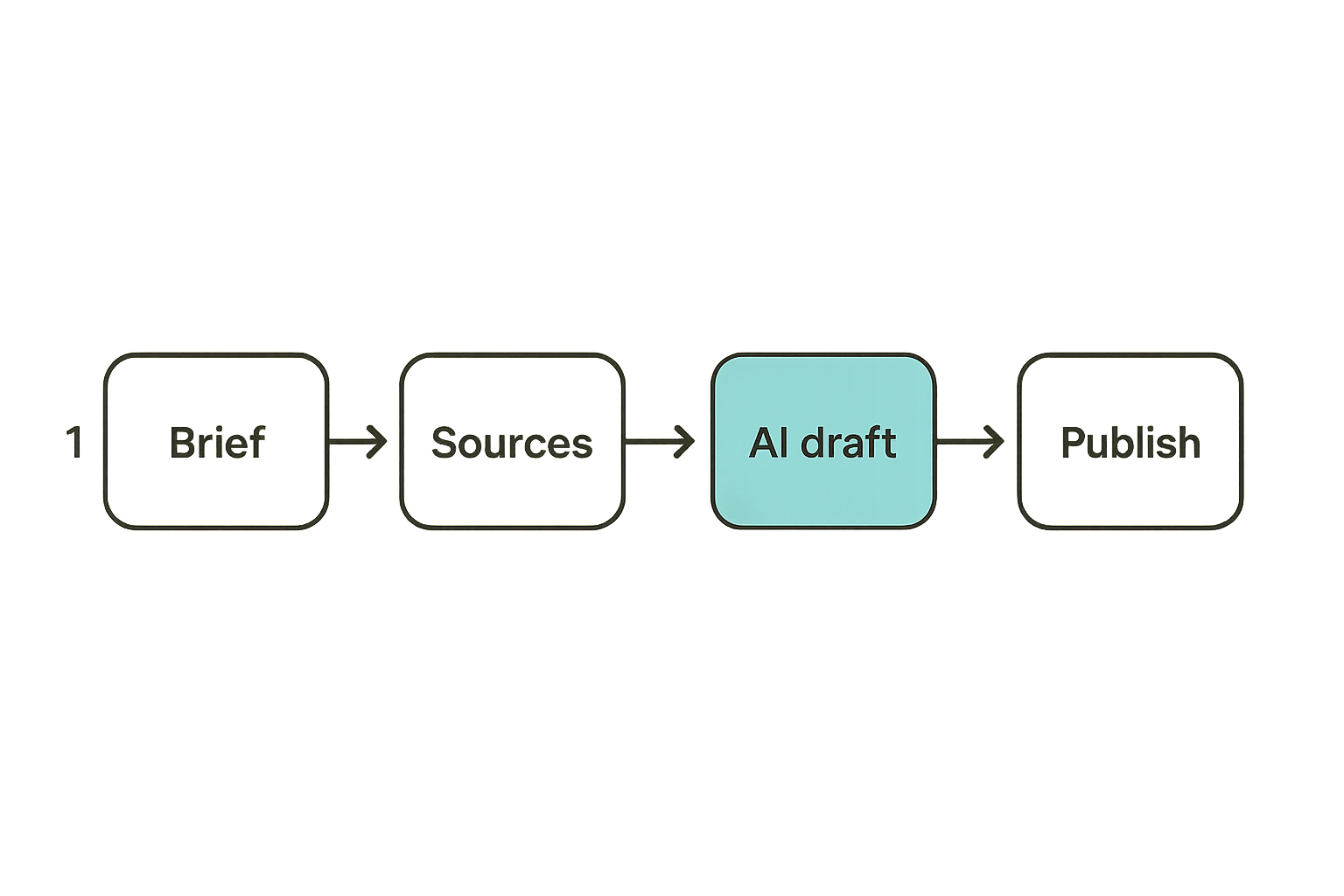
Treat every article like a build artifact
In software delivery, the artifact is the thing you ship. In publishing, the artifact is not just the article body. It is the brief, source pack, draft history, approvals, distribution variants, and metadata that support the published page.
That mindset matters because AI-generated content is rarely created in one clean step. It is assembled through a series of transformations. Each transformation can improve the piece or introduce risk.
A basic AI content artifact should include:
- Topic and audience intent
- Target keyword or distribution goal
- Approved source list
- Prompt or instruction set used
- Draft owner
- Review status
- Approver identity
- Publication destination
- Distribution variants
- Post-publication corrections
The mistake teams make is treating the CMS page as the only record. By the time content reaches the CMS, many decisions have already happened.
Identify inputs, transforms, and release gates
Map the workflow before adding more tools. Keep it simple at first.
| Pipeline element | Publishing example | Security question |
|---|---|---|
| Input | Brief, source, interview notes, product docs | Is this approved for AI use? |
| Transform | Outline, draft, rewrite, summary, translation | What changed and who triggered it? |
| Check | Fact review, plagiarism scan, brand review | Is the check mandatory or optional? |
| Approval | Editor, legal, product owner, sponsor | Who can move it forward? |
| Release | CMS publish, newsletter send, social queue | Can release be stopped or rolled back? |
| Observation | Analytics, comments, complaints, corrections | Are defects fed back into the workflow? |
This does not need to become bureaucracy. It needs to become visible.
Separate creative freedom from production authority
Writers and editors should have room to explore. Exploration is not the same as release authority.
A writer may generate ten headline variants. A strategist may test different outlines. A newsletter operator may ask for shorter subject lines. That is normal creative work.
But production authority should be narrower. Only defined roles should be able to approve the final version, schedule distribution, or change required review lanes.
Practical rule: Let many people experiment in draft space. Let fewer people promote content into publishable space.
Define the threat model for AI publishing pipelines
Prompt injection is not only a chatbot problem
Prompt injection gets discussed as a chatbot issue, but publishers should care too. If your AI workflow reads external pages, customer submissions, comments, scraped material, transcripts, or vendor documents, those inputs can contain instructions that try to influence the model.
For example, a page being summarized could include hidden or visible text telling the model to ignore earlier instructions, endorse a product, leak system prompts, or prioritize certain links. The content team may never see that instruction directly, but the output can still be affected.
This is why source handling matters. AI should not be treated as a neutral reader. It is a transformation layer that can be manipulated by hostile or messy inputs.
The team at vu1nz.com often frames this as a software supply chain issue: when you trust a pipeline output, you are also trusting every upstream input and transformation that shaped it.
Source poisoning and citation drift
Source poisoning is not always dramatic. It can be a low-quality page ranking for a query, an outdated PDF, a copied article, or a vendor page that overstates a claim.
Citation drift is equally common. A source may support one narrow point, while the AI-generated draft expands it into a broader claim. The citation looks legitimate, but it no longer supports the sentence attached to it.
What works:
- Use approved source collections for recurring topics.
- Require reviewers to check claim-to-source alignment, not just link presence.
- Label internal, external, customer, and restricted sources differently.
- Treat dates as part of source quality, especially for product, legal, and technical content.
What fails:
- Asking AI to find sources after the draft is written.
- Letting citations become decoration.
- Assuming a confident paragraph is a verified paragraph.
Account, API, and plugin exposure
AI content operations often connect to more systems than teams realize. Browser extensions, CMS plugins, AI writing tools, automation platforms, analytics dashboards, and social schedulers may all have access to drafts or publishing endpoints.
The risk is not only data leakage. It is also action leakage. A tool with write access can change content. A scheduler can distribute it. A CMS plugin can update pages. An automation account can operate outside normal editorial review.
The practical control is least privilege. If a tool only needs draft access, do not give it publish access. If a contractor only needs one project, do not give them the whole workspace. If an integration is no longer used, remove it.
Build quality gates that editors can actually use
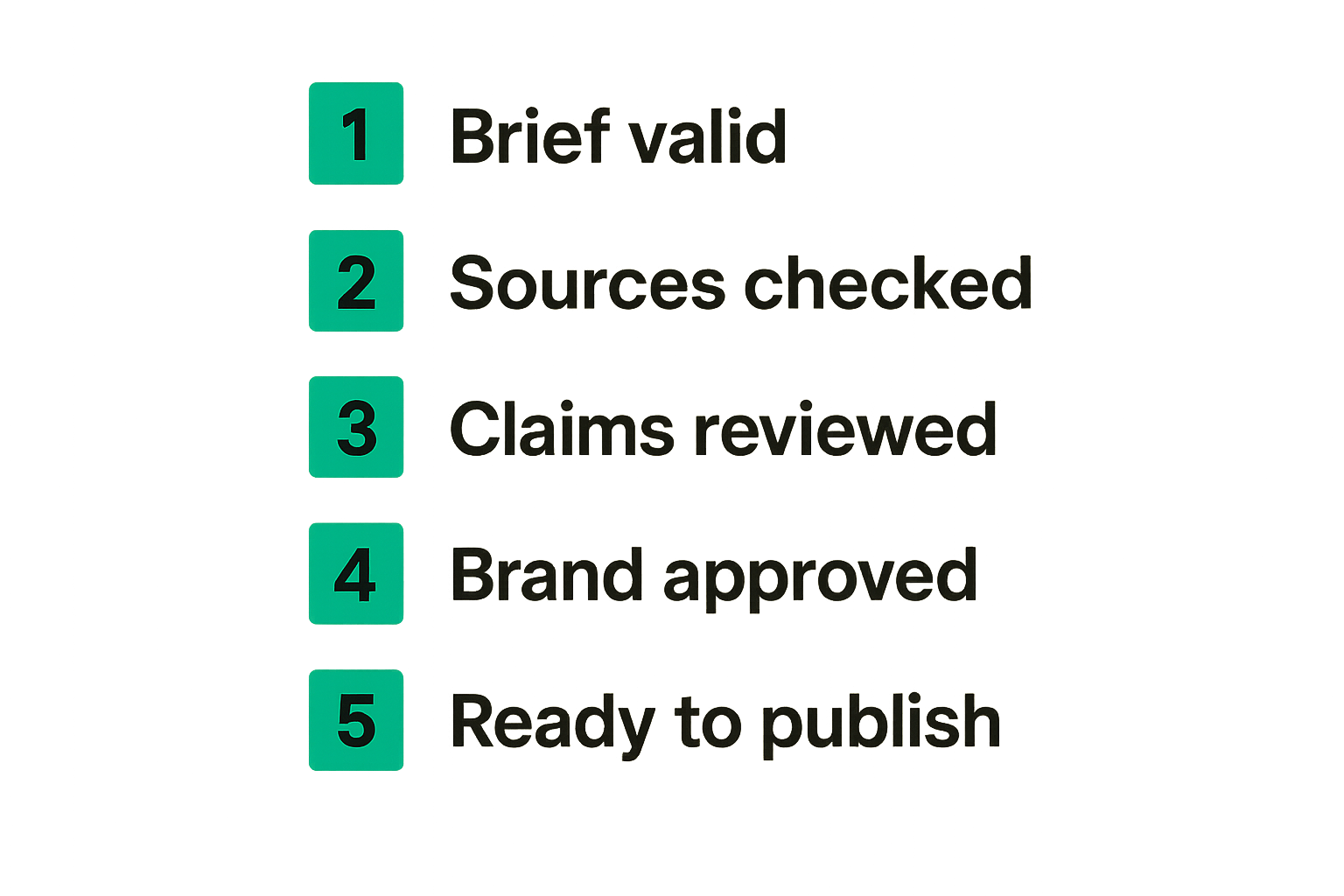
Gate one intent and brief validation
A secure AI content workflow starts before drafting. If the brief is vague, every downstream check gets harder.
The first gate should answer:
- Who is the audience?
- What decision should this piece help them make?
- What claims are allowed?
- What topics are out of scope?
- Which sources are approved?
- Which review lane does this content require?
This is where teams can prevent a lot of rework. AI performs better when the task is constrained. Editors perform better when they know what the draft was supposed to accomplish.
A simple brief control might look like this:
content_type: blog_post
risk_level: medium
audience: content_marketers
ai_allowed_for:
  - outline
  - first_draft
  - headline_variants
restricted_inputs:
  - customer_data
  - unreleased_product_details
required_reviews:
  - editor
  - product_marketing
publish_authority: managing_editor
The format matters less than the decision. The brief should define the lane before the draft enters production.
Gate two evidence and originality checks
The second gate is about the substance of the draft. This is where many teams over-automate and under-review.
Automated checks can flag missing links, suspicious similarity, broken URLs, reading level issues, banned phrases, and missing disclosure fields. Useful. But they cannot fully decide whether a claim is fair, whether a recommendation is responsible, or whether the piece reflects real experience.
Editors should check:
- Does each major claim have support?
- Do citations actually support the sentences near them?
- Are examples plausible and specific?
- Is any confidential or customer-specific detail present?
- Does the draft overstate what the product, method, or source proves?
Practical rule: Automation should reduce the editor's search space. It should not certify truth on behalf of the editor.
Gate three brand, legal, and human approval
The third gate is release readiness. By this stage, the question is not whether the draft is interesting. The question is whether the organization is willing to stand behind it.
For low-risk content, one editor may be enough. For regulated, medical, financial, security, legal, or product-claim-heavy content, the release gate should include more explicit approval.
Do not hide this in comments. Use a status transition. Draft to reviewed. Reviewed to approved. Approved to scheduled. Scheduled to published.
The distinction matters because comments are easy to miss. Status changes create a visible record.
Design roles and approvals like a release process
Who can generate, edit, approve, and publish
Role design is where many AI publishing systems quietly fail. Everyone can do everything because that was convenient during experimentation.
That does not scale.
A practical role model separates four actions:
| Role action | Typical owner | Common mistake |
|---|---|---|
| Generate | Writer, strategist, assistant editor | No limits on source material |
| Edit | Writer, editor | AI rewrites after approval |
| Approve | Managing editor, product owner, legal | Approval happens in comments only |
| Publish | Managing editor, publisher, ops | Scheduler bypasses review status |
The key is not job title purity. Small teams will have people wearing multiple hats. The key is knowing when the same person should not perform every action on high-risk content.
Two-person control for high-risk content
Two-person control is common in security and finance because some actions are too sensitive for one unchecked operator. Publishers can borrow the idea without making it heavy.
Use two-person approval when content includes:
- Legal, financial, health, or security advice
- Product claims with revenue impact
- Customer stories or partner mentions
- Competitive comparisons
- Sensitive company announcements
- AI-generated research summaries
The second reviewer should not just skim. They should have a defined responsibility: factual accuracy, legal exposure, brand risk, technical correctness, or customer sensitivity.
Exceptions should expire
Every team needs exceptions. A breaking news item, urgent newsletter, or timely campaign may need a faster path.
The mistake teams make is letting exceptions become permanent backdoors. A temporary skip becomes normal. A trusted operator gets broad access forever. A fast lane never receives a retrospective.
Build exceptions with expiration:
- Who approved the exception?
- Which gate was skipped or compressed?
- Why was it necessary?
- When does the exception expire?
- What review happens after publication?
Fast workflows are fine. Invisible workflows are not.
Automate checks without automating judgment
What to automate before an editor reads
Automation is most useful when it catches mechanical issues before a human spends attention. Editors should not waste time discovering that a draft has no meta description, broken headings, missing sources, or a duplicated intro.
Good pre-review automation includes:
- Required field checks
- Missing source warnings
- Broken link detection
- Similarity and duplication flags
- Brand terminology checks
- Forbidden phrase detection
- Reading level or structure alerts
- Image alt text reminders
- Disclosure and authorship fields
These checks do not decide whether the content is good. They make the review queue cleaner.
Where humans must stay in the loop
Human judgment is required anywhere the content makes meaning, promises value, or creates liability.
Keep humans responsible for:
- Editorial angle
- Source interpretation
- Sensitive claims
- Audience fit
- Ethical judgment
- Final approval
- Correction decisions
The goal is not to slow the system down. It is to put human attention where it has leverage.
A useful way to think about it is queue design. Automation should push obvious defects back to the owner. Editors should receive drafts that are ready for judgment, not cleanup.
A simple implementation sequence
If you are starting from a loose AI workflow, do not try to rebuild everything in one week. Start with the highest-risk transition: draft to publish.
- Inventory every tool that can create, edit, schedule, or publish content.
- Define content risk levels such as low, medium, and high.
- Create a required brief template for AI-assisted work.
- Add pre-review checks for sources, metadata, links, and restricted terms.
- Define approval states that cannot be skipped silently.
- Limit publish permissions to specific roles.
- Log the prompt set, source pack, draft owner, and approver.
- Test rollback and correction workflows before you need them.
- Review incidents monthly and adjust gates based on real failures.
This sequence works because it does not ask editors to become security engineers. It asks the workflow to carry more of the control burden.
Logging, provenance, and rollback for AI content
Keep a content bill of materials
Software teams use bills of materials to understand what components exist inside a release. Publishers need a lighter version for AI-assisted content.
A content bill of materials should answer:
- Which AI tools were used?
- Which prompts or templates were used?
- Which sources fed the draft?
- Which restricted sources were excluded?
- Who edited the output?
- Who approved it?
- Where was it published or distributed?
You do not need to expose all of this publicly. You do need it internally when a correction, complaint, audit, or performance review happens.
Without provenance, every investigation becomes archaeology.
Version prompts, drafts, and approvals
Prompt versioning sounds excessive until a prompt change quietly changes output quality.
For example, a team may update an instruction to make posts more persuasive. That could also make claims more aggressive. Another team may add a summarization step that drops caveats from technical material. Nobody notices until several pieces have shipped.
Version control does not require a developer workflow. It can be as simple as named prompt templates and locked review notes:
prompt_template: product_blog_v4
source_pack: editorial_ai_security_sources_june_2026
draft_version: 3
editor_review: passed
legal_review: not_required
approval_time: 2026-06-04 14:30 UTC
The point is repeatability. If a workflow produced a good result, you should know how. If it produced a bad result, you should know why.
Rollback is an editorial feature
Rollback is not only for code. Publishers need the ability to stop, correct, and replace content quickly.
Rollback can mean:
- Unpublishing a page
- Restoring a previous version
- Pausing newsletter distribution
- Removing social queue variants
- Updating syndicated copies
- Adding correction notes
- Notifying stakeholders
What breaks in practice is distribution. The CMS page gets corrected, but the newsletter has already sent. Social posts are still queued. Partner feeds have copied the old version. Sales enablement has downloaded the PDF.
Your rollback plan should include every channel the content touches.
What breaks when AI content CI/CD security is weak
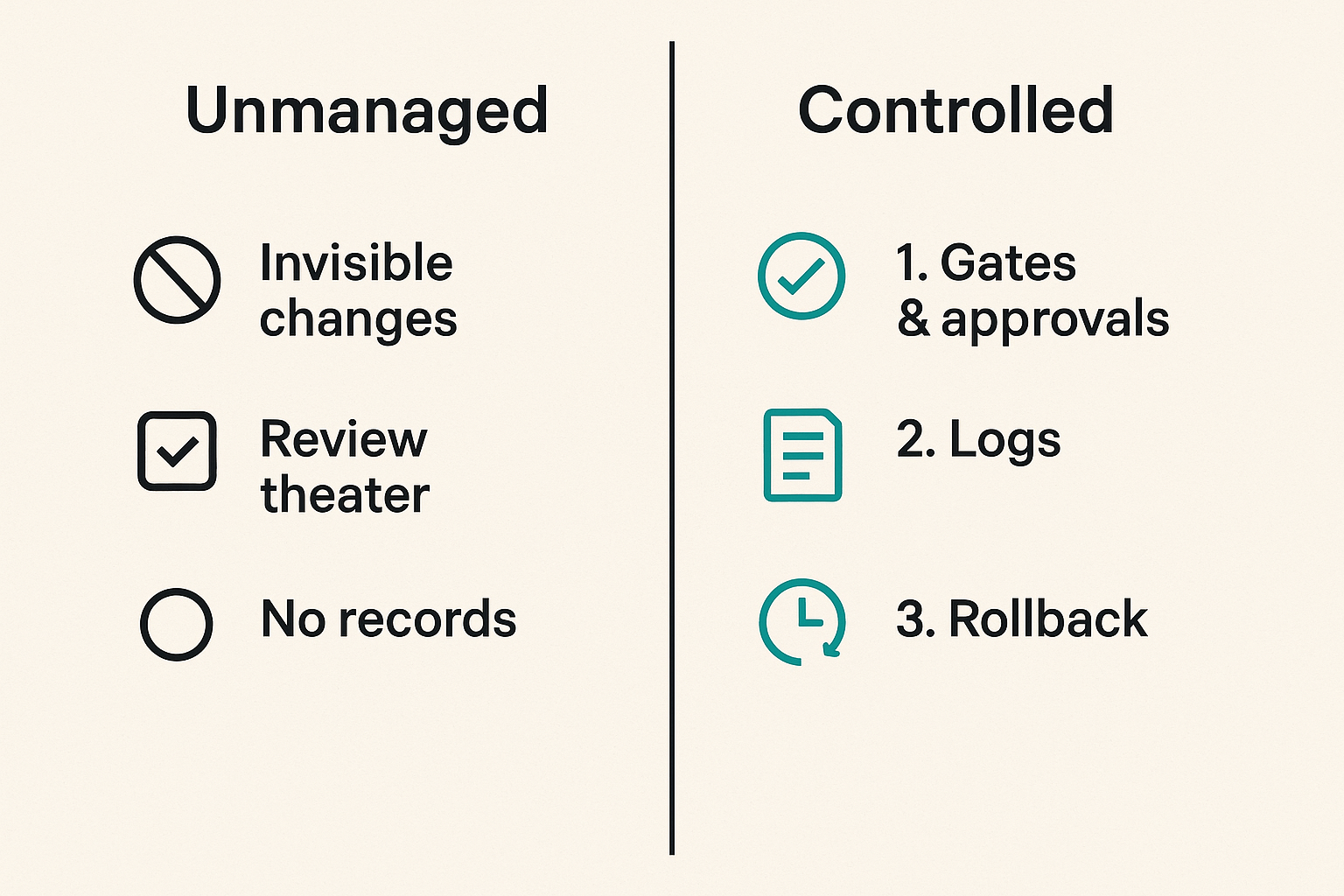
Failure mode: invisible model changes
AI tools change. Models get upgraded. Settings move. Vendors adjust behavior. A prompt that produced careful drafts last month may produce more confident, less cautious drafts today.
If your workflow does not record tool versions, prompt templates, and review results, you may not notice the change until defects increase.
The fix is not to freeze all tools forever. The fix is to treat model or prompt changes like pipeline changes. Test them on known content. Compare outputs. Ask editors what changed. Update review guidance if needed.
Failure mode: review theater
Review theater happens when a workflow looks controlled but does not actually stop bad content.
Common signs include:
- Every draft is marked approved within minutes.
- Reviewers do not know what they are accountable for.
- Required checks live in a document nobody opens.
- Editors review after scheduling instead of before approval.
- AI rewrites happen after final review.
- Publish permissions ignore workflow state.
This is worse than no process because it creates false confidence.
Practical rule: A gate is real only if it can block release and create a record of why it blocked release.
Failure mode: distribution outruns correction
AI speeds up production, but distribution tools can amplify mistakes faster than teams can correct them.
A single flawed claim can move from blog draft to newsletter, LinkedIn, X, partner portal, sales sequence, and paid ad copy. By the time someone flags it, the original article is only one of several places that need repair.
The prevention is not more meetings. It is state-aware distribution. Only approved versions should be available for downstream channels. Distribution variants should inherit approval status from the parent content or require their own review when they introduce new claims.
Metrics that show whether the workflow is working
Measure queue health, not just output
Many teams measure AI success by output volume. More drafts. More posts. More campaigns. That is incomplete.
For secure AI publishing, measure queue health:
- How many drafts are waiting for review?
- How long does each stage take?
- Which gates block most often?
- How many drafts are returned for missing evidence?
- How many pieces require post-publication correction?
- Which tools or templates produce the most rework?
Output without queue health can hide quality debt.
Track defects by pipeline stage
When something goes wrong, classify it by where it should have been caught.
| Defect type | Example | Stage that should catch it |
|---|---|---|
| Bad brief | Audience or angle unclear | Brief validation |
| Unsupported claim | Citation does not prove point | Evidence review |
| Brand mismatch | Tone or terminology off | Editorial review |
| Legal exposure | Overstated guarantee | Legal or risk review |
| Publishing error | Wrong version scheduled | Release gate |
| Distribution drift | Social post adds new claim | Channel review |
This is how you improve the system instead of blaming the last person who touched the draft.
Watch rework and escalation patterns
Rework is a signal. Some rework is normal. Repeated rework from the same template, tool, writer, source type, or topic means the pipeline is misconfigured.
Escalations are also useful. If editors constantly escalate the same content type to legal, make legal review part of the default lane. If product reviewers keep correcting the same claim, update the source pack and prompt guidance.
The practical question is not whether AI content has defects. It will. The practical question is whether defects teach the workflow to improve.
Where bl0ggers fits in a secure AI content workflow
Use the platform as the controlled workbench
The best place for human-in-the-loop AI content is not scattered across personal tools, private chats, and unmanaged docs. It is a controlled workbench where briefs, drafts, review lanes, approvals, and publishing decisions are visible.
That is the role a platform like bl0ggers.com should play for content teams: not replacing editors, but giving editors a pipeline they can actually operate.
In practice, that means centralizing the parts of the workflow that matter:
- Brief creation
- AI-assisted drafting
- Editorial review
- Approval states
- Content ownership
- Publishing readiness
- Measurement feedback
The value is not that every step becomes automatic. The value is that the team can see the step, assign the step, and enforce the step.
Product fit without pretending software replaces editors
Software cannot decide your editorial judgment for you. It can make the judgment easier to apply consistently.
For publishers and content marketers, the right product fit looks like this:
- AI helps create options, not unchecked final authority.
- Review lanes match real editorial risk.
- Approvals are recorded as workflow events.
- Distribution depends on content state.
- Measurement feeds back into future briefs.
- Humans retain control over meaning, claims, and release.
That is the architecture that makes AI useful instead of chaotic.
The closing point is simple: ci/cd security ai content is not about turning writers into DevOps teams. It is about borrowing the useful parts of release discipline so AI publishing can scale without losing control.
Try bl0ggers.com
Build AI-assisted publishing workflows with human review, quality gates, approvals, and editorial control. Try bl0ggers.com.