
Your content backlog is not getting smaller. The team has more keywords, more product launches, more newsletters, more partner requests, and more channels than it can reasonably support by hand.
That is why blog content automation keeps coming up in 2026 planning. Not because every marketer wants a robot writer, but because the old workflow breaks when the business wants consistent publishing across blogs, newsletters, podcasts, and social distribution.
Teams think the problem is generating more drafts. The real problem is moving ideas through a controlled publishing system without losing judgment, quality, or accountability.
The mistake teams make is treating automation as a content shortcut. The practical question is different: what parts of the publishing operation should be automated, what parts must stay human, and how do you make the handoffs observable?
Table of contents
- Blog content automation is a workflow architecture
- What blog content automation should own
- The operating model for human in the loop automation
- Build the pipeline around states not files
- Quality gates that prevent scaled mediocrity
- Integration points that matter in production
- Measurement for blog content automation
- Common failure modes and what breaks
- What works versus what fails
- Implementation sequence for 2026
- Where bl0ggers.com fits in the stack
- Closing make blog content automation boring
Blog content automation is a workflow architecture
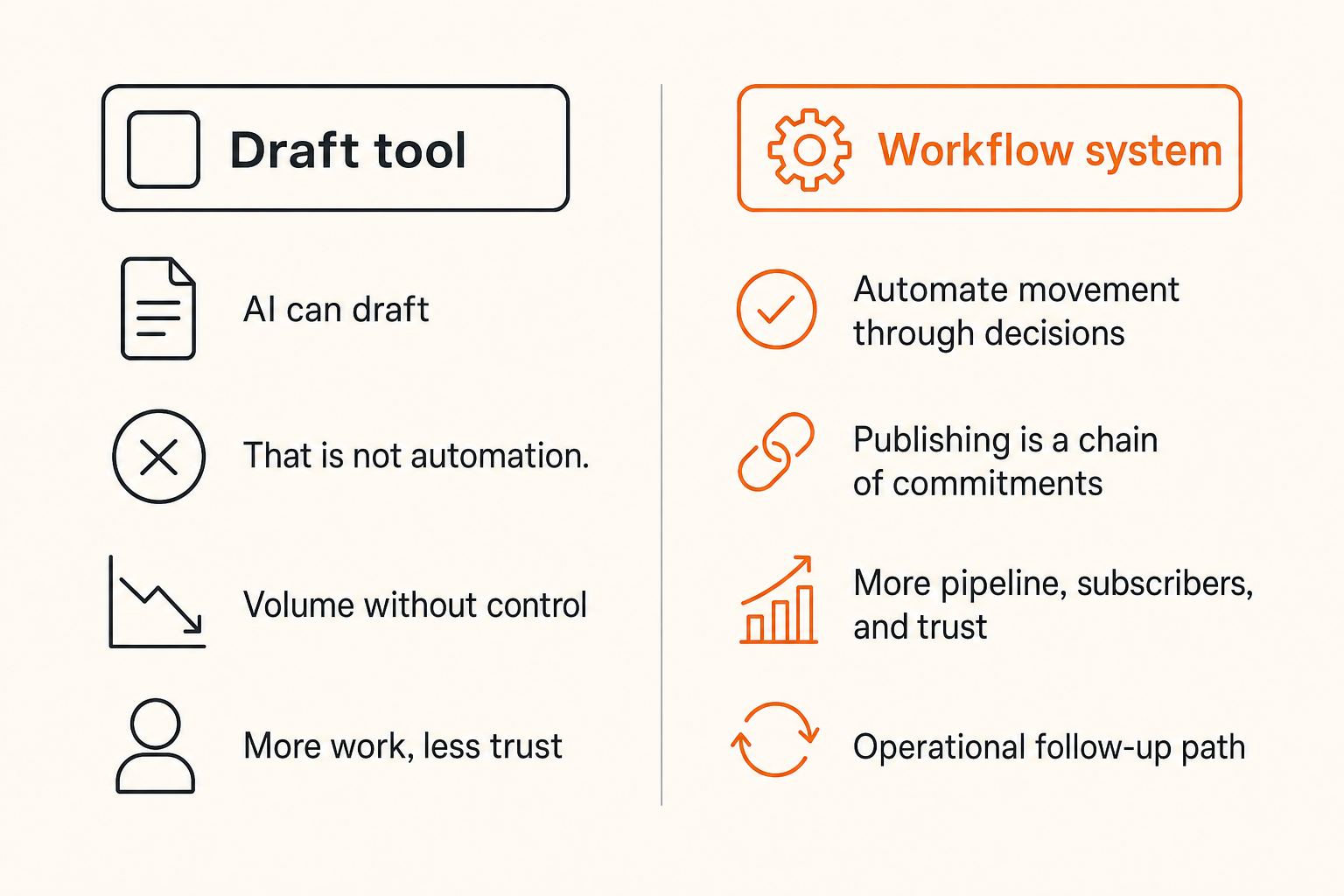
The mistake teams make is treating AI like a writer
Most failed blog content automation projects start with the same assumption: if the model can draft, the operation is automated.
That is not automation. That is draft generation.
A publishing operation includes topic selection, search intent checks, audience alignment, source collection, outline approval, draft creation, expert review, editing, compliance checks, formatting, CMS publishing, newsletter repackaging, social snippets, internal linking, analytics, and refresh decisions.
If only one of those steps is automated, the team still owns the whole mess manually. Worse, the automated draft can create more work if it arrives without context, citations, positioning, or a clear approval path.
A useful way to think about it is this: AI can produce text quickly, but publishing is a chain of commitments. Every article commits the brand to a point of view, a promise to the reader, and an operational follow-up path.
Practical rule: Automate the movement of content through decisions, not just the production of paragraphs.
When teams skip that distinction, they get volume without control. Editors become cleanup staff. Strategists stop trusting the queue. Writers resent the system. Leadership sees more posts but not more pipeline, subscribers, or trust.
That changes the conversation. The question is no longer whether AI can write a blog post. The question is whether your team can design a system where AI assists the right steps, humans approve the right decisions, and every asset has a clear state.
The practical question is where judgment belongs
Judgment is not evenly distributed across a publishing workflow.
Some decisions are mechanical. Does the title fit the field length? Is the slug unique? Are required metadata fields present? Did the article include the chosen CTA? Has the post been exported to the CMS?
Some decisions are editorial. Is the angle useful? Does the article say something the reader can act on? Is the claim too broad? Does the draft reflect the brand voice? Should this piece exist at all?
Some decisions are business decisions. Which persona matters this quarter? Which product motion needs support? Which channel gets the first version? Which topics deserve refreshes instead of net new posts?
Good blog content automation keeps those decision types separate. It lets systems handle repeatable checks and routing. It lets humans handle judgment. It gives operators enough visibility to see where content is stuck.
The practical design question is not human versus AI. It is which decision belongs to the model, which belongs to the editor, which belongs to the strategist, and which belongs to the publishing system.
What blog content automation should own
Inputs research and briefs
Automation should start before the draft. If the only input is a keyword, the system will produce generic content because the brief is generic.
A strong automated content lane should collect and normalize inputs such as:
- Primary keyword and secondary search themes
- Target reader and buying stage
- Product or offer connection
- Internal links to include
- External sources or notes approved by the team
- Required examples, objections, or use cases
- Formatting requirements
- Distribution targets
- Reviewer and approval owner
This is where many teams underinvest. They expect the model to infer strategy from a topic. In production, that creates shallow articles that sound polished but do not support the business.
The brief is the control surface. If you want better automated content, improve the brief schema before you tune the prompt.
Practical rule: A weak brief produces weak automation, even with a strong model.
A practical brief does not need to be long. It needs to be explicit. For example:
content_lane: seo_blog
persona: newsletter_operator
intent: compare workflow options
risk_level: medium
required_angle: automation must preserve editorial approval
reviewer: managing_editor
publish_target: blog
repurpose_targets: newsletter, social
That type of structured input gives the system something operational to work with. It also gives reviewers a baseline. They can ask whether the article satisfied the brief instead of debating vague taste.
Drafting enrichment and packaging
Drafting is still useful. It is just not the whole system.
Automation can generate outlines, first drafts, meta descriptions, excerpts, pull quotes, newsletter summaries, podcast scripts, internal link suggestions, and social variants. It can also normalize formatting so editors are not wasting time fixing heading levels and metadata fields.
The mistake teams make is asking for one final article too early. Better systems produce intermediate artifacts:
- Search intent summary
- Proposed angle
- Outline
- Draft
- Editorial risk notes
- Repurposed newsletter version
- Social post options
- CMS-ready package
Each artifact gives a human a chance to intervene at the right level. If the angle is wrong, reject it before a 2,000-word draft exists. If the outline is sound but the intro is weak, route only that part for revision.
This is especially important for publishers and creators with a strong point of view. The more distinctive the voice, the more the system needs structured review points.
Publishing distribution and measurement
Publishing is where many automation projects stop being impressive.
A draft in a document is not a published asset. A published blog post is not a distributed asset. A distributed asset is not a measured asset.
Blog content automation should own the handoff from approved content into the systems where content lives and performs. That usually means CMS publishing, tags, canonical fields, author assignment, newsletter packaging, social snippets, and event logging.
This is also where business context matters. A founder newsletter may need a different approval path from an SEO glossary post. A sponsored editorial piece may need legal review. A product launch post may need coordination with sales enablement.
The workflow should know those differences. Otherwise every asset becomes an exception, and exception-heavy systems do not scale.
The operating model for human in the loop automation
Assign clear ownership for each state
Human-in-the-loop publishing is not a slogan. It is an ownership model.
If a post is in draft review, who owns the next action? If it is waiting on subject matter review, who can approve or reject it? If it is approved but not published, who is accountable for the CMS handoff?
Many teams say they have human review, but what they really have is a shared queue with unclear responsibility. That breaks under volume.
A better model assigns an owner to every state:
| State | Primary owner | Automation role | Human decision |
|---|---|---|---|
| Brief requested | Strategist | Collect fields and validate completeness | Is this topic worth producing? |
| Outline ready | Editor | Generate structure and intent notes | Is the angle right? |
| Draft ready | Writer or editor | Produce first draft and metadata | Is it useful and accurate? |
| SME review | Expert | Route risky claims | Are claims defensible? |
| Publish ready | Content ops | Format and prepare CMS package | Can this go live? |
| Distributed | Growth owner | Generate channel variants | Where should this be promoted? |
| Measured | Operator | Pull performance data | Refresh, repurpose, or retire? |
If you are designing this from scratch, it is worth reading the adjacent workflow view in Human in the Loop AI Publishing, because the core issue is not model capability. It is routing, review, and authority.
Separate production speed from editorial authority
Automation increases production speed. It should not automatically increase publishing authority.
That distinction matters. A system can create ten drafts overnight. It should not publish ten drafts overnight unless the team has explicitly approved that lane for auto-publishing.
Different lanes need different authority levels:
- Low-risk updates may publish after automated checks.
- Standard SEO posts may require editor approval.
- Product positioning posts may require product marketing review.
- Regulated or sensitive topics may require legal or executive review.
The practical question is not whether you trust AI. The question is which content types can tolerate automation risk and which cannot.
Practical rule: Speed belongs in production. Authority belongs in approval.
This also protects morale. Editors should not feel like the system is pushing content live behind their backs. Operators should not need to beg for approvals in Slack. The workflow should make authority visible.
Build the pipeline around states not files
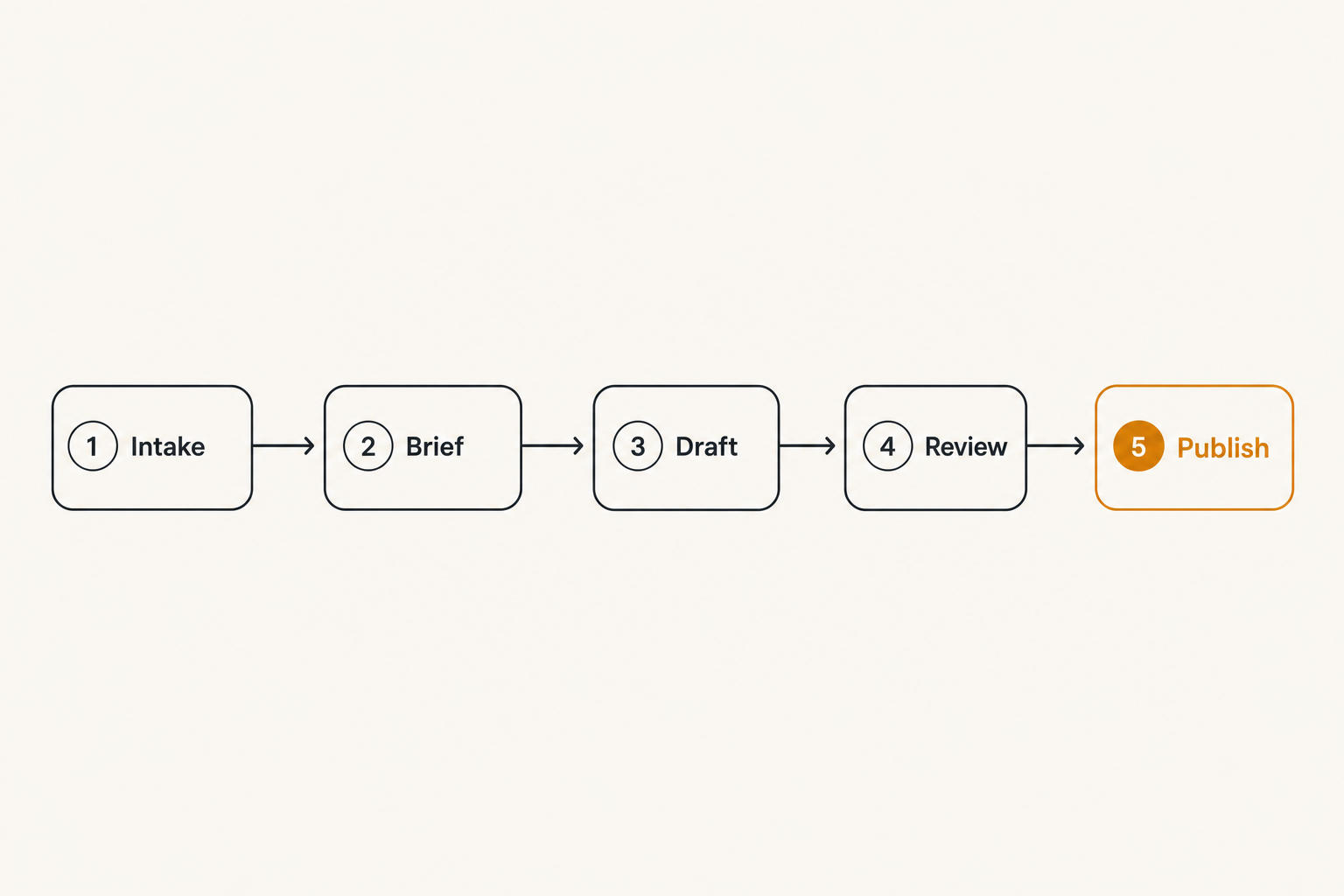
A practical state machine for posts
The simplest way to make blog content automation reliable is to stop thinking in documents and start thinking in states.
A document is just a container. A state tells the team what has happened, what is allowed next, and who owns the decision.
A practical state machine might look like this:
- Intake submitted
- Brief validated
- Outline generated
- Outline approved
- Draft generated
- Editorial review requested
- Revision requested or approved
- SME review requested if needed
- Publish package generated
- Scheduled or published
- Distributed
- Measured
- Refresh queued or archived
This is not bureaucracy. It is how you prevent content from disappearing into random docs, inboxes, and chat threads.
Each transition should have rules. A draft should not move to publish ready if required metadata is missing. A post should not move to distributed if it has not been published. A refresh should not be queued unless there is a reason, such as outdated positioning, declining traffic, or a new product feature.
Related reading from our network: editor-native agent workflows face similar state and permission problems, and Vim Tools in 2026 is a useful adjacent read on schemas, events, and operator-safe automation.
Idempotency for content operations
Payments teams talk about idempotency because retries can accidentally charge a customer twice. Content teams need a lighter version of the same discipline.
If a webhook fires twice, should the article publish twice? If a reviewer clicks approve twice, should the system create duplicate CMS entries? If a newsletter export fails and retries, should it create conflicting campaign drafts?
What breaks in practice is not usually the happy path. It is retries, partial failures, duplicate events, and manual overrides.
A useful content operation should track IDs and state transitions:
article_id: ai-pub-1042
current_state: publish_ready
last_event: editor_approved
cms_entry_id: wp_88319
newsletter_draft_id: nl_4412
allowed_next_states:
  - scheduled
  - returned_to_edit
This is the difference between a toy automation and a production workflow. If you cannot answer what happened to an asset, who approved it, and which downstream systems received it, you do not have operational control.
For a broader platform-level view, the earlier guide to automated blog posting platform architecture maps these same issues across review gates, approvals, integrations, and measurement.
Quality gates that prevent scaled mediocrity
Gate for intent and audience fit
The first quality gate should happen before drafting. It answers a simple question: should this content exist for this audience?
Many teams automate from keyword lists without checking intent. That creates articles that technically target a term but do not satisfy the reader. A newsletter operator searching for automation does not need a generic definition. They need to know what to automate, what to review, and how not to damage subscriber trust.
An intent gate can be lightweight:
- Who is the reader?
- What decision are they trying to make?
- What pain point opens the article?
- What practical workflow should the article help them implement?
- What should the reader do next?
If those answers are weak, do not draft. Fix the brief.
Gate for factual risk and brand voice
Not every article has the same risk profile. A low-stakes listicle and a technical product comparison should not use the same review path.
Classify risk before review:
| Risk level | Examples | Required review |
|---|---|---|
| Low | Simple recaps, internal updates, basic evergreen posts | Editor only |
| Medium | SEO posts with product claims or workflow advice | Editor plus subject owner |
| High | Legal, financial, medical, security, or competitive claims | Expert review and approval log |
Brand voice is a separate gate. Automation often produces text that is clean but bland. Editors should not only check grammar. They should check whether the article sounds like the company has a real operating point of view.
A useful review prompt for editors is: would a knowledgeable reader believe this was written by a team that has actually dealt with the problem?
If the answer is no, the article needs more context, sharper examples, or a narrower claim.
Gate for publish readiness
Publish readiness is not editorial taste. It is an operational checklist.
Before content moves into the CMS, the system should verify:
- Title and slug are present
- Meta description and excerpt exist
- Category and tags are assigned
- Internal links are included
- CTA is present
- Image placeholders or assets are handled
- Author and publish date are set
- Canonical rules are correct
- Newsletter and social variants are ready if required
This is where automation saves real time. Humans are expensive when they are doing repetitive formatting checks. Let the system catch missing fields and broken handoffs.
Practical rule: Humans should review judgment. Systems should enforce completeness.
Integration points that matter in production
CMS and subdomain publishing
The CMS is not just a place where content appears. It is part of the automation boundary.
If your workflow cannot create drafts, update metadata, attach authors, manage categories, and preserve canonical rules, your team will still do manual publishing work. That may be acceptable at low volume. It becomes a bottleneck when publishing across multiple sites, brands, or subdomains.
For publishers building media networks or persona-specific properties, subdomain publishing adds another layer. Each property may need different templates, CTAs, taxonomy, and review authority.
The practical question is whether the automation system understands those differences or treats every destination like the same blog.
Newsletters podcasts and social distribution
A blog post rarely lives alone. For creators and newsletter operators, the blog is often the source asset for multiple downstream formats.
A good system can turn an approved article into:
- Newsletter edition
- Podcast outline or short script
- LinkedIn post
- X thread
- Internal sales note
- Short-form summary
- Refresh reminder
The point is not to spam every channel. The point is to reduce the cost of adapting a strong idea into the formats your audience already uses.
This is also where human judgment still matters. A newsletter intro needs more personality than an SEO intro. A podcast outline may need a stronger narrative arc. A social post may need a sharper opinion.
Automation should create variants. Humans should approve the ones that represent the brand well.
Webhooks and events for operational control
Webhooks are where blog content automation becomes part of the broader business system.
Events such as brief approved, draft ready, editor approved, post published, newsletter packaged, and refresh queued can trigger notifications, task creation, CMS updates, or analytics logging.
This matters because content operations rarely live in one tool. Teams use CMS platforms, project management systems, analytics tools, newsletter providers, and internal databases. Without events, people become the integration layer.
Related reading from our network: high-risk payment teams deal with similar handoff, reconciliation, and settlement boundaries, and Wolverine Peptide Payments is a useful comparison for thinking beyond the visible checkout screen.
Measurement for blog content automation
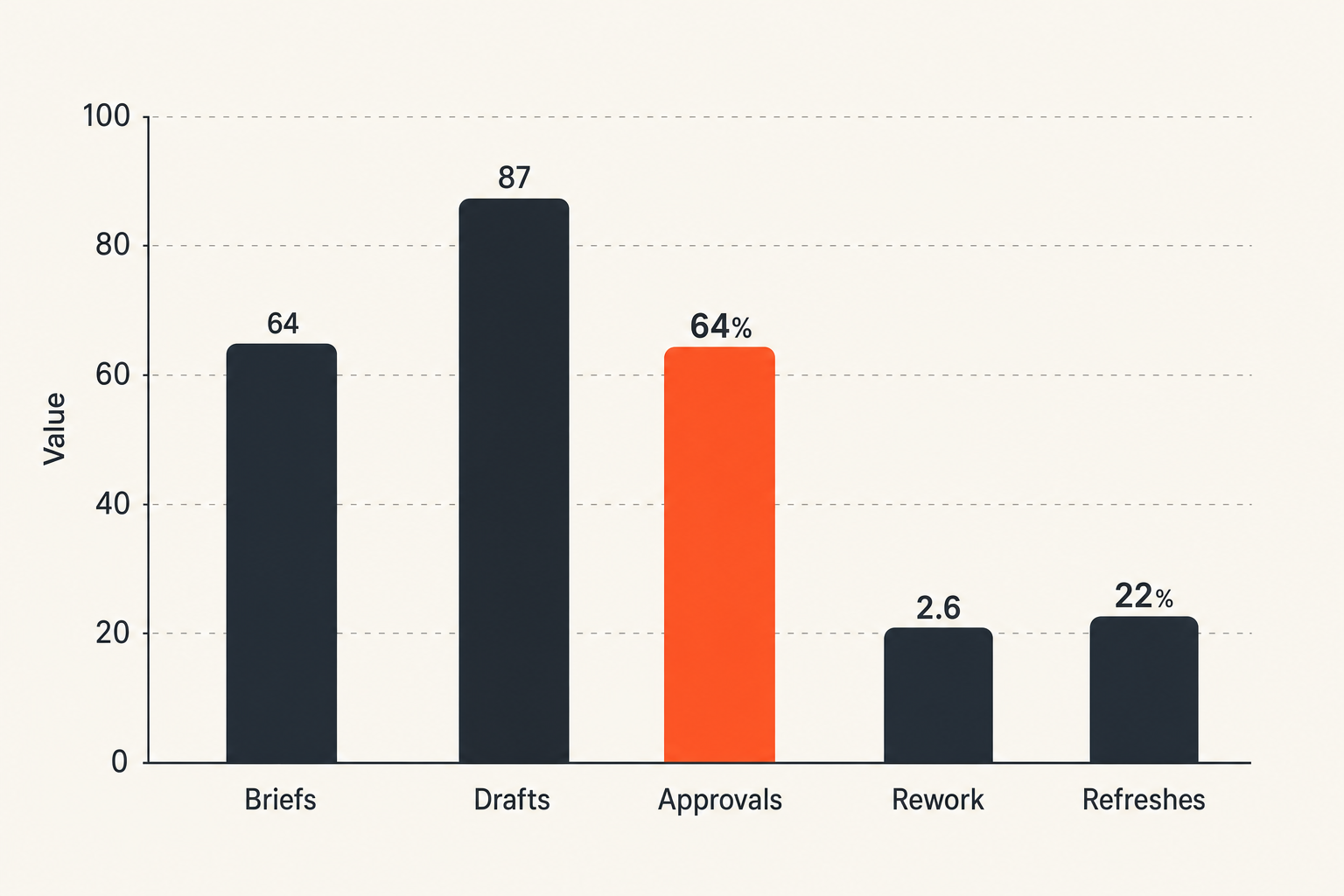
Track throughput without rewarding junk
Measurement can ruin automation if you pick the wrong scoreboard.
If the main metric is posts published, the system will optimize for posts published. That sounds obvious, but many teams still do it. They create more content and then wonder why quality drops, editors burn out, and the site fills with overlapping articles.
Track throughput, but pair it with quality and business context:
| Metric | Why it matters | What to watch |
|---|---|---|
| Briefs approved | Shows strategy input volume | Too many weak briefs |
| Drafts generated | Shows production capacity | Drafts without review capacity |
| Approval rate | Shows brief and draft quality | Rubber-stamp approvals |
| Revision cycles | Shows review friction | Endless rewrites |
| Publish cycle time | Shows operational speed | Fast publishing of weak assets |
| Refresh rate | Shows maintenance discipline | New posts while old posts decay |
| Assisted conversions or subscribers | Shows business contribution | Attribution overconfidence |
A useful dashboard separates production health from performance health. Production health tells you whether the workflow is moving. Performance health tells you whether the work is worth doing.
Track review friction and rework
Review friction is one of the best signals in an AI publishing workflow.
If editors are rewriting every draft, the model is not the only problem. The brief may be weak. The voice guidance may be vague. The topic may be poorly chosen. The reviewer may be receiving work too late in the process.
Track rework by reason:
- Wrong audience
- Wrong angle
- Thin examples
- Unsupported claims
- Brand voice mismatch
- Missing product context
- Formatting or metadata issues
- Duplicate topic overlap
This makes improvement concrete. Instead of saying AI content is bad, you can see the failure mode. If most rework is brand voice, improve examples and style constraints. If most rework is factual risk, add source requirements and SME routing. If most rework is audience mismatch, fix intake.
That changes the conversation from taste to operations.
Common failure modes and what breaks
When automation bypasses strategy
The fastest way to create a low-quality content engine is to connect a keyword list directly to a draft generator.
What breaks in practice is topical discipline. You get duplicate posts, shallow angles, and articles that compete with each other. Editors become traffic cops. Readers see repetition. Search performance becomes harder to interpret because the site is full of near-overlapping assets.
The fix is not more prompting. The fix is strategy gates before production.
Every topic should answer:
- Which persona is this for?
- Which business motion does it support?
- What existing asset does it compete with or complement?
- What unique angle are we adding?
- What should happen after publication?
If those answers are missing, automation should stop.
Related reading from our network: incident response teams face the same ownership and triage problem under pressure, and CHP Traffic Incident Thinking for SOC Incident Response Architecture is a useful adjacent analogy for routing work instead of just receiving alerts.
When approvals are unclear
Unclear approvals create two bad outcomes.
Either content waits too long because nobody knows who can approve it, or content goes live too easily because everyone assumes someone else checked it.
Both are operational failures.
For each content lane, define:
- Who can approve the brief
- Who can approve the outline
- Who can approve the draft
- Who can override a rejection
- Who can publish
- Who can request a post-publication correction
Approval logs do not need to be heavy. But they need to exist. If a claim is challenged later, the team should know who approved the piece and what review path it followed.
This is especially important for multi-author publishers, agencies, and creator teams where freelancers, editors, and founders may all touch the same asset.
When distribution is bolted on later
A common pattern: the team automates blog drafting, publishes more posts, and then realizes nobody built a distribution workflow.
The content goes live. Maybe it gets indexed. Maybe it does not. The newsletter team does not know it exists. The social team rewrites from scratch. The sales team never sees it. The post has no feedback loop.
Distribution should be designed at intake. If the post is meant to support a newsletter, collect that requirement up front. If it should feed a podcast, create the outline while the article is still fresh. If it supports a product launch, schedule it against the launch calendar.
Automation should not end at publish. Publish is just one state in the workflow.
What works versus what fails
What works
The teams that make blog content automation useful tend to do a few things consistently.
They start with a narrow lane. They pick one content type, one audience, and one review path. They define the states. They assign owners. They measure cycle time and rework. They improve the brief before blaming the model.
They also keep human review close to the decisions that matter. Editors approve angles early. Subject experts review risky claims before publication. Operators enforce metadata and distribution rules with automation.
A working system usually looks boring:
| Good pattern | Why it works |
|---|---|
| Structured intake | Reduces vague prompts and weak drafts |
| Outline approval | Catches bad angles early |
| Risk-based review | Avoids over-reviewing simple posts and under-reviewing sensitive ones |
| State-based workflow | Makes ownership visible |
| CMS-ready packaging | Reduces manual publishing labor |
| Measurement by rework reason | Improves the system over time |
Boring is the point. The best automation disappears into the operating rhythm of the team.
What fails
What fails is usually louder.
A team buys a tool, connects a model, generates a batch of posts, and creates a new review burden. The first week looks exciting. The third week exposes the real issue: nobody defined what good means, who approves what, or how the content supports the business.
Common failure patterns include:
- Prompt libraries with no workflow
- Draft volume without review capacity
- Auto-publishing without risk classification
- No internal linking plan
- No refresh process
- No channel packaging
- No audit trail
- No clear owner for stuck content
The mistake teams make is assuming automation removes the need for content operations. In reality, automation increases the need for content operations because the system can move faster than the team can reason about it.
Implementation sequence for 2026
Start with one content lane
Do not automate the whole publishing function first.
Start with one lane that has enough volume to matter and low enough risk to learn safely. For many teams, that is an SEO blog lane, founder newsletter repurposing lane, or product education lane.
Define the lane in plain terms:
- Audience
- Content type
- Required input fields
- Draft format
- Review owner
- Approval rule
- Publishing destination
- Distribution outputs
- Metrics
Then run a small batch. Not fifty posts. Five to ten is enough to reveal workflow problems.
Look for where content gets stuck. Intake? Outline approval? Draft review? CMS formatting? Newsletter packaging? Analytics? That bottleneck is the next automation target.
Add automation only after the lane is observable
Automation without observability creates hidden failure.
Before adding more generation, make sure you can see:
- How many items are in each state
- Average time per state
- Rejection reasons
- Revision reasons
- Reviewer workload
- Publish errors
- Distribution completion
- Performance after publication
Once the lane is observable, automate the repetitive steps. Brief validation, outline generation, metadata creation, CMS packaging, review notifications, and distribution variants are all good candidates.
Avoid automating decisions that the team cannot yet describe. If editors disagree on what good looks like, forcing the model to guess will not help.
Expand by persona topic and channel
After one lane works, expand deliberately.
The safest expansion paths are:
- Same persona, more topics
- Same topic, more formats
- Same workflow, more publishing destinations
- Same approval model, higher volume
The riskiest expansion path is everything at once. New persona, new topic, new channel, new reviewer, and new tool integration in the same rollout will make failures hard to diagnose.
Treat expansion like versioning:
lane_version: seo_blog_v2
change_type: add_newsletter_variant
new_gate: newsletter_editor_review
rollback_plan: disable_newsletter_export
This may feel overly operational for content. It is not. It is how you scale without turning the editorial team into a cleanup crew.
Where bl0ggers.com fits in the stack
Human review as a first class control
bl0ggers.com is built around the idea that AI publishing should increase output without removing editorial control.
That means the product fit is not just generate articles faster. The architectural fit is review lanes, persona-led publishing, optional human approval, and repeatable workflows for blogs, newsletters, podcasts, and subdomain media properties.
For content teams, creators, and publishers, the value is in controlling the handoffs:
- Research becomes structured content inputs
- Drafts move into review queues
- Humans approve or reject before publication
- Approved assets can be packaged for multiple channels
- Publishing can happen across owned destinations
- Webhooks can connect the workflow to the rest of the stack
This matters because many teams do want more output. They just do not want a black box posting on behalf of the brand.
Subdomain publishing and webhook driven operations
Subdomain publishing is useful when a team wants to build persona-specific blogs, niche content properties, partner publications, or media networks without forcing everything into one main site architecture.
Webhook-driven operations matter when publishing is part of a larger system. A draft approval might notify an editor. A publish event might trigger newsletter packaging. A measurement event might queue a refresh. A rejected article might return to the brief owner with structured feedback.
If you are evaluating where this fits, the simple test is whether your team needs both scale and control. If the answer is yes, a workflow-first publishing platform is more useful than another disconnected generation tool.
For teams that want to discuss review queues, generated article integrations, podcast and newsletter workflows, or subdomain publishing, the contact path is straightforward through bl0ggers.com contact.
Closing make blog content automation boring
The final operating test
The final test for blog content automation is not whether it can produce a decent draft. Most modern systems can do that some of the time.
The test is whether the workflow keeps working when volume increases.
Can the team see every article state? Can editors approve early enough to prevent wasted drafts? Can subject experts review only the pieces that need them? Can the CMS receive clean packages? Can newsletter and social variants be generated without manual scrambling? Can performance data inform refreshes instead of only new production?
If the answer is yes, the system is doing its job.
The next step
Start by mapping the current workflow. Not the ideal workflow. The real one.
Where do topics come from? Who approves them? Where do drafts sit? Who rewrites them? Who publishes? Who distributes? Who measures? Where does work disappear?
Then choose one lane and make it explicit. Add structured intake. Add states. Add review authority. Add automation to the repetitive steps. Measure rework. Improve the lane. Then expand.
That is how blog content automation becomes useful: not as a magic content button, but as publishing infrastructure.
Try bl0ggers.com
bl0ggers.com is for content teams, creators, and publishers who want to use AI to increase output without giving up editorial control. Try bl0ggers.com.