
Most teams do not have an AI content problem. They have a workflow problem. The AI assisted publishing workflow starts to look useful when drafts are piling up, editors are stuck doing cleanup, and nobody can explain which pieces are approved, blocked, or ready to publish.
Teams think the problem is better prompting. The real problem is state, ownership, review, and distribution. A better prompt might improve a paragraph. It will not tell your team who owns claims, when legal review is required, which newsletter variant shipped, or whether a correction was pushed to every channel.
That changes the conversation. AI is not just a writing assistant anymore. In 2026, content teams are using it across research, outlining, drafting, repurposing, newsletters, podcasts, and social distribution. The practical question is not whether AI can produce text. The practical question is whether your publishing operation can absorb that speed without creating brand risk and editorial debt.
A useful way to think about it is this: AI increases the volume of decisions. Your workflow decides whether those decisions are visible, reviewed, and reversible.
Table of contents
- Why an AI assisted publishing workflow is an operating system, not a prompt
- Define ownership before you automate drafting
- Design the content state machine
- Build briefs that constrain the machine
- Put quality gates where risk changes
- Connect production to distribution
- Measure the AI assisted publishing workflow without vanity metrics
- Failure modes that break teams
- Implementation sequence for content teams
- Where bl0ggers.com fits in an AI assisted publishing workflow
Why an AI assisted publishing workflow is an operating system, not a prompt
The output problem is really a state problem
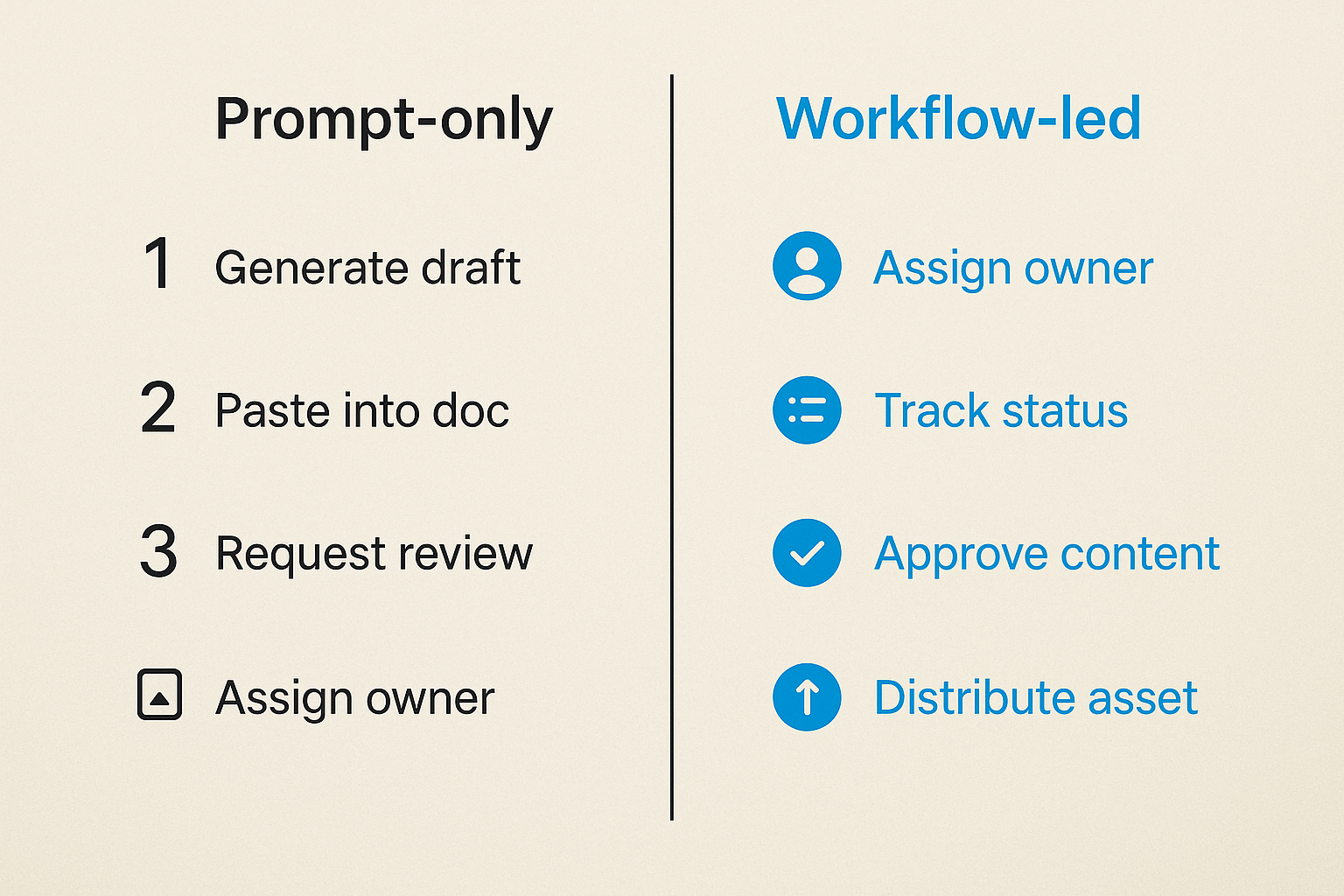
The mistake teams make is treating AI like a faster freelance writer. They add a prompt, generate a draft, paste it into a doc, and ask an editor to make it usable. For a few articles, this feels efficient. At volume, it becomes a messy queue of half-reviewed assets.
What breaks in practice is not usually the first draft. It is the status of the draft. Is this article approved for the brand voice? Has the SME checked the claims? Did the editor reject the angle or just request changes? Is the newsletter version derived from the approved article or from an earlier AI draft?
An AI assisted publishing workflow needs a visible state machine. Every asset should have a known status, owner, next action, and exit condition. Without that, AI simply makes the mess arrive faster.
Practical rule: Never automate content generation faster than you can track review status, approval evidence, and publishing outcomes.
Why this matters more in 2026
AI publishing has moved beyond isolated blog drafts. Many teams now want one research input to produce a blog post, newsletter, podcast script, LinkedIn post, short video outline, and internal sales enablement note. That is reasonable. It is also where uncontrolled workflows become dangerous.
If the source article contains a weak claim, every derivative asset inherits the problem. If the product positioning changes, every channel needs an update. If an editor approves the blog but not the newsletter hook, your system needs to preserve that distinction.
For a broader baseline on how modern teams frame this, the practical guide to AI publishing workflow architecture is useful context. The point here is narrower: build the workflow so AI can accelerate production without removing editorial control.
The minimum architecture to agree on
Before you pick tools, agree on four primitives:
- Asset: the thing being produced, such as an article, newsletter, podcast script, or social post.
- State: where the asset sits in the workflow.
- Owner: the person or role accountable for moving it forward.
- Gate: the review or condition required before the asset can move to the next state.
That sounds simple. It is not. Most content operations fail because these primitives are implied instead of explicit. The editor becomes the default owner of every ambiguity. The content lead becomes the emergency router. The founder becomes the final reviewer for pieces they should never have seen.
Define ownership before you automate drafting
Who owns the brief
The brief is the control surface. If the brief is weak, AI output will be directionally plausible and operationally expensive. The owner of the brief should not be whoever has spare time. It should be the person responsible for the business purpose of the asset.
For a content marketer, that might be the campaign owner. For a publisher, it might be the managing editor. For a creator, it might be the operator who understands the audience promise. The brief owner defines the topic, reader, intent, positioning, source material, exclusions, and success criteria.
A weak brief says: write a post about email marketing.
A usable brief says: produce a practical operator guide for newsletter teams migrating from manual sponsorship tracking to a lightweight approval workflow; avoid beginner definitions; include failure modes around missed approvals and sponsor copy changes.
That difference matters because AI follows constraints better than vibes.
Who owns review risk
Review is not one job. It is several jobs that often get collapsed into one overloaded editor lane.
Common review risks include:
- Editorial quality: clarity, structure, voice, usefulness.
- Factual accuracy: claims, dates, product details, examples.
- Brand risk: promises, tone, positioning, competitive references.
- Legal or compliance risk: regulated claims, privacy, financial language, health claims.
- Channel fit: subject lines, previews, social hooks, podcast intros.
The practical question is: which risks exist for this asset, and who is qualified to approve them? If every article gets the same review path, you either over-review low-risk content or under-review high-risk content.
Practical rule: Route review by risk, not by content type alone. A low-risk how-to article and a high-risk product comparison should not have the same approval path.
Related reading from our network: freelance operators face similar ownership tradeoffs when they decide which platform owns lead generation, proof, delivery, and repeat work; this guide to freelance website workflow choices is adjacent if your content team also manages contractors.
Who owns publishing and follow-up
Publishing is not the end. It is a state transition into monitoring, distribution, updates, and support.
Somebody needs to own:
- CMS formatting and metadata.
- Canonical URL and internal links.
- Newsletter scheduling.
- Social variants.
- Podcast or audio generation, if used.
- Correction handling.
- Performance review.
If nobody owns follow-up, the workflow produces content but not learning. You will not know which briefs created strong assets, which AI outputs required heavy editing, or which channels created the best downstream results.
Design the content state machine
The core states
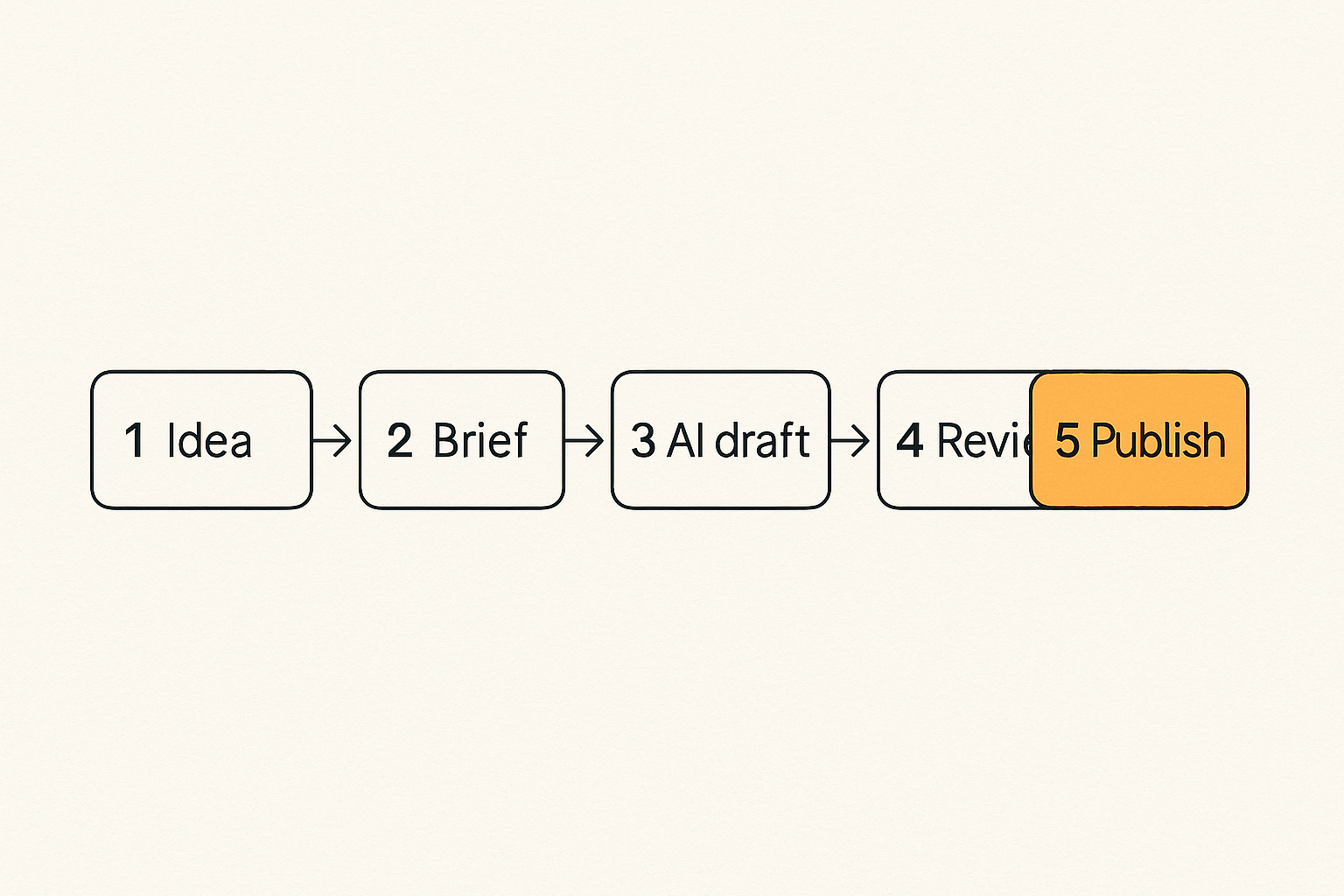
A content state machine does not need to be complex. It needs to be explicit. Start with states that match how work actually moves through your team.
A practical baseline:
- Idea captured.
- Brief ready.
- AI draft generated.
- Editorial review.
- SME or risk review.
- Revision required.
- Approved for publishing.
- Scheduled or published.
- Distributed.
- Measured.
- Update required or archived.
The important part is not the exact labels. The important part is that each state has a clear owner and exit condition. If a piece is in editorial review, who is reviewing it? What does done mean? Can it move forward with comments unresolved? Can AI revise automatically, or does a human need to decide?
The transitions that need evidence
A state transition is a decision. Some decisions need evidence. For example, moving from AI draft generated to editorial review might require that the draft includes a title, excerpt, outline, sources used, and known uncertainty notes. Moving from SME review to approved might require a named approver and timestamp.
Do not overbuild this. You do not need enterprise bureaucracy for a newsletter. But you do need enough evidence to reconstruct why something shipped.
A simple approval record might include:
asset_id: article_2026_0713_ai_workflow
current_state: approved_for_publishing
approved_by: managing_editor
approval_scope:
  - editorial_quality
  - brand_voice
pending_risks:
  - none
source_version: draft_v4
publish_channels:
  - blog
  - newsletter
  - linkedin
This is not about paperwork. It is about reversibility. If a correction appears later, you can trace the source version and update derivative assets.
A simple workflow table
| Workflow layer | Bad implementation | Better implementation |
|---|---|---|
| Ideation | Random prompt list | Prioritized backlog tied to audience and campaigns |
| Briefing | One-line topic | Structured brief with intent, sources, exclusions, CTA |
| Drafting | AI output pasted into doc | Draft generated against brief with metadata and version |
| Review | Everyone comments everywhere | Risk-based lanes with named owners |
| Approval | Looks fine in chat | Approval state with scope and timestamp |
| Distribution | Manual copy-paste | Channel variants generated from approved source |
| Measurement | Pageviews only | Cycle time, edit depth, approvals, conversions, updates |
The mistake teams make is confusing collaboration with control. A comment thread can help people discuss a draft. It is not, by itself, a workflow system.
Build briefs that constrain the machine
What a usable AI brief contains
The brief should reduce ambiguity before AI touches the draft. That does not mean writing a 2,000-word instruction file for every article. It means including the fields that actually change output quality.
A practical AI brief includes:
- Target reader: who the piece is for and what they already know.
- Business purpose: acquisition, retention, education, sales enablement, authority, support.
- Search intent or audience intent: what question the piece should satisfy.
- Angle: the opinion or operating stance.
- Must-use source material: interviews, product docs, notes, examples.
- Must-avoid claims: things the brand should not say.
- Voice constraints: direct, technical, skeptical, conversational, executive, etc.
- Structure requirements: sections, tables, examples, CTA, glossary, FAQ.
- Review requirements: editor, SME, legal, founder, sponsor, or none.
- Distribution plan: blog only, newsletter, social, podcast, video outline.
A good brief is not a prompt hack. It is an input contract.
What works
What works is repeatable constraint. Templates help, but only if they force real choices. The best briefs make the content lead decide what the piece is not about.
Example:
Topic: AI assisted publishing workflow
Reader: content marketers and newsletter operators with existing publishing cadence
Angle: AI is not the bottleneck; workflow state and review gates are
Exclude: generic AI definition, tool roundup, hype claims
Required sections: state machine, ownership, quality gates, failure modes, metrics
Primary CTA: human-in-the-loop publishing platform
Review path: editor plus brand owner
This gives the system something to obey. It also gives the reviewer something to evaluate against.
Practical rule: Review the draft against the brief first. If the brief was wrong, fix the brief before asking AI for another version.
What fails
What fails is prompt sprawl. One marketer has a prompt for thought leadership. Another has a prompt for SEO intros. A freelancer has a different prompt for newsletter repurposing. Nobody knows which one reflects current positioning.
Prompt sprawl creates inconsistent voice and invisible policy drift. The team thinks it is moving fast. In reality, it is forking the editorial system.
A better approach is to separate stable instructions from asset-specific instructions:
- Stable: brand voice, banned claims, formatting rules, editorial principles.
- Asset-specific: topic, reader, angle, sources, CTA, review path.
- Channel-specific: subject line rules, podcast intro style, social post length.
When these layers are separated, updates are easier. If the brand voice changes, you update the stable layer. If the campaign changes, you update the asset brief. If LinkedIn formatting changes, you update the channel layer.
Put quality gates where risk changes
Gate one strategic fit
The first quality gate should happen before drafting. This is where many teams waste the most time. They generate drafts for ideas that should never have been approved.
Strategic fit asks:
- Does this topic serve a current audience or campaign?
- Is the angle differentiated enough to publish?
- Do we have enough source material to support it?
- Is the piece worth a human editor's time?
- Does it need expert input before drafting?
If the answer is no, do not draft. AI makes it cheap to create text, which makes it easier to create irrelevant text. The cost moves downstream into review, publishing, and brand clutter.
Gate two factual and editorial review
The second gate is where the draft becomes publishable. Editorial review should not be a vague pass for quality. It should separate issues by type.
Useful review categories:
- Structural: the piece is organized logically.
- Substantive: the argument is useful and not generic.
- Factual: claims are supported or hedged.
- Voice: it sounds like the brand.
- Reader value: the piece helps the target reader make a decision or do a job.
For high-risk content, add a specific SME or compliance lane. Do not ask a general editor to silently absorb expert risk. That is how bad claims slip through.
Related reading from our network: checkout teams deal with similar verification problems, where the visible UI hides eligibility, totals, and failure states; this workflow guide to DoorDash promo code verification is a useful analogy for checking before committing.
Gate three distribution readiness
Distribution readiness is its own gate. A blog article can be approved while the newsletter subject line is not. A podcast script can be usable while the social thread is too promotional.
Before publishing, confirm:
- Title and meta description are final.
- Internal links are intentional.
- CTA matches the reader stage.
- Newsletter subject and preview text are approved.
- Social posts point to the final URL.
- Podcast script or audio variant uses the approved source version.
- Tracking parameters are correct.
This gate is boring. It also prevents many of the failures that make content teams look careless.
Connect production to distribution
The channel is part of the workflow
The UI is not the whole system. A draft in a document is not a published asset. A published asset is not a distributed asset. A distributed asset is not a measured asset.
Content teams often build their AI workflow around the writing screen. That is too narrow. The actual publishing system includes CMS fields, newsletter tools, social schedulers, podcast workflows, analytics, and sometimes sponsor approval.
If the workflow stops at draft approval, the most operationally fragile work remains manual. That is where wrong links, outdated CTAs, duplicate subject lines, and missed sponsor mentions happen.
Newsletter podcast and social variants
AI is useful for derivative formats, but only when variants inherit from an approved source. Do not generate the newsletter from draft version two if the final article is version five. Do not create a podcast intro from an outline that changed during review.
A safer pattern:
- Approve the canonical source asset.
- Generate channel variants from that approved version.
- Review each variant for channel-specific risk.
- Publish or schedule variants with traceability back to the source.
- If the source changes, flag dependent variants for review.
This is especially important for newsletter operators. Subject lines and intros often carry stronger claims than the article itself. They need their own approval lane.
Related reading from our network: community platforms have a similar routing problem, where the real system is not the homepage but trust, follow-up, and coordination; this guide to Mighty Networks alternatives for local communities is adjacent for operators thinking about audience workflows.
Webhooks and handoffs
Once the workflow is clear, automation becomes safer. Webhooks can move approved assets into a CMS, notify an editor, create a newsletter draft, or send a Slack update. But automation should follow state, not bypass it.
A useful implementation sequence looks like this:
- Asset enters approved for publishing.
- System creates CMS draft with title, slug, body, tags, and metadata.
- System creates newsletter draft from approved source.
- Editor receives a checklist for final channel review.
- Publishing owner approves schedule.
- System records published URLs and timestamps.
- Measurement job checks performance and flags update candidates.
The key is idempotency in operational terms: running the handoff twice should not create duplicate posts or conflicting newsletter drafts. Even small teams need this discipline once automation touches publishing systems.
Measure the AI assisted publishing workflow without vanity metrics
Operational metrics
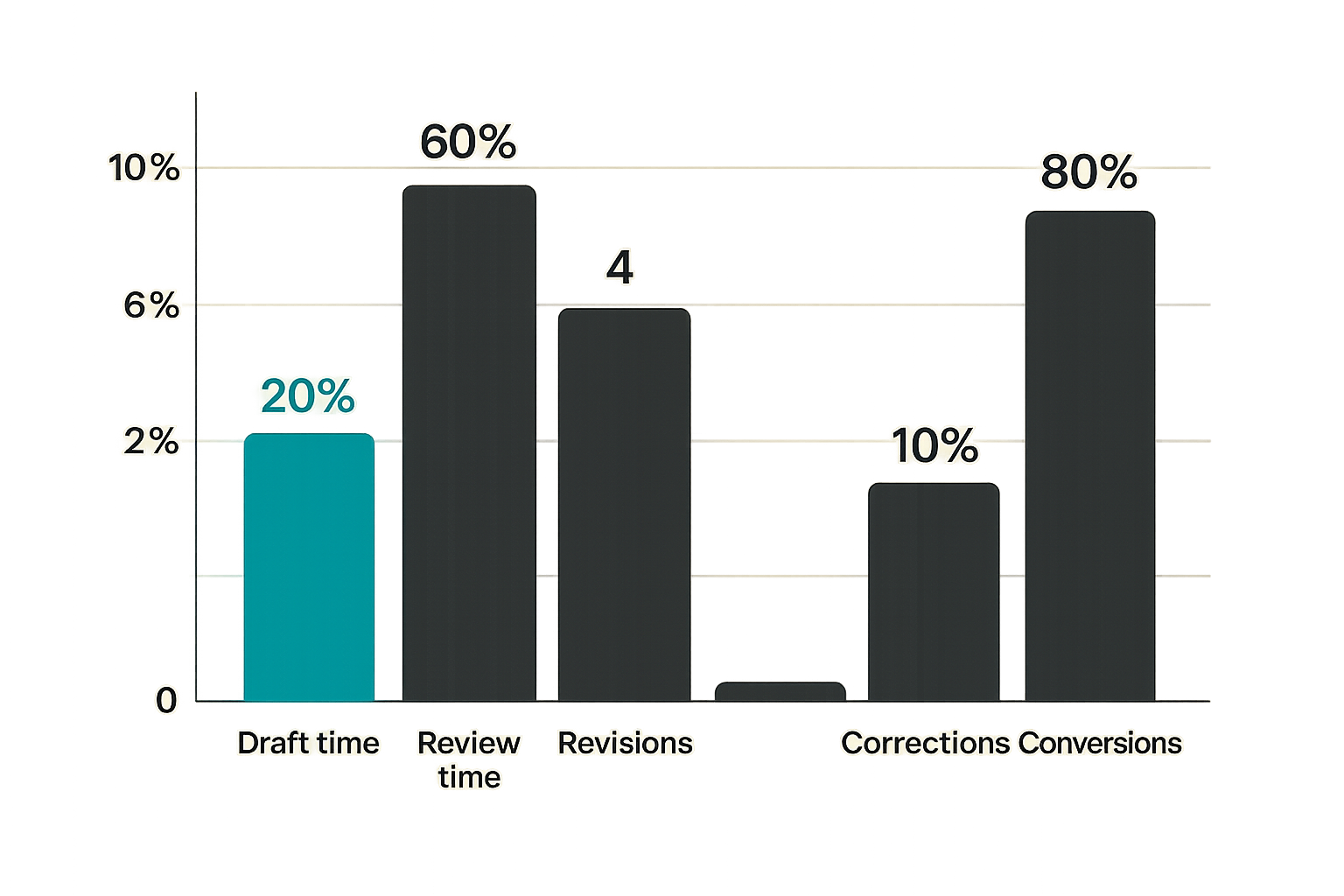
The first measurement layer is operational. You need to know whether the workflow is actually improving throughput without hiding cost.
Track:
- Time from idea to brief.
- Time from brief to first draft.
- Time from draft to approval.
- Number of revision cycles.
- Review queue age.
- Percentage of drafts rejected before publishing.
- Percentage of assets needing post-publish correction.
These metrics show where the system is slow or noisy. If AI reduces draft time by 80 percent but doubles editorial cleanup, you have not improved the operation. You have moved labor from writing to repair.
Editorial metrics
Editorial metrics are harder, but they matter. You need signals that the content is not becoming generic sludge.
Useful editorial signals include:
- Editor rating against brief.
- Edit depth by section.
- Number of unsupported claims removed.
- Voice consistency notes.
- Reader usefulness score from internal review.
- Ratio of approved to regenerated drafts.
Do not pretend these are perfect. They are still better than relying only on traffic. A piece can get traffic and still be off-brand, shallow, or expensive to produce.
A deeper look at review routing and human approval patterns is covered in human-in-the-loop AI publishing workflow architecture, especially for teams trying to scale review without turning editors into bottlenecks.
Business metrics
Business metrics connect publishing to outcomes. The right metrics depend on the team, but common examples include:
- Assisted conversions.
- Newsletter signups.
- Demo or inquiry starts.
- Subscriber retention.
- Sponsor performance.
- Search visibility for priority topics.
- Sales team usage.
The practical question is not whether AI content performs. The practical question is which workflow inputs produce assets that perform. That means tying results back to brief type, review lane, topic cluster, channel, and update cadence.
Practical rule: Measure the workflow, not just the article. The article is the output. The workflow is the production system you can improve.
Failure modes that break teams
Prompt sprawl
Prompt sprawl starts innocently. Someone finds a prompt that works. Someone else improves it. A freelancer makes a variation. The team now has five versions of the voice, three versions of the CTA, and no source of truth.
The fix is not to ban experimentation. The fix is to promote successful patterns into controlled templates. Treat prompts like operational assets. Version them. Name owners. Retire old ones. Document what changed.
What breaks in practice is consistency. Readers may not notice one odd article. They will notice when every channel sounds like a different company.
Review bottlenecks
AI can increase draft volume faster than humans can review. If every draft goes to the same senior editor, that editor becomes the constraint. The queue grows, turnaround slows, and the team concludes AI did not work.
Usually, the workflow design was the problem. Not every asset needs the same reviewer. Some need only editorial cleanup. Some need expert review. Some should be rejected at the brief stage. Some can be routed to junior editors with a checklist.
A better review model uses lanes:
- Low-risk educational content: editor review only.
- Product content: editor plus product owner.
- Comparative content: editor plus brand owner.
- Regulated content: editor plus compliance.
- Sponsored content: editor plus sponsor approval.
That changes the conversation from who has time to what risk exists.
Unowned corrections
Corrections are where bad workflows expose themselves. A reader flags an issue. The editor fixes the blog post. But the newsletter archive still contains the old claim, the podcast script is unchanged, and the social thread is still live.
Correction handling needs a workflow state. Call it update required, correction pending, or revision after publish. The label matters less than the ownership.
A correction workflow should answer:
- Which source asset changed?
- Which derivative assets depend on it?
- Who approves the correction?
- Which channels need an update or note?
- What should be logged for future review?
If AI helped create many derivatives, the correction process matters even more. More outputs means more places for stale information to survive.
Implementation sequence for content teams
Week one map current work
Do not start by buying tools or rewriting every prompt. Start by mapping the current workflow. Write down how an idea becomes a published asset today.
Interview the people who touch the process:
- Content lead.
- Editor.
- Writer or AI operator.
- SME.
- Newsletter owner.
- Social or distribution owner.
- Analytics owner.
Ask where work waits, where quality drops, and where ownership is unclear. You will usually find that the team already has a workflow, but it is hidden in chat messages, docs, memory, and emergencies.
Week two create lanes
In week two, create explicit lanes. Do not overcomplicate it. Start with three or four content classes.
Example lanes:
- Low-risk evergreen education.
- Product or feature content.
- Thought leadership or executive content.
- Sponsored, comparative, or sensitive content.
For each lane, define:
- Required brief fields.
- Allowed AI tasks.
- Required reviewers.
- Approval evidence.
- Distribution channels.
- Measurement expectations.
This gives the team a routing system. Once routing is clear, automation can help instead of creating confusion.
Week three automate safely
In week three, automate the obvious transitions. Do not automate judgment first. Automate handoffs, notifications, metadata creation, variant drafts, and measurement reminders.
A safe first automation stack might include:
- Generate draft only after brief approval.
- Create editor task when draft is ready.
- Move asset to revision required if editor rejects it.
- Generate newsletter and social variants only after source approval.
- Create CMS draft but require human publish approval.
- Record published URL and trigger measurement review after a set period.
This sequence keeps humans in control of judgment while removing repetitive coordination work. That is the real leverage.
Where bl0ggers.com fits in an AI assisted publishing workflow
When a platform helps
A platform helps when the workflow crosses formats, reviewers, and publishing destinations. If you are producing one article a month, a doc and checklist may be enough. If you are turning research into blogs, newsletters, podcasts, and persona-led content streams, the coordination cost grows quickly.
The product-fit question is architectural: where do briefs, generated drafts, review queues, approvals, publishing destinations, and measurement records live? If they live in five disconnected tools, your team will spend more time reconciling state than improving content.
bl0ggers.com is designed around human-in-the-loop AI publishing: generated research and articles, optional review, persona journeys, subdomain publishing, newsletters, podcasts, and automation hooks. The useful part is not that AI can write. The useful part is giving teams a workflow where AI output still passes through editorial control.
When you should keep work manual
Keep work manual when judgment is still unstable. If your positioning is changing weekly, do not automate final publishing. If your reviewers disagree on voice, fix the editorial standard first. If your source material is messy, improve ingestion and briefing before scaling drafts.
Automation amplifies the system you already have. If the system is unclear, automation makes it unclear at higher volume.
Manual review is also appropriate for:
- Founder essays.
- Sensitive announcements.
- Legal or compliance-heavy topics.
- Original reporting.
- Crisis communications.
- High-value sponsor content.
The goal is not to remove humans. The goal is to put humans where judgment matters and remove them from repetitive routing.
Closing the loop
An AI assisted publishing workflow should make content production faster, but speed is not the only goal. The better goal is controlled throughput: more useful assets, clearer review ownership, fewer stale drafts, cleaner distribution, and better learning from every published piece.
Teams think the problem is generating more content. The real problem is operating a publishing system that can decide what deserves to exist, route it through the right checks, publish it cleanly, and learn from the result.
That is the standard worth building toward in 2026.
Try bl0ggers.com
bl0ggers.com is for content teams, creators, and publishers who want to use AI to increase output without giving up editorial control. Try bl0ggers.com.